Camp David summit could lead to breakthrough in trilateral ties in East Asia

Former President Lee Myung-bak, right, and his U.S. counterpart George W. Bush, wave as they drive a golf cart at Camp David in Maryland, April 18, 2008. Korea Times photo by Son Yong-seok
Leaders of S. Korea, US, Japan expected to come up with tangible outcomes at historic retreat
By Nam Hyun-woo
A trilateral summit between South Korea, the United States and Japan will take place this weekend for the first time at Camp David, the U.S. presidential retreat in Maryland, which many diplomats and experts believe may lead to a breakthrough in addressing tricky issues in East Asia.
This gives an extra significance to the summit, as the retreat has served as the site for paramount diplomatic events in critical junctures of history.
President Yoon Suk Yeol will depart for Camp David on Thursday to attend the trilateral summit slated for Friday (local time). So far, the three countries have held three-way meetings on 12 occasions, three of which were between Yoon, U.S. President Joe Biden and Japanese Prime Minister Fumio Kishida, on the sidelines of multilateral diplomatic events. This will be the first instance of a trilateral meeting becoming a standalone event.
“Holding a summit at Camp David is completely different from having one in Washington, D.C.,” a senior official at the presidential office said.
“It will be more casual and the leaders will be able to have discussions while strolling, dining and doing other events in a comfortable atmosphere. Various issues will be discussed while the leaders are feeling less political pressure.”
First Deputy Director of National Security Kim Tae-hyo also said the upcoming summit will be the Biden administration's first visit by foreign leaders to Camp David, which shows “the importance that President Biden is placing on the cooperation of the three countries.”
The Camp David summit has a distinctive significance as a diplomatic platform, because it provides an environment for heads of state to engage in candid and in-depth conversations on a certain matter in a very comfortable atmosphere.
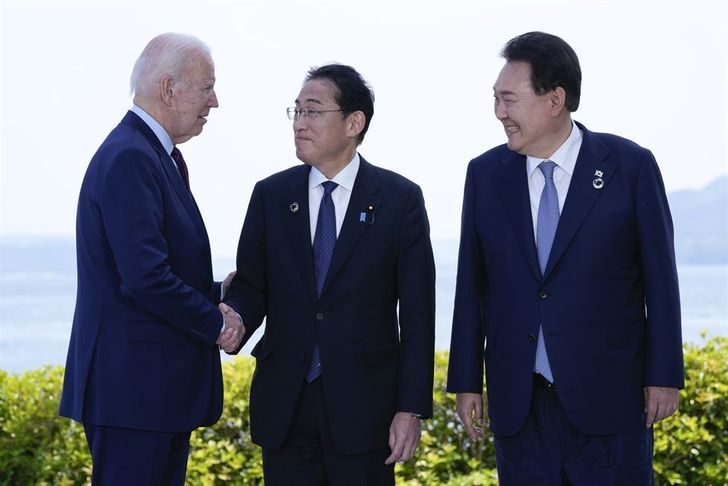
President Yoon Suk Yeol watches U.S. President Joe Biden, left, and Japanese Prime Minister Fumio Kishida shaking hands during their meeting on the sidelines of the Group of Seven Summit in Hiroshima, Japan, May 21. AP-Yonhap
During the previous trilateral meeting between Yoon, Biden and Kishida in Hiroshima, Japan, on the sidelines of the Group of Seven summit in May, the leaders met but could not have lengthy conversations on pending matters due to time constraints. At that time, Biden invited Yoon and Kishida to Washington for extensive talks, which resulted in the summit at Camp David.
“The venue will serve as a place for more concentrated and in-depth talks between the leaders,” another official at the presidential office said. “And the outcome could also be greater in terms of depth.”
The Camp David summit is also expected to be a chance to showcase the importance of stronger ties between the three countries, because the presidential retreat has been the venue of high-stakes talks at critical junctures of history.
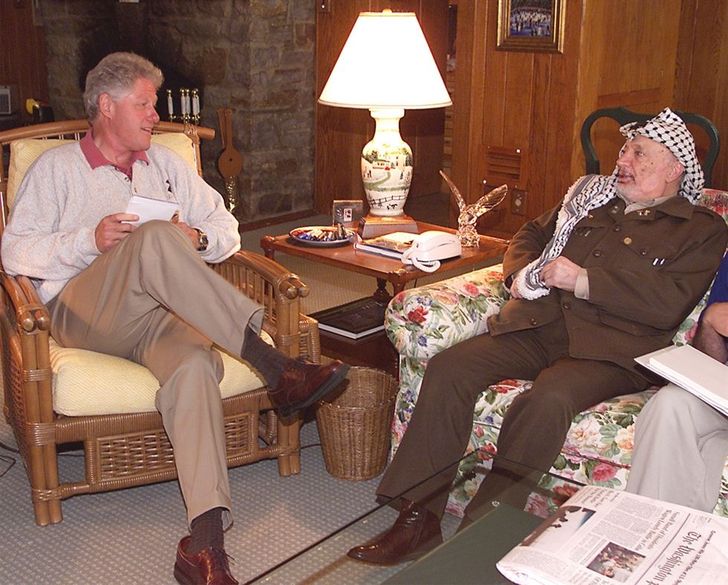
Former U.S. President Bill Clinton meets with Palestinian leader Yasser Arafat at Camp David in this July 16, 2000 photo. AP-Yonhap
Camp David was built as a presidential retreat in 1942 by former President Franklin Roosevelt, who called it “Shangri-La.” It was renamed Camp David by former President Dwight Eisenhower in honor of his grandson, David Eisenhower.
In 1943, U.K. Prime Minister Winston Churchill visited the retreat as the first foreign leader, and had discussions on how to end World War II. This landmark event set a precedent for the retreat's role in hosting vital diplomatic discussions.
In 1959, then-Soviet leader Nikita Khrushchev and Eisenhower met at Camp David to hold two days of talks about the Cold War.
Another prominent event in the retreat's history were the Camp David Accords in 1978, brokered by President Jimmy Carter and involving Egyptian President Anwar Sadat and Israeli Prime Minister Menachem Begin. After 13 days of talks, the leaders of Egypt and Israel agreed on issues including the return of the Sinai Peninsula to Egypt and the establishment of autonomous Palestinian self-rule in the West Bank and Gaza Strip.
In 2000, former U.S. President Bill Clinton hosted then-Israeli Prime Minister Ehud Barak and Palestinian leader Yasser Arafat at the retreat in search of a conflict-ending accord, but failed to reach an agreement.
Among Korean leaders, former President Lee Myung-bak visited the presidential retreat for a summit with then-President George W. Bush in 2008 and discussed ways to strengthen the bilateral alliance and free trade agreement between the two countries.