3-way summit at Camp David to 'institutionalize' security ties between Korea, US, Japan

President Yoon Suk Yeol, right, speaks with U.S. President Joe Biden, left, and Japanese Prime Minister Fumio Kishida ahead of their three-way talks in Hiroshima, Japan, May 21, on the sidelines of the G7 Summit. AP-Yonhap
3 countries poised to set up multiple consultative bodies
By Nam Hyun-woo
President Yoon Suk Yeol will visit Camp David, a U.S. presidential retreat in Maryland, for a three-way summit with U.S. President Joe Biden and Japanese Prime Minister Fumio Kishida, Friday, during which they will focus on “institutionalizing” the three countries' security cooperation, Seoul's presidential office said, Sunday.
First deputy director of national security Kim Tae-hyo explained the main details of the agenda in a press briefing, including Yoon's plan to depart for the U.S., Thursday.
Yoon, Biden and Kishida will have the summit on Friday morning, followed by a luncheon and a joint press conference. Kim said the presidential office is now working on a schedule for Yoon's separate bilateral summits with Biden and Kishida, and Yoon will leave the U.S. on Friday. Depending on the flight schedule, the visit could span three or four days.
“The trilateral meeting will be the Biden administration's first visit by foreign leaders to Camp David, and this shows the importance that President Biden is placing on the cooperation of the three countries,” Kim said.
“Through the summit, Camp David will sketch as a new stage of cooperation among the three countries in the 21st-century diplomatic history… Through this meeting, the trilateral framework will gain distinct independence as a cooperative body in the Indo-Pacific region.”
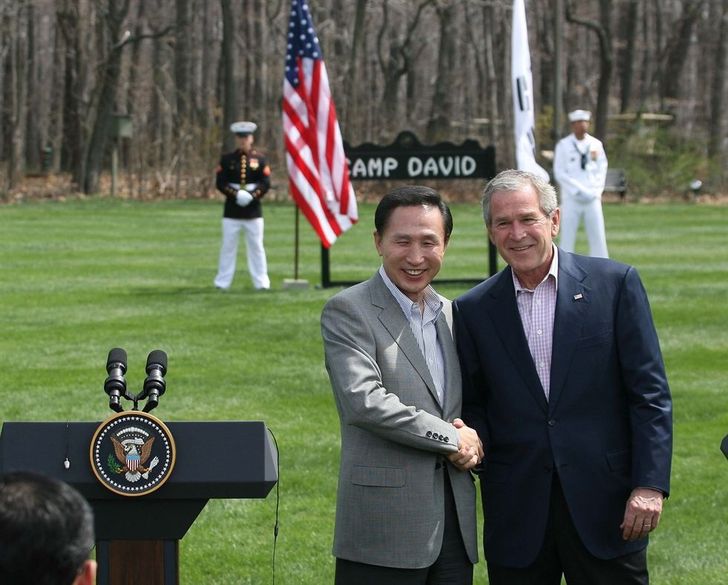
Former President Lee Myung-bak, left, and U.S. President George W. Bush shake hands after their joint press conference at Camp David, Maryland, in this April 20, 2008, file photo. Korea Times photo by Son Yong-seok
So far, the three countries have held three-way meetings 12 times, three of which were during the Yoon administration, on the sidelines of multilateral diplomatic events. This will be the first case of a trilateral meeting becoming a standalone event.
Security cooperation will be at the top of the agenda, particularly in relation to regional risks such as North Korea's missile and nuclear threats.
“During the summit, the three countries will be able to build the backbone of trilateral security cooperation and institutionalize this,” Kim said. “The leaders will concentrate their talks on practical cooperation to jointly respond to North Korea's nuclear and missile threats.”
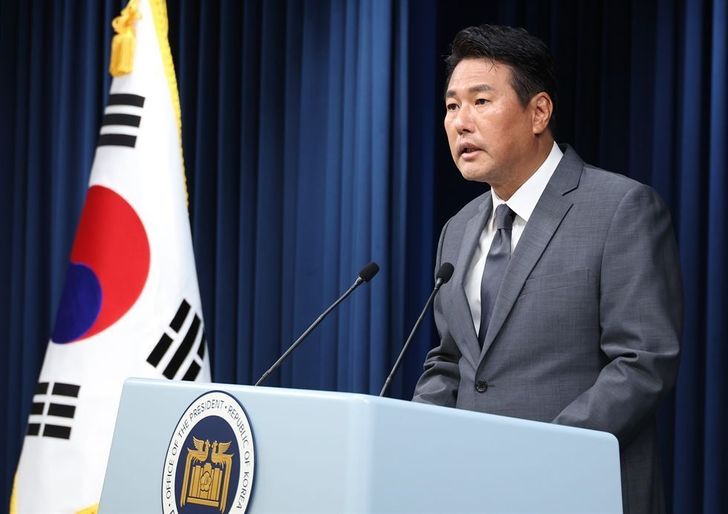
First deputy director of national security Kim Tae-hyo speaks during a press briefing at the presidential office in Yongsan District, Seoul, Sunday. Yonhap
A senior official at the presidential office said the joint response of the three countries will likely be included in a document stating the outcome of the trilateral summit, but the document will not mention China.
During the summit, the official said that the three countries will launch multiple consultative bodies in the fields of military information sharing, security, the economy and other pending issues, and the countries' working officials are now fine-tuning the names of the consultative bodies and how often they will meet.
Along with those consultative bodies, speculation is growing that the three countries may hold trilateral summits on a regular basis, as well as joint military training.
In regard to reports that Japan will seek South Korea's and American endorsement during the summit for its plan to release radioactive wastewater from the Fukushima Daiichi Nuclear Power Plant, the official ruled out the possibility, saying the countries have had enough consultations on a bilateral basis.