US nuclear sub docks in South Korea for first time in 42 years

The Ohio-class ballistic-missile submarine USS Kentucky (SSBN 737) proceeds on the surface to Busan for a port visit while escorted by Arleigh Burke-class guided-missile destroyers USS John Finn (DDG 113) and USS Ralph Johnson (DDG 114). Courtesy of U.S. Forces Korea
Seoul, Washington hold inaugural NCG meeting
By Nam Hyun-woo
A U.S. nuclear-armed submarine arrived in South Korea, Tuesday, as Seoul and Washington held their inaugural Nuclear Consultative Group (NCG) meeting, a platform to show their commitment to enhancing extended deterrence against North Korea's threats.
According to the South Korean and U.S. militaries, the USS Kentucky ballistic-missile submarine made a port call in Busan. The last time a U.S. nuclear-powered submarine docked in South Korea was more than four decades ago.
“This port visit to Busan reflects the United States' ironclad commitment to the Republic of Korea for our extended deterrence guarantee, and complements the many exercises, training, operations, and the other military cooperation activities conducted by Strategic Forces to ensure they are available and ready to operate around the globe at any time,” the U.S. Forces Korea said in a press release.
“It is a launch platform for submarine-launched ballistic missiles, providing the United States with its most survivable leg of the nuclear triad.”
Armed with 20 Trident II D-5 submarine-launched ballistic missiles, the USS Kentucky serves as a formidable deterrent aimed at discouraging a nuclear attack. Nuclear-armed submarines are one component of the U.S. nuclear triad along with land-launched nuclear missiles and nuclear-capable strategic aircraft.
"As we speak, an American nuclear submarine is making port in Busan today. It's the first visit of an American nuclear submarine in decades," U.S. National Security Coordinator (NSC) for Indo-Pacific Affairs Kurt Campbell said after co-chairing the NCG meeting with South Korea's First Deputy Director of National Security Kim Tae-hyo at the presidential office in Seoul. The meeting was held behind closed doors.
The last U.S. ballistic-missile submarine to visit South Korea was the USS Robert E. Lee in 1981.
A deployment of a nuclear-armed submarine is part of the Washington Declaration, in which President Yoon Suk Yeol and U.S. President Joe Biden agreed in April to send ballistic missile submarines to the Korean Peninsula.
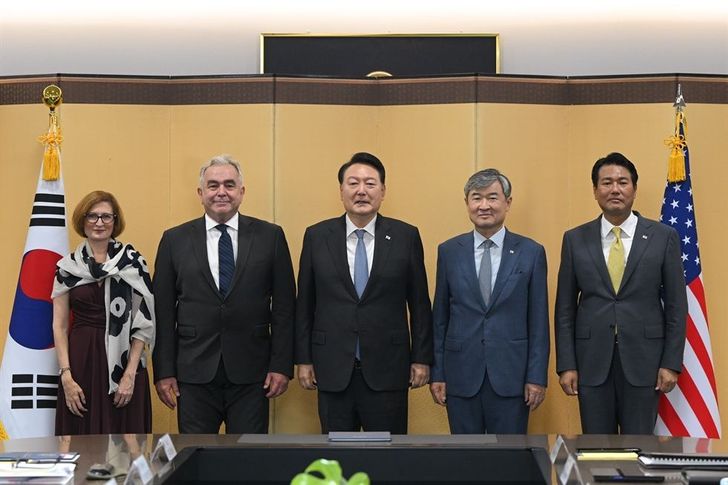
President Yoon Suk Yeol poses with participants of the inaugural meeting of the South Korea-U.S. Nuclear Consultative Group at the presidential office in Yongsan District, Seoul, Tuesday. From left are U.S. National Security Council (NSC) Coordinator for Defense Policy and Arms Control Cara Abercrombie, NSC Coordinator for the Indo Pacific Affairs Kurt Campbell, Yoon, Korea's Director of National Security Cho Tae-yong and First Deputy Director of National Security Kim Tae-hyo. Courtesy of presidential office
Encouraged by the U.S. pledge for extended deterrence, Kim said during a press conference, “Today's meeting gave the confidence that it has become clear and certain that South Korea is sufficiently assured in the extended deterrence to the extent that there is no need to consider Seoul's own nuclear armament.”
In a joint statement after the meeting, the two sides reaffirmed that “any nuclear attack by North Korea against the United States or its allies is unacceptable and will result in the end of that regime, and the U.S. and South Korean sides highlighted that any nuclear attack by North Korea against South Korea will be met with a swift, overwhelming, and decisive response.”
In particular, the two sides discussed the joint planning and execution of South Korea's non-nuclear and conventional support of U.S. nuclear operations as well as how to enhance the visibility of U.S. strategic asset deployments around the Korean Peninsula.
The NCG is the outcome of the Washington Declaration, which was announced by Yoon and Biden during the Korean president's state visit to the U.S. in April.
The declaration is aimed at reaffirming the U.S.' extended deterrence to counter North Korea's escalating nuclear and missile threats. The NCG focuses on implementing that extended deterrence by giving Seoul more insight and an increased presence in U.S. nuclear planning and execution in response to worst-case scenarios involving an attack by the North.
Campbell said that there is no issue that the U.S. takes more seriously than the confidence of its nuclear deterrence.
“I want to just state clearly that we believe the steps we took today and we will take in the future will go a long way towards making clear that our partnership is rock solid and that we are taking every possible step to ensure confidence in the nuclear strategic and military partnership between our two nations,” Campbell said.
“The consultative body should respond seamlessly to the escalating North Korean nuclear and missile threats through the enhanced execution of deterrence,” Yoon said while talking to the officials at the beginning of the meeting.
“Just as President (Joe) Biden warned in April that a nuclear attack by North Korea would result in the end of their regime, we must strengthen the execution of deterrence through a nuclear-based South Korea-U.S. alliance to prevent North Korea from daring to use nuclear weapons.”
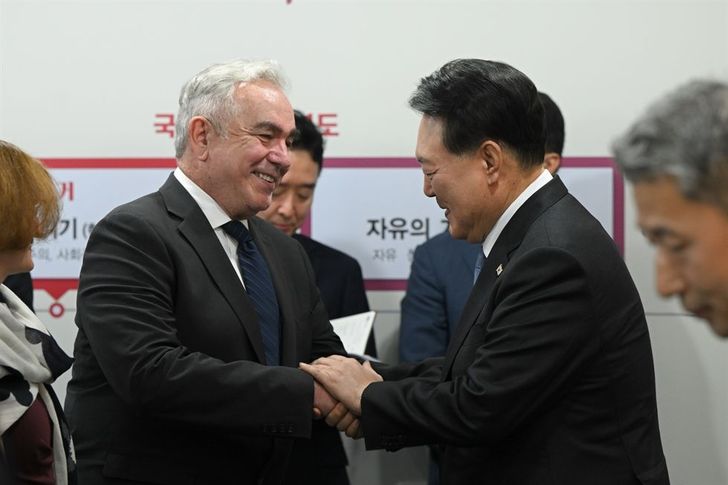
President Yoon Suk Yeol shakes hands with U.S. National Security Council Coordinator for Indo-Pacific Affairs Kurt Campbell during the inaugural meeting of the South Korea-U.S. Nuclear Consultative Group at the presidential office in Yongsan District, Seoul, Tuesday. Courtesy of presidential office
'Complex journey'
Although the NCG kicked off to flesh out the nuances of the consultative group and provide a security assurance that South Korea can rely on, experts said there are differences that Seoul and Washington need to resolve.
For South Korea, the goal of the NCG is institutionalizing its presence in Washington's planning and operation of nuclear assets in the process of executing extended deterrence. The Yoon administration has been promoting that the NCG allows Seoul to take part in the planning of U.S. nuclear operations, which is similar to NATO's Nuclear Planning Group (NPG).
On the other hand, the Biden administration describes the NCG as a vehicle giving South Korea greater insight into U.S. nuclear planning and execution, showing differences the two sides have on the issue.
“For the Biden administration, which has been making efforts to prevent the proliferation of nuclear weapons, the reference to the term 'nuclear' in the NCG comes as a big concession,” said Go Myong-hyun, a senior fellow at the Asan Institute for Policy Studies.
“While South Korea is seeking to evolve the NCG into something close to the NPG, the pace of these talks could be slower than what Seoul expects … Given that, the NCG is likely to be upgraded in a step-by-step growth curve, not a linear one, with each escalation occurring in response to provocations by North Korea.”
Lee Seong-hyon, a senior fellow at George H. W. Bush Foundation for U.S.-China Relations, also said the first NCG meeting illustrates just how seriously the two allies regard this issue, but at the same time signals the beginning of a complex journey.
“This initial step represents the beginning of a complex journey, where the details and terminology, such as the interpretation of 'joint planning,' will require thorough clarification,” Lee said. “Although the term is used by the Yoon administration, it is not in the Biden administration's lexicon.”
Lee said Washington wants to assure South Korea of its security by providing an opportunity for them to observe U.S. nuclear operations, but South Korea seeks to be more than just an observer, saying a tabletop exercise might not meet the expectations of South Koreans
“Ultimately, the extent to which NCG caters to South Korea's nuclear aspirations will be determined, in part, by the U.S. perception of South Korea's status as an ally,” Lee said.
“This pertains not only to managing the North Korean threat but also to considering South Korea's potential broader role in the Indo-Pacific region.”