Authorities criticized over botched response to flooded tunnel in Osong

Emergency personnel retrieve a body from the flooded tunnel in the town of Osong, Cheongju, North Chungcheong Province, Sunday. Yonhap
At least 9 dead in flooded tunnel, with death toll expected to rise
By Lee Hyo-jin
Local authorities in Osong, Cheongju, North Chungcheong Province, are facing widespread criticism over a lack of execution of safety measures in response to a flooded tunnel in the area which has left at least nine people dead as of Sunday afternoon.
Critics view that the accident, which occurred amid the days-long torrential rain, could have been prevented had the local municipalities taken preemptive measures such as closing the tunnel and establishing other traffic controls.
According to the Korea Fire Agency, Gungpyeong 2 Underpass in Osong was submerged around 8:45 a.m., Saturday, after the banks of the nearing Miho River collapsed due to heavy rainfall in the region.
The four-lane, 430-meter-long underground passage was flooded by some six tons of water in just three minutes, leaving 15 vehicles ― including a public bus and two trucks ― trapped inside. It is unclear exactly how many individuals were trapped, but the police said at least 11 individuals were reported to be missing in the tunnel, excluding nine survivors who were rescued soon after the flooding as of Saturday.
By Sunday afternoon, rescuers retrieved the bodies of nine flood victims from the scene, among whom seven were found to be passengers of the public bus.
Residents and families of the victims called it a “man-made disaster,” pointing out the city government's ill-preparedness for the torrential rain despite repeated warnings from the weather agency.
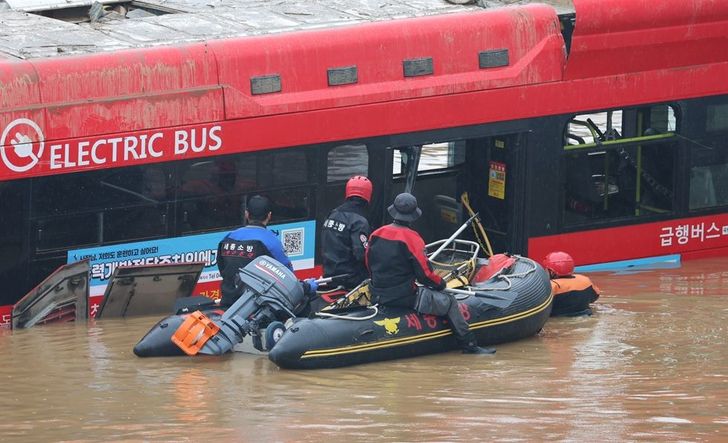
Rescuers search for missing people in a bus that was trapped in a flooded tunnel in Osong, Cheongju, North Chungcheong Province, Sunday. Yonhap
“When I was at the site an hour before the accident occurred, I saw an excavator making a temporary levee with sand,” Jang Chan-gyo, a 68-year-old resident in the region was quoted as saying by Yonhap News Agency.
“They have been warning us to be prepared for the monsoon season from a week ago, but it doesn't make sense why the authorities did not preemptively build a strong levee that could have prevented the disaster.”
Criticisms also arose as to why the provincial government did not close down the low-lying tunnel, which is located just 600 meters away from the Miho River, despite a flood warning issued across the river some four hours before the accident.
In response, the North Chungcheong Provincial Government said that its emergency response manual does not require the immediate closing of a tunnel in such conditions.
“It is not always mandatory to implement entry restrictions in the event of a flood warning. We review the overall road situation and make decisions based on close monitoring. There didn't seem to be particular issues until the breach of the embankment … and due to the rapid influx of water, we did not have enough time to stop the cars from entering,” Kang Jong-geun, a provincial official told reporters on Saturday.
However, Moon Hyun-cheol, a professor of disaster management at Soongsil University, argued that by law, the local government should have issued a traffic restriction.
“It is hard to understand why the protection system, which is stipulated in the Disaster and Safety Management Basic Act did not function properly. There should be close examination as to why the system has failed,” he said.
The disaster in Osong is feared to turn into a blame game between the local municipalities.
While the tunnel itself is under the supervision of the North Chungcheong Provincial Government, the embankment facility of the Miho River was constructed by the National Agency for Administrative City Construction, a state-run organization responsible for operating various infrastructure items in nearby Sejong City.
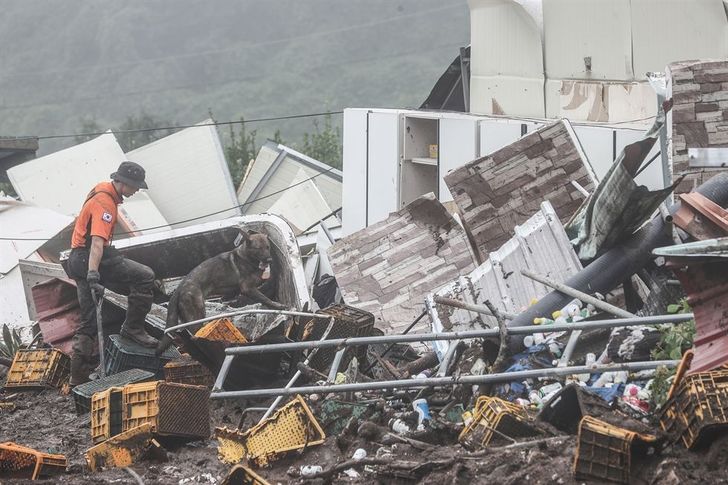
An emergency worker and a rescue dog comb through the debris of a landslide that destroyed five houses in Yecheon County, North Gyeongsang Province, Sunday. As of Sunday afternoon, heavy rainfall has claimed nine lives and left eight individuals missing in Yecheon. Yonhap
Meanwhile, Yecheon County, North Gyeongsang Province, was also hit hard by the heavy rainfall. As of Sunday, nine deaths were reported in neighborhoods near the mountains where landslides and flooding occurred, with eight people missing.
Searches are underway for the missing individuals, with over 600 firefighters, 400 soldiers, police officers and 10 rescue dogs deployed in the region.