EXCLUSIVE US soldier who fled to NK skipped flight claiming missing passport: sources

A banner advertising a DMZ tour can be seen on a tour bus at Imjingak Pavilion in Paju, South Korea, near the border with North Korea, Wednesday. AP-Yonhap
Exact reason for defection remains unclear
By Lee Hyo-jin
An American soldier who defected to North Korea during a Joint Security Area (JSA) tour on Tuesday apparently lied that his passport was missing to avoid boarding a flight back to his home country, where he faces disciplinary action, according to sources, Wednesday.
Travis King, a 23-year-old Army private, crossed the inter-Korean boarder at around 3:27 p.m., Tuesday, while on a tour of the JSA, also known as the border truce village of Panmunjeom, in Paju, Gyeonggi Province.
King, who was facing disciplinary action in the United States on charges of assault he committed in Seoul, fled to North Korea, a day after he was scheduled to return to Fort Bliss in Texas aboard an American Airlines flight.
On Monday, the American soldier was escorted by military police from Camp Humphreys in Pyeongtaek, Gyeonggi Province, to Incheon International Airport. The soldier then went through a security checkpoint alone because the military police officers were not allowed to accompany him.
King arrived at the boarding gate, but did not board the plane.
“At the gate, he approached an American Airlines official and reported that his passport was missing, and was able to return out of the departure gate under the escort of an airline employee,” an official at Incheon International Airport told The Korea Times, adding that King appears to have lied about his missing passport.
Once a passenger goes through the customs and immigration checkpoint at Incheon airport, he or she cannot go back to the terminal without a valid reason approved by an authorized personnel.
U.S. Forces Korea (USFK) and the United Nations Command (UNC) declined to comment when asked by The Korea Times whether King lied about his passport to avoid boarding the flight.
“We cannot confirm the details at this stage as investigations are still ongoing,” said a USFK official.
Until recently, King had been held at a detention facility for about two months for multiple assault charges, before being released on July 10.
A court record found that King was ordered to pay a 5 million won ($3,900) fine in February of this year for inflicting damage to police property on Oct. 8, 2022. He was also indicted for assaulting a Korean national in September of last year.
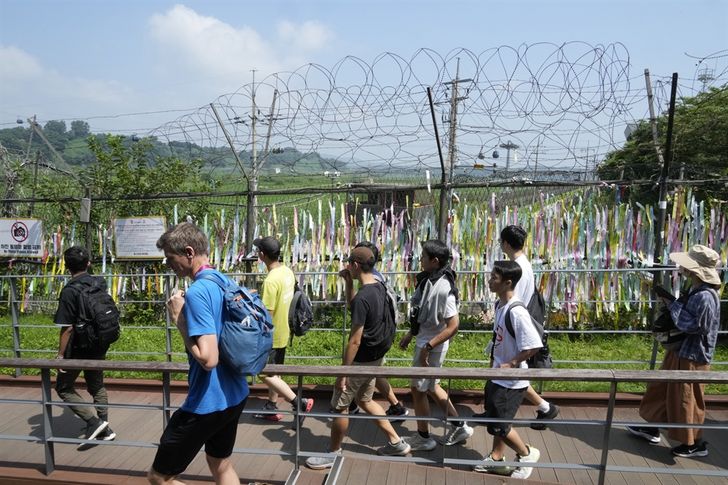
Visitors pass by a wire fence decorated with ribbons written with messages wishing for the reunification of the two Koreas at Imjingak Pavilion in Paju, South Korea, near the border with North Korea, Wednesday. AP-Yonhap
It remains unclear how King traveled to Panmunjeom after getting out of the airport. The border truce village is located some 85 kilometers away from the airport. But it is highly likely that joining the JSA group tour, which requires prior registration, was a part of his plan to defect to the North.
JSA is an area in the demilitarized zone (DMZ) which serves as the dividing line between South and North Korea. The area is under the supervision of UNC, which conducts orientations and tours to civilians ― both Koreans and non-Koreans ― four days a week on Tuesdays, Thursdays, Fridays and Saturdays.
Visitors are required to submit applications and documents prior to the tour and have to go through strict identification checks. A typical tour takes about 90 minutes. Visitors should attend a 30-minute briefing at Camp Bonifas, after which they take a tour through the selected areas by car or on foot.
According to NK News, a Swedish national who was on the same tour with King said that he laughed out loud seconds before running across the border to the North.
The U.S. Defense Department acknowledged that the soldier “willfully” crossed the border.
“One of our service members who was on a tour willfully and without authorization crossed the military demarcation line,” Defense Secretary Lloyd Austin said during a press conference, Tuesday (local time), adding that the soldier is believed to be in North Korea's custody.
In an official statement through its Twitter, the UNC said it is working with its North Korean counterparts to resolve the incident.
Tuesday's border crossing is a highly rare case of a U.S. soldier's defection to North Korea and is the first reported case in over 40 years.
In 1965, Charles Jenkins deserted his army post in South Korea and crossed the DMZ, after which he appeared in various propaganda leaflets and films of the reclusive regime. Joseph White is another American soldier who defected to the North in 1982, but three years later, his parents received a letter from a North Korean that their son drowned while swimming in a river.