Yoon calls for NATO's united response against NK threats

President Yoon Suk Yeol speaks with Swedish Prime Minister Ulf Kristersson during a summit between North Atlantic Treaty Organization members and their Indo-Pacific partner countries in Vilnius, Lithuania, Wednesday (local time). Joint Press Corps
S. Korea to join NATO's intelligence-sharing framework
By Nam Hyun-woo
VILNIUS ― President Yoon Suk Yeol called for the North Atlantic Treaty Organization's (NATO) united response to North Korea's nuclear and missile programs, Wednesday (local time), stressing that Pyongyang's belligerent behavior also poses an “actual threat” to European countries.
Yoon stressed that point in his speech at a summit between NATO members and their so-called AP4 Indo-Pacific partner countries ― South Korea, Japan, Australia and New Zealand ― in Vilnius, Lithuania, hours after the North launched what is believed to be an intercontinental ballistic missile (ICBM) into the East Sea, resuming armed provocations after a month-long break.
“North Korea's nuclear missiles are an actual threat that can strike not only here, Vilnius, but also Paris, Berlin and London,” Yoon said. “We should strongly unite to respond to and condemn this threat in a single voice.”
Yoon noted that NATO adopted the Vilnius Communique a day earlier condemning the North's nuclear and missile programs for the first time in five years, which serves as a “grave warning” that the international community will no longer tolerate the North's “illegal behavior.”
In the communique, the military alliance “condemned in the strongest terms the DPRK's weapons of mass destruction and ballistic missile programs,” referring to the regime's official name of Democratic People's Republic of Korea. The last time that NATO condemned the North's nuclear programs was 2018 and the alliance did not mention North Korea's nuclear programs in last year's communique.
“In this time of super-connectivity, the security of Europe and Asia cannot be separated,” Yoon said, noting that both South Korea and NATO define each other as an important security partner.
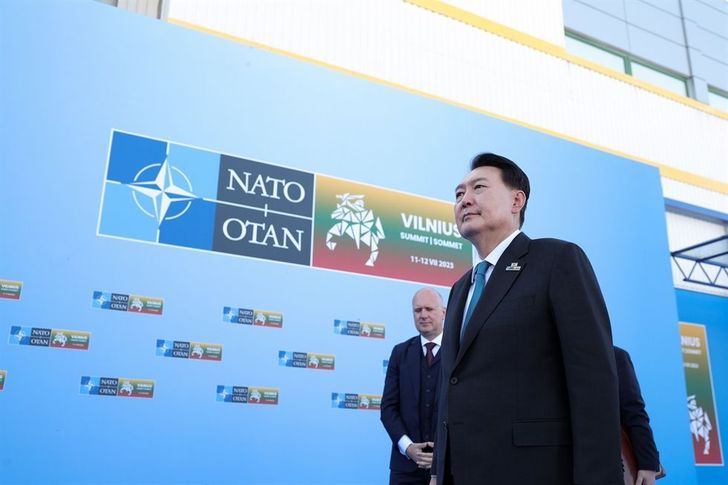
President Yoon Suk Yeol enters the 2023 North Atlantic Treaty Organization Summit at Lithuanian Exhibition and Convention Center in Vilnius, Wednesday (local time). Joint Press Corps
Yoon has used his participation in the 2023 NATO Summit to stress the inseparability of Indo-Pacific security issues from those of the Atlantic region, in what appears to be a move to strengthen international pressure against Pyongyang's nuclear and missile programs by convincing NATO members that the regime's ambitions also threaten European countries.
As part of this effort, Yoon said South Korea will expand intelligence-sharing with NATO and the presidential office announced that Seoul will seek to join its intelligence-sharing framework, known as Battlefield Information Collection Exploitation Systems (BICES).
BICES refers to a system providing the U.S., NATO forces and other allied military organizations with near real-time correlated, situational and order of battle information. Military intelligence, as well as information related to allies' nuclear assets, is shared through this network to enable further assessment or planning.
According to a senior official at the presidential office, NATO proposed South Korea's participation in the system during NATO Secretary General Jens Stoltenberg's visit to Seoul in January this year, and South Korea has been preparing for approvals of BICES members and NATO members for months, viewing that it will be helpful for the country's security.
This means, theoretically, South Korea will be able to share its intelligence on North Korea's nuclear and missile programs with NATO members, effectively strengthening international pressure against the regime's ambitions.
“Once we join BICES and share intelligence, it could be a reference for what kind of nuclear information we will share with the U.S. in the South Korea-U.S. Nuclear Consultative Group (NCG),” the official said. The NCG will involve information sharing and joint planning of U.S. extended nuclear deterrence against North Korea. Its inaugural meeting will take place on July 18.
The official added, however, it will depend on members' autonomy to decide what level of intelligence they will share through the system, and it will be mostly related to cybersecurity.
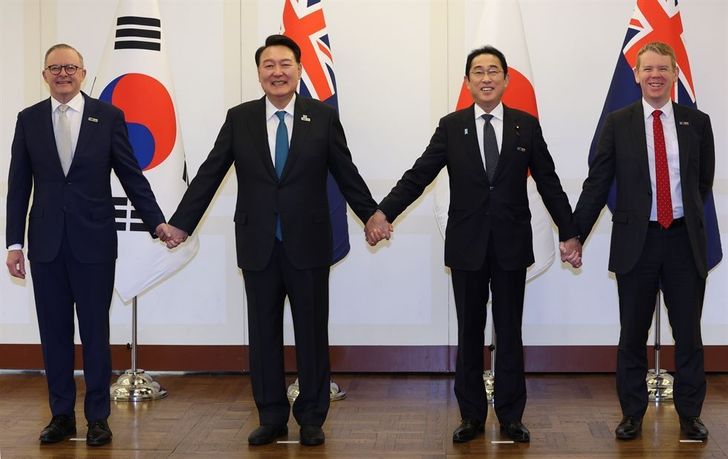
President Yoon Suk Yeol poses with the leaders of NATO's other Indo-Pacific partner countries during their meeting at a hotel in Vilnius, Lithuania, Wednesday (local time). From left are Australian Prime Minister Anthony Albanese, Yoon, Japanese Prime Minister Fumio Kishida and New Zealand Prime Minister Chris Hipkins. Yonhap
Before attending the NATO summit, Yoon and other leaders of AP4 countries had a separate meeting and condemned North Korea's ballistic missile launch.
“(The missile launch) again shows that the security of the Atlantic and the Pacific regions are inseparable,” Yoon said before entering the meeting. “I believe AP4 countries should form solidarity to set up a strong collective security posture. Beginning with this, we should institutionalize the cooperative framework with NATO, and AP4 will play a leading role in the regional security of Indo-Pacific.”
Following Yoon's remarks, Japanese Prime Minister Fumio Kishida strongly condemned North Korea's missile launch, which he called “a threat to the peace and stability of global society.” Australian Prime Minister Anthony Albanese also condemned the North “for breaching United Nations rules and laws” and New Zealand Prime Minister Chris Hipkins also echoed this.
After the four-way meeting, the leaders issued a joint statement condemning the North's missile launch.
“The four countries resolutely oppose North Korea's unlawful provocation and urge it to fully comply with all of its obligations under the relevant U.N. Security Council resolutions,” the statement reads. “Even if North Korea continues to develop its nuclear and missile programs and threaten the use of nuclear weapons, it will only bolster the international community's resolve to achieve the complete denuclearization of North Korea.”