Ukrainian media expert calls for vigilance against wartime propaganda

Ruslan Deynychenko, co-founder of StopFake, gives a talk to journalists at the Ukrainian Embassy in Seoul, June 30. / Courtesy of Bereket Alemayehu
By Bereket Alemayehu
A Ukrainian media expert urged Korean journalists to be vigilant against fake news in combating harmful disinformation by Russian propagandists looking to justify the war in Ukraine.
Ruslan Deynychenko, co-founder of the Ukrainian media project StopFake, told a group of gathered journalists about how he co-founded StopFake, a Ukrainian website revealing false information in pro-Kremlin media. Run for almost 10 years as a project of the nongovernmental organization Media Reforms Center, StopFake fact-checks, debunks, edits, translates, researches and disseminates information.
“Right now, because of the ongoing war, because of the Russia invasion of our country Ukraine, I have to tell you that it's very dangerous in there now,” he said during the talk on June 30 hosted by the Ukraine Embassy in Seoul. “Every night we rush to the shelters when we hear alerts, we hear rocket explosions and bombing. Those past six months were very critical in my own life because of the war,” he said.
In 2014, Deynychenko co-founded StopFake, a Ukrainian website revealing false information in pro-Kremlin media. Run as a project of the nongovernmental organization Media Reforms Center, StopFake fact-checks, debunks, edits, translates, researches and disseminates information.
StopFake was created in 2014 as a result of an online conversation between faculty and alumni of the journalism school at the National University of Kyiv-Mohyla Academy. Alarmed by Russian disinformation and propaganda, they decided to establish a fact-checking website. The next day they started their mission, and they've been at it ever since.
“There is a lot of disinformation about Ukraine in Russia. Initially, in the beginning, we didn't pay attention. We thought it was bad journalism ― they made mistakes but they never corrected these mistakes. So, we decided to do something. We needed to resist such disinformation and defend our people, our citizens from this harmful influence,” Deynychenko said.
“We published thousands of articles on our website debunking lies and fake news. This is not about bad journalism, not about mistakes ― Russia uses intentional disinformation, propaganda and media as an extension of its own foreign policy.”
He explained how Russia uses various approaches for different media platforms to justify the invasion of Ukraine to nations like Korea, Latin America, African countries and the U.S.
“They use it to influence the countries. They use it to brainwash the people,” he said. “In that propaganda effort, not only news is used but also soap operas, entertainment, movies and even children's cartoons. They target different segments of the audiences with different sets of messages to change the way how people think. Because we didn't pay attention, we allowed Russian TV broadcast media and social media platforms in Ukraine. They use such media outlets to disseminate disinformation, fake news and propaganda.”
Deynychenko also explained how Russian media uses so-called “experts” as tools of disinformation and propaganda. He cited the case of one such expert who claimed to be an American geopolitical analyst but was exposed as an insurance coordinator for a car insurance company.
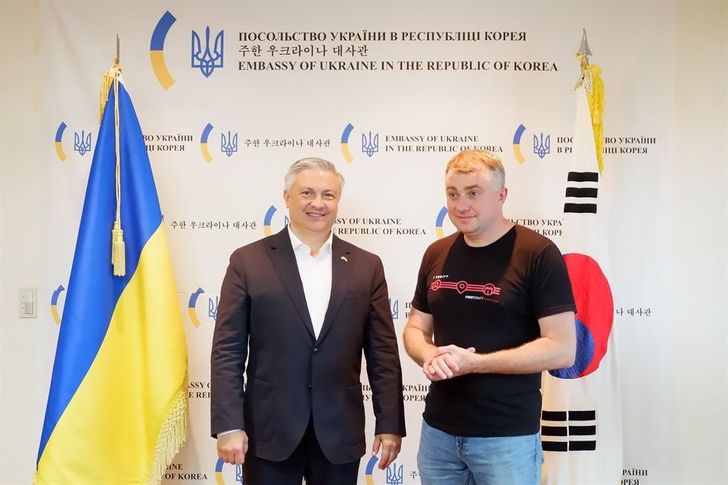
Ruslan Deynychenko, co-founder of StopFake, poses with Ukrainian Ambassador to Korea Dmytro Ponomarenko at the embassy in Seoul, June 30. / Courtesy of Bereket Alemayehu
Before the war, StopFake translated and published articles and other content in eight languages, and produced three TV shows and a radio show weekly in Ukrainian, Russian and English. It also published a textbook on Media literacy for university students. Now, StopFake publishes in 14 languages: Ukrainian, Russian, English, Spanish, Serbian, Turkish, French, German, Italian, Dutch, Czech, German, Polish and Bulgarian.
When asked whether Ukrainian media has ever been caught using similar disinformation techniques, he answered that they monitor Ukraine media also. “When such incidents happen, we ask for a correction and usually they apologize and correct the mistakes or they explain the situation for their audience. In the case of Russian media, they don't do the same. We have in our database 100,000 examples of disinformation and fake news, none of them corrected.”
Ukrainian Ambassador to Korea Dmytro Ponomarenko welcomed the journalists who attended the talk, saying that journalists are important players in finding the truth by themselves during such times like Russia's invasion of Ukraine.
Deynychenko was in Korea to give a speech at the 10th Global Fact-Checking Summit (GlobalFact 10), which was hosted by the International Fact-Checking Network (IFCN) from June 28 to 30 at southern Seoul's COEX.
Bereket Alemayehu is an Ethiopian photo artist, social activist and writer based in Seoul. He's also a co-founder for a social initiative called
and freelance contributor for Pressenza Press Agency. Visit
for more information.