INTERVIEW Aiming to create classic art

K-Arts puts greater focus on fostering artistic creativity to global standard
By Chung Hyun-chae
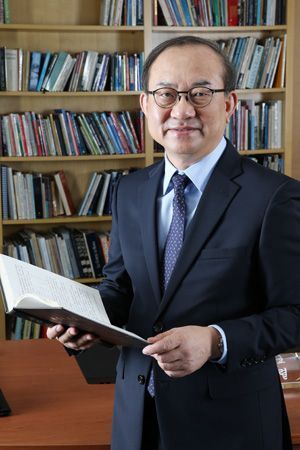
K-Arts President Kim Bong-ryol
The Korea National University of Arts (K-Arts) has been focusing on cultivating world-class artists who can represent and spread the nation’s artistic caliber here and around the world.
Riding on the decades’ achievements, it has set a higher goal of creating classical works of art that can benefit humankind and go down in art history.
“Founded over 20 years ago, K-Arts has been pushing for the seemingly impossible dream of fostering world-renowned artists without sending them overseas to study,” K-Arts President Kim Bong-ryol said. “Today, K-Arts has raised its international standing as an arts school with a remarkable track-record.”
K-Arts ranked 46th in the performing arts category of the 2016 QS World University Rankings based on its academic and industrial reputation.
The art school has 27 departments in six schools ― Music; Drama; Film, TV and Multimedia; Dance; Visual Arts; and Korean Traditional Arts.
“While our students had dreamed of becoming star artists, now they should aim to become master artists who can create classics with Korean style beauty that remains for centuries,” Kim said.
Kim cited examples of Kim Jeong-hui (1786-1856), a calligrapher and scholar of the Joseon Kingdom, and pioneering video artist Paik Nam-june who passed away in 2006.
“We have been encouraging our students to create their own art by building on their creative power and originality,” Kim said.
For this, the school launched a project called K-Arts Platform Project in 2013 in which students make and share their artworks through various exhibits and performances.
“The university spares no expense and effort in providing abundant materials and facilities capable of fulfilling the students’ desire for the arts, as well as offering various opportunities for students to showcase their work,” Kim said.
The school has held a festival every September since 2015 to showcase the best artwork created through the project.
“Many industry insiders are interested in our students’ works and some even buy them,” Kim said.
K-Arts also financially supports its students to participate in international competitions. In 2016, the school provided about 65 million won ($56,700) to 37 talented students.
.jpg?w=728)
One of three campuses of the Korea National University of Arts (K-Arts) in Seongbuk-gu, northern Seoul / Courtesy of K-Arts
Famous alumni
With the school’s support, K-Arts alumni have won national and international awards while achieving good performances in domestic and international competitions.
A recent example is Kim Ki-min, 24, a principal dancer at Russia’s Mariinsky Ballet, a world-class ballet troupe, who won the top ballerina prize at the 2016 Benois de la Danse, known as the “Oscars of ballet.” This was the first time for a Korean or Asian ballerina received the prize.
As of 2016, the number of prizes K-Arts alumni had been awarded is tallied at 3,107, of which 906 are first prize.
The arts school was established by the Ministry of Culture, Sports and Tourism in 1992 with the motto, “Practical training based arts education.”
Trained under the school’s creative and practical classes, many alumni as well as those attending the school are actively engaged in a variety of arts fields.
“Our students have been regarded as professionals who can work in the field right away, not amateurs,” Kim said.
He cited an example of a movie director Na Hong-jin, whose previous works include the 2008 hit film “The Chaser” and last year’s "Goksung.”
“Na made a name for himself through his works while attending the school,” Kim said.
Leading hallyu
In line with its goal to create classics in the future, Kim vowed to strengthen pure arts, which he also believes can continue hallyu, or the Korean wave.
“It is often said that the reason why Korea has never received a Nobel Prize in science is a lack of investment in pure science,” Kim said. “In the same vein, current hallyu, typified by K-pop fever, is commercialized too much; it is time to create new killer hallyu content.”
Kim was proud that one of K-Arts students created the cartoon character Pororo, a little penguin that wears orange glasses and a yellow hat, which is popular among kids in Korean and abroad.
“I hope our alumni can contribute to keeping hallyu going with their creative content,” Kim said.
The president also stressed the importance of increasing diversity to enhance pure arts.
Under such a belief, the school launched a program called Art Major Asian Scholarship (AMA) in 2005 to invite artists from developing countries and provide them with high quality art education.
“Many AMA alumni are leaders in the culture and art sectors after returning to their home countries,” Kim said.
The number of AMA alumni stands at 145.
Successful cases include Abu Shahed Emon who graduated from the filmmaking department of the School of Film, TV and Multimedia in 2015 and has become a famous film director in Bangladesh.
Another example is Him Sotithya who also graduated from the filmmaking department at K-Arts in 2010 and now serves as vice dean at The Royal University of Fine Arts in Cambodia.
“Through these kinds of programs, I believe that the school will become an arts hub that spreads Korean arts to the world,” Kim added.
Expanding international exchanges
In another effort to increase diversity, the president has committed to expand international exchanges.
The art school has created partnerships with 113 foreign universities of arts in 37 countries. They include the Moscow State Tchaikovsky Conservatory in Russia, Hannover University for Music and Drama in Germany, Conservatoire de Paris in France and University of the Arts London in the U.K.
“We are also making efforts to promote exchanges with many selected Chinese universities to help our students make inroads into Chinese market and give them various opportunities,” Kim said.
K-Arts has close relationships with 10 Chinese art colleges including the Communication University of China, the Central Academy of Fine Arts and the Shanghai Theatre Academy.
K-Arts has been running an exchange program called Collective Action for Mobility Program of University Students in Asia with partner schools.
This year, it plans to open a course in which students from Korea, China and Japan work together to create international animation.
“We also plan to launch a project called the Cultural Olympics before August in which students from the three countries deliver performances, and hold exhibitions and workshops in Seoul, Beijing and Tokyo,” Kim said.