Blinken visit triggers calls for Korea to improve relations with China

U.S. Secretary of State Antony Blinken arrives in Beijing, Sunday. Reuters-Yonhap
Abrupt thawing of US-China relations unlikely
By Nam Hyun-woo
United States Secretary of State Antony Blinken arrived in China on Sunday as part of his mission to cool down the tensions between Washington and Beijing.
With the world watching the high-profile trip and asking how exactly the competition between the superpowers will unfold, Seoul, which has been locking horns with Beijing over recent remarks by the Chinese ambassador here, is also paying keen attention to the implications of Blinken's visit to its relations with China.
Blinken arrived in Beijing early Sunday, becoming the first U.S. secretary of state to visit China in five years. He was set to have talks with senior Chinese officials, including Chinese Foreign Minister Qin Gang, to discuss “guardrails” to enable the responsible management of competition between the two superpowers.
Amid the visit, there have been concerns that there could be an abrupt thawing of relations between Washington and Beijing, and this may leave Seoul somewhat isolated in its strained relationship with China.
In the wake of the Yoon Suk Yeol administration, Korea has been echoing the stance of the U.S. in matters that China finds sensitive. President Yoon has been reiterating that he is against any “attempt to change the status quo by force” referring to Beijing's stance on the self-governing island state of Taiwan.
Tensions reached a peak when Chinese Ambassador to Seoul Xing Haiming commented earlier this month that Korea was making a “wrong bet” by leaning toward the U.S. The remarks irked Yoon, who slammed Xing saying that the envoy's “attitude of mutual respect and reciprocity as a diplomat” is doubtful.
However, experts said prospects for Blinken's visit becoming a major breakthrough are slim, and chances are low for Korea to find itself in an awkward position between the U.S. and China.
“Blinken's visit, while not exactly a breakthrough, is still an important step in managing relations,” said Lee Seong-hyon, a senior fellow at George H. W. Bush Foundation for U.S.-China Relations and a visiting scholar at Harvard University's Fairbank Center for Chinese Studies. “His aim is to 'establish a floor' for U.S.-China relations that have been in a downward spiral.”
Lee noted that Blinken reached out to his counterparts in Korea and Japan before his visit in order to “reaffirm Washington's commitment” to its alliance and clarify the visit is not intended as “a Nixon moment,” referring to former U.S. President Richard Nixon's 1972 visit to China. The unanticipated visit marked a dramatic detente and at the same time surprised many U.S. allies, including Korea, because they were not prepared for the abrupt thawing of relations.
“It's crucial for Washington to convey its intentions clearly not only to China but also to its allies. In the realm of alliance diplomacy, the last thing desired is a surprise, so as to ensure allies don't feel neglected or out of the loop.”
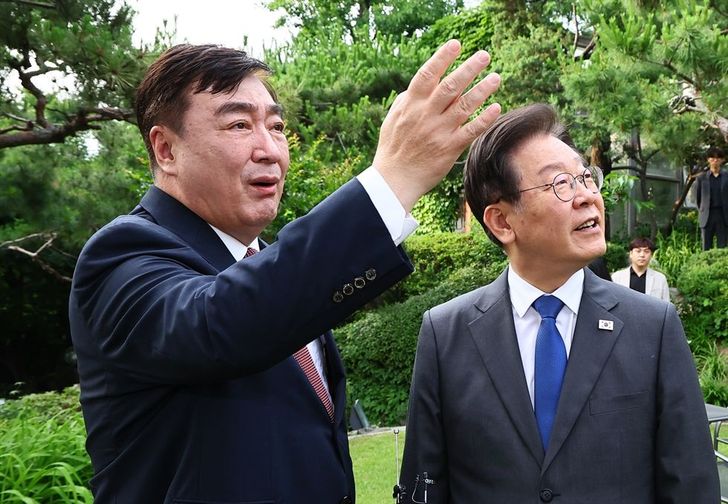
Chinese Ambassador to Korea Xing Haiming, left, gestures during a meeting with main opposition Democratic Party of Korea Chairman Lee Jae-myung at the envoy's residence in Seongbuk District, Seoul, Thursday. Joint Press Corps
Despite the slim possibility of dramatic improvements in U.S.-China relations and Korea being neglected in any moves, experts stressed that the importance of Blinken's visit implies that Seoul should be more prudent in handling its rising tensions with Beijing and maintain open lines of communication with China in this diplomatic climate.
“What we should consider in the wake of Blinken's visit to China is that Seoul should maintain its communication channel with China,” said Lee Dong-gyu, a research fellow at the Asan Institute for Policy Studies.
“In the context of the current diplomatic environment, disputes or conflicts may continue between Korea and China down the road. Seoul should not forget that even if it has to showcase a hardline stance on issues that China finds sensitive, the country should continue sending messages that it is open for discussions regarding the two sides' feuds.”
Harvard's Lee also stressed the importance of keeping communications with China open.
“Korea and China should strive to manage their steadily deteriorating relationship. China is a nation that often invites misunderstanding, but that doesn't render attempts at communication pointless,” he said. “There's also a difference between Washington and Seoul. The White House NSC is now teeming with China experts, while the Korean presidential office has none. From a national strategic perspective, that's not a good sign.”