Will full THAAD deployment trigger retaliatory measures from China?

The Terminal High Altitude Area Defense (THAAD) battery base is seen in Seongju, North Gyeongsang Province, Thursday. The government completed its environmental assessment of the base the previous day, paving the way for full-fledged deployment of the anti-missile system. Yonhap
NK's growing nuclear threats may discourage Beijing from taking strong sanctions, experts say
By Lee Hyo-jin
Bilateral relations between South Korea and China could turn from bad to worse, according to diplomatic observers, as Seoul prepares for full-fledged deployment of a U.S. anti-missile system at the displeasure of Beijing.
However, China seems to have limited options if it is to take retaliatory measures, as it would not want to further harm the already-strained relationship between the two nations, the experts said.
The Terminal High Altitude Area Defense (THAAD) system, capable of intercepting incoming ballistic missiles, was first deployed in 2017 in Seongju, North Gyeongsang Province, to deter North Korean nuclear and missile threats.
The anti-missile system had remained as a “temporary” installation for the past six years due to fierce backlash from China, as well as residents of Seongju. China claims that THAAD's radar can be used to spy on its airspace, while residents of the southeastern town are concerned about health and environmental impacts.
But earlier this week, the Ministry of Environment and the Ministry of National Defense completed the environmental impact assessment of THAAD, paving the way for its operation at full capacity.
According to the ministries, the assessment found that the maximum amount of electromagnetic waves generated by the base was just 0.2 percent of the legal safety standard. Seongju residents claimed that this was enough to pose severe health hazards.
The announcement immediately drew strong backlash from the residents who protested the “hasty and flawed” research.
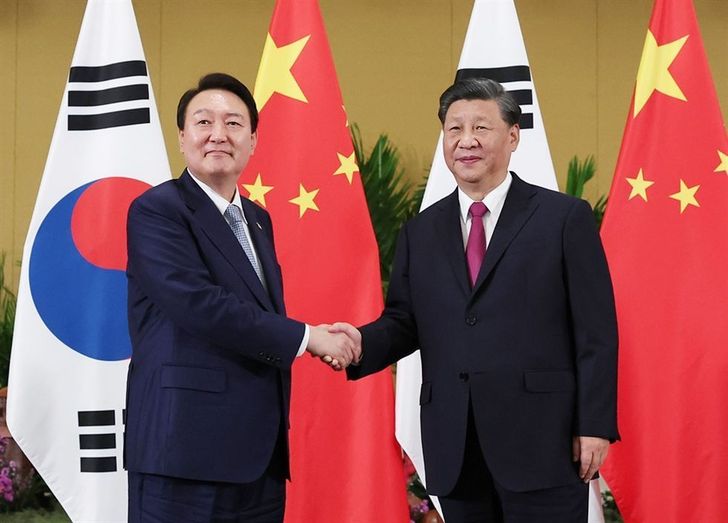
President Yoon Suk Yeol shakes hands with Chinese President Xi Jinping during a summit in Bali, Indonesia, Nov. 15, 2022. Yonhap
Diplomatic experts think that the full-fledged THAAD deployment could widen the rift between Seoul and Beijing. Relations between the two nations have soured under the Yoon Suk Yeol administration, with China expressing discontent about South Korea's pro-U.S. foreign policy.
“The decision (for full installation of THAAD) will certainly not be helpful in improving the strained relations,” said Lee Sang-man, a professor at the Institute for Far Eastern Studies at Kyungnam University.
But he said Beijing should look at the fact that Seoul is facing growing nuclear threats from Pyongyang, as justification for the South Korean government's rationale in pursuing stronger self-defense and deployment of THAAD.
Lee said the chances of China implementing strong economic sanctions on South Korea, similar to those of 2017, are slim, as Beijing would not want to deteriorate the already-strained bilateral ties.
“Rather than retaliatory economic measures, it is likely to protest in the form of scaled-up military exercises in the West Sea and more frequent intrusions of its warplanes into the Korea Air Defense Identification Zone (KADIZ),” he said.
When THAAD was first deployed here in 2017, Beijing responded with massive economic sanctions on Seoul, as well as a tacit ban on South Korean entertainment content.
Against this backdrop, the previous Moon Jae-in administration created the so-called “Three Nos” policy to mend ties with China. The policy refers to no additional THAAD deployment, no South Korean integration into a U.S.-led regional missile defense system and no trilateral alliance with the U.S. and Japan.
The incumbent Yoon administration has been hinting at abandoning the policy adopted by its predecessor. During the presidential campaign, Yoon pledged additional deployment of THAAD.
However, South Korea's defense ministry said on Wednesday that there are so far no plans to add more THAAD units here.