Ruling party head pledges to take away voting rights of Chinese residents

Ruling People Power Party Chairman Kim Gi-hyeon speaks during a plenary session of the National Assembly in Seoul, Tuesday. Yonhap
Immigration expansion possible alternative solution to low birthrate
By Nam Hyun-woo
Rep. Kim Gi-hyeon, chairman of the ruling People Power Party, pledged, Tuesday, to scrap the voting rights of Chinese nationals in Korea, stressing “the principle of reciprocity” between Seoul and Beijing.
The move appears to be an attempt to exploit growing anti-China sentiment among Koreans, which has been escalating following Chinese Ambassador to Seoul Xing Haiming's recent comment that Seoul is making the “wrong bet” by leaning toward the United States.
“There is a national assignment that we must achieve to protect our people's interests,” Kim said in a speech during a negotiation group meeting at the National Assembly in Seoul. “It is building foreign relations based on the principle of reciprocity. We need to reorganize our relations with China.”
He said that more than 100,000 Chinese nationals here had the right to vote in the local elections last June, but no Korean nationals in China are able to cast their ballots there.
“Why should we be the only one to open the gate? It is fair for Korea not to give voting rights to those from countries which do not give voting rights to Koreans.”
Kim also criticized that the health insurance coverage for Chinese nationals in Korea is “way broader” than Koreans living in China receive.
“Chinese are enjoying greater benefits. This is inappropriate and unfair,” Kim said. “We should stop wasting our national health insurance fund, which was established by our people's precious efforts, on foreigners' medical tourism. We should prevent health insurance fraud and free-riding on the health insurance system.”
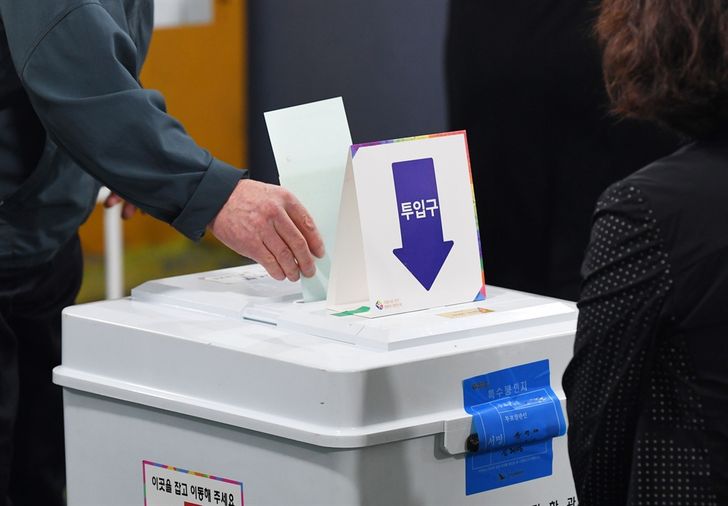
A voter submits a ballot at a polling station in western Seoul's Mapo District during the local elections on June 1, 2022. Korea Times photo by Hong In-kee
Following a revision to the Public Official Election Act in August 2005, foreign nationals who have resided in Korea for three or more years after obtaining permanent residency are given the right to vote in local elections that choose mayors and governors.
As the foreign population continues to grow, a record-high 126,000 foreign residents were eligible to vote in the local elections on June 1 last year, and nearly 100,000 of them were Chinese nationals, making up 80 percent of the total.
The PPP has been arguing Chinese residents' voting rights should be limited, citing reciprocity between the two countries.
PPP Rep. Kweon Seong-dong is one of the frontrunners making such a call, proposing a law revision last December to limit the voting rights only to foreign residents from countries that offer the same rights to Korean nationals living there.
The Yoon Suk Yeol administration is also showing a positive response, with Justice Minister Han Dong-hoon saying in December that “giving foreigners voting rights without considering the principle of reciprocity may distort the will of the people.”
Senior presidential secretary for public relations Kim Eun-hye has also made similar claims. In April last year, when she was running for governor of Gyeonggi Province, she wrote on Facebook that allowing Chinese nationals to cast ballots is unfair.
She lost to eventual winner Kim Dong-yeon of the main opposition Democratic Party of Korea by a razor-thin margin of 0.15 percentage points or 8,913 ballots. Gyeonggi Province is assumed to have more than 25,000 Chinese nationals with voting rights.
Meanwhile, the PPP chairman said that expanding migration into Korea could be “an inevitable alternative measure” for Korea's declining population and low birthrate.
“Our economy is already reliant on foreign workers, and rural areas and companies suffering labor shortages are crying out that there are no people to work,” Kim said.
“We will collect the public consensus on the agenda of expanding immigration. We will thoroughly review the possible side effects and confusions.”
According to data from the Ministry of Justice, the number of foreigners in Korea stood at 2.25 million last year, but the number of those holding an F-5 visa granting permanent residency stood at 176,107, accounting only for 7.84 percent.