North Korea set for another plenary meeting on economy

North Korean leader Kim Jong-un visits a rice farm damaged by heavy rain, in this Aug. 6, 2020, photo. North Korea is preparing to convene another plenary meeting of the ruling Workers' Party in a week or two to discuss economic issues. Analysts said Sunday that the unusual frequency of such gatherings ― the third one in just six months ― suggests an unusually bad food situation. Yonhap
Third gathering in six months is sign of food shortages, loosening of control: experts
By Jung Min-ho
North Korea is preparing to convene another plenary meeting of the ruling Workers' Party in a week or two to discuss economic matters. Analysts believe the unusual frequency of such gatherings ― the third one in just six months ― suggests an unusually bad food situation.
The party will hold the eighth plenary meeting of its eighth central committee sometime this month to review the implementation of national economic plans in the first half of 2023 and discuss policy issues, four months after the previous one held on the same agenda. Usually, the party convenes a plenary meeting once or twice a year.
Speaking to The Korea Times on Sunday, experts said the meeting plan might be a sign of two things: The economy is in trouble and, even without any feasible plans to turn it around, Kim Jong-un, leader of North Korea, still wants the meeting to happen as a means of uniting the party and strengthening his grip on power.
“Little has changed regarding its economic prospects since its previous plenary meeting. This means that the regime wants to hold the meeting for political purposes,” said Park Won-gon, an expert on North Korea at Ewha Womans University.
“Perhaps the only possible way for North Korea to improve the situation quickly is resuming trade with its allies such as China and Russia. But it won't be easy, given its low vaccination rate among other reasons. So far, there have not been any definite signs that it is opening up its borders.”
Expectations were high that North Korea may return to the international sports scene after the coronavirus pandemic, with 14 athletes registered to participate in an international weightlifting competition in Cuba. But according to the governing body of the sport, Friday, North Korea decided eventually not to send them.
North Korea had been facing serious food shortages for decades. But the international sanctions for its weapons program and lockdowns caused by the pandemic appeared to have made it even worse. Speaking before the National Assembly last month, Unification Minister Kwon Young-se said the problem aggravated this year, compared with 2022.
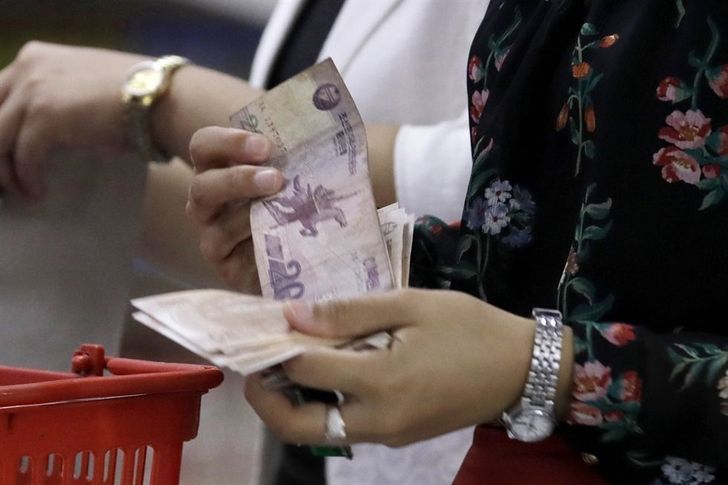
A North Korean pays money to a cashier at a supermarket in Pyongyang, in this Sept. 12, 2018, photo. AP-Yonhap
Experts say North Korea is likely to focus solely on economic issues and refrain from sending messages targeting other countries.
“Kim Yo-jong (sister of the North Korean ruler) issued the North's messages when deemed necessary regarding South Korea or the U.S. I don't see any reason for additional messages,” said Cha Du-hyeogn, a senior researcher at the Asan Institute for Policy Studies, a think tank.
“If North Korea is to say anything in regard to foreign policies, it would probably be about strengthening relations with China or Russia. So far, North Korea has been quite consistent in its stance that it does not want to talk to South Korea or the United States under current President Joe Biden.”
Two weeks ago, Pyongyang attempted to launch a military reconnaissance satellite into space, which ended in failure. Given that most North Koreans are still unaware of the botched project, the regime is likely to remain quiet, experts added.
“If North Korea succeeded, there would be a message, given directly by Kim Jong-un. Given what happened, North Korea will most likely avoid mentioning it,” Park said.