Opposition tests President Yoon with labor, rice control law revisions

Lawmakers pass a resolution during a plenary session at the National Assembly in Yeouido, Seoul, Tuesday. Yonhap
By Nam Hyun-woo
The main opposition Democratic Party of Korea (DPK) has thrown a challenge to President Yoon Suk Yeol following the former's attempt to pass revisions to labor and rice control acts, which contradict presidential policy direction.
It is anticipated that the revisions will be voted on as early as next week's National Assembly plenary session. The presidential office appears to be weighing options including a veto.
The National Assembly's Environment and Labor Committee held its coordination subcommittee on Friday and passed a revision to the Trade Union and Labor Relations Adjustment Act. The Assembly establishes a coordination subcommittee when parties exhibit stark differences on a certain bill.
The revision will likely pass the environment and labor committee next week, and a plenary session vote, because the DPK holds a majority in the committee and the Assembly, and the Justice Party is backing it up.
The revision called the Yellow Envelop Act, is aimed at amending Articles 2 and 3 so as to limit the range of companies demanding compensation from labor unions that stage strikes.
The DPK and the minor opposition Justice Party have been endorsing the revision, saying “the revision is aimed at clarifying the boundary of a lawful labor dispute and preventing compensation demands from being misused.”
The ruling People Power Party (PPP) has been critical of the revision. PPP floor leader Joo Ho-young said, “The revision is nothing more than turning a blind eye to labor unions' illegalities and violence.”
The presidential office also has been negative about the revision. President Yoon said in October last year that “there are concerns over serious side effects.”
The presidential office has been refraining from commenting about the revision officially. A senior official of the office said: “It is worrisome that (the opposition bloc) is pursuing the revision without a proper consensus.”
The presidential office and the ruling party are opposing the revision because it contradicts' Yoon's labor reform initiative. As part of his labor reform efforts, Yoon has been targeting labor unions' militant-style approach to disputes, emphasizing that he will “not compromise with illegal strikes.”
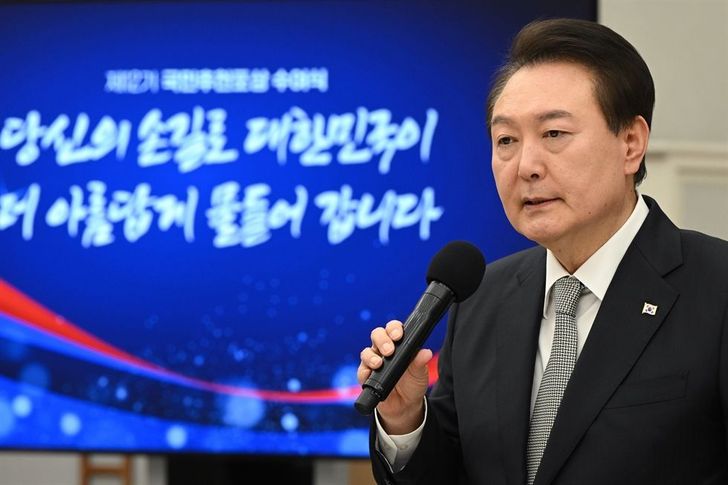
President Yoon Suk Yeol speaks during a luncheon with state award winners at the presidential office in Yongsan District, Seoul, Thursday. Courtesy of presidential office
The situation is similar to the rice control act revision pursued by the DPK. It is aimed at revising the Grain Management Act to force the government to purchase overproduced rice when the production volume surpasses a certain level, or when rice prices drop by more than 5 percent from a year earlier.
The revision has already passed relevant processes and is waiting for a plenary session vote. Given the DPK's majority at the Assembly, this will likely be approved.
The presidential office and the PPP have been negative about the revision because of its effectiveness. Yoon said on Jan. 4 that “this unconditional and unlimited purchase will not help the country's farmers.”
The PPP is raising concerns regarding equality with other crops, fisheries, dairies and even manufactured goods.
Chances are high that the two revisions will pass the Assembly and reach the president. The presidential office appears to be considering Yoon's veto on those revisions which would force the Assembly to review them.
Article 53 of the Constitution states that the president can return a bill to the National Assembly with a written explanation of his objection, and request it to be reconsidered. In the case of returned bills, the Assembly has to win more than two-thirds of attending lawmakers' approval to pass bills ― more difficult than majority approval.
“Given the government and president Yoon have expressed objections to the revisions, it is natural for the president to exercise his veto rights,” another official at the presidential office said.
Reportedly, Yoon recently told his secretaries that any president can demand the Assembly review bills in cases where procedural problems, unconstitutionality and the public interest come into question.