Busan officials hone English skills for World Expo 2030

Busan Mayor Park Heong-joon speaks during a presentation promoting the city's bid to host World Expo 2030 at the Bureau International des Expositions' headquarters in Paris, June 19. Courtesy of Busan Metropolitan Government
Mayor, spokesperson, district head share how they are digging the language
By Ko Dong-hwan
Not being fluent in English might not mean the end of the world. But for those representing a city with an unprecedented bid to host a mega-scale international event in less than eight years, it could be a shame.
It's a concern of the officials of Busan, which is betting on being selected a host city for World Expo 2030 in Paris next year.
They rolled up their sleeves last year to campaign for the bid, having pulled off two preliminary rounds of self-promotional presentations in front of the more than 160 member states of the Bureau International des Expositions. The southern port city is up against Riyadh, the rival Saudi city in the bid, which had started its campaigning almost a year earlier.
With both cities determined to host the event that they both see as having the potential to provide a major economic boon, some top-tier government officials in Busan have taken the challenge rather personally. Their common goal is as straightforward as it is difficult to implement: to use English more fluently and encourage other city officials and members of the public to do the same. The bold initiative could draw leverages from the city government's 18 bureau chiefs, 12 of whom have studied, worked or received vocational trainings outside Korea.
Busan Mayor Park Heong-joon is an ambitious go-getter. Having been re-elected as mayor in the June 1 local elections this year, he said that, as he has been governing the southeastern coastal metropolitan area of more than 3.3 million residents since then, Busan is more global than he had expected.
“I meet people from overseas at least once a day, usually those who are here for investment relations or envoys from other countries,” Park, 62, told The Korea Times. With one of the city's top goals being to make Busan an ideal educational hub for English learners, the mayor, who has never studied nor lived outside the country, realized he had to do something not to embarrass himself with his poor language skills. “I didn't want to use my old age as an excuse anymore.”
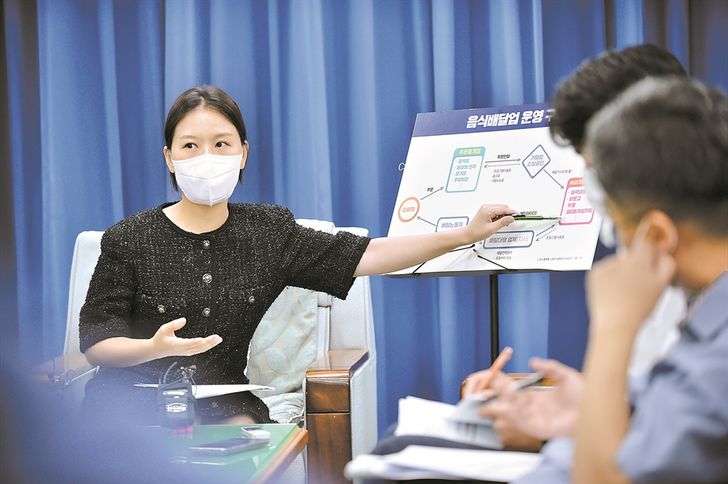
Busan Metropolitan City spokesperson Na Yun-bin talks to journalists in a press room at city hall, November 2021. Courtesy of the Busan Metropolitan Government
From late last year, Park started waking up early in the morning to video-chat with a native instructor in English on a smartphone app.
“I didn't reveal myself as the mayor of Busan to the instructor at first. When I did later, it surprised him. He also said he sort of felt proud to be my teacher,” he said.
Park said that talking to people of foreign nationality through interpreters lacks a sense of “intimacy.” “I want to express my willingness and passion to whomever I talk to in English. They also like it more when I directly talk to them instead of through interpreters.”
Na Yun-bin, the mayor's spokesperson who also never studied abroad, is spending time outside the office to learn English as well. She talks to Filipino instructors three times a week on KakaoTalk, the country's most popular smartphone messaging app. It's been six months since this practice became part of her routine.
“Someday I will go abroad and test my English,” Na told The Korea Times. “When I found out that the mayor was also privately learning English, I was really psyched.”
Some officials of the city have already proven that hard work does not lie. Kim Byoung-ki, the vice-head of Jin District, the central district of the city, and a senior policy maker specializing in Smart City and Blockchain technology, is one of the city government's busiest public speakers. His credentials gained traction by having delivered presentations to foreign nationals on various occasions in English about how the city has realized the Smart City concept. But before reaching his current English level, the 50-something experienced self-mortification and despair countless times.
“I discovered my knack for reading and writing in English in high school,” Kim told The Korea Times. “But my listening and speaking skills were just hopeless.”
Feeling pressured, he kept challenging himself, as he studied at the country's state-run Korea Development Institute School and later, the Syracuse Maxwell School in the United States. While working for the Korean Embassy in Singapore for over two years, he found it depressing that his fluency in English didn't catch up as he expected, and he started lagging behind his children who had come to Singapore with him. He almost gave up on the language back then.
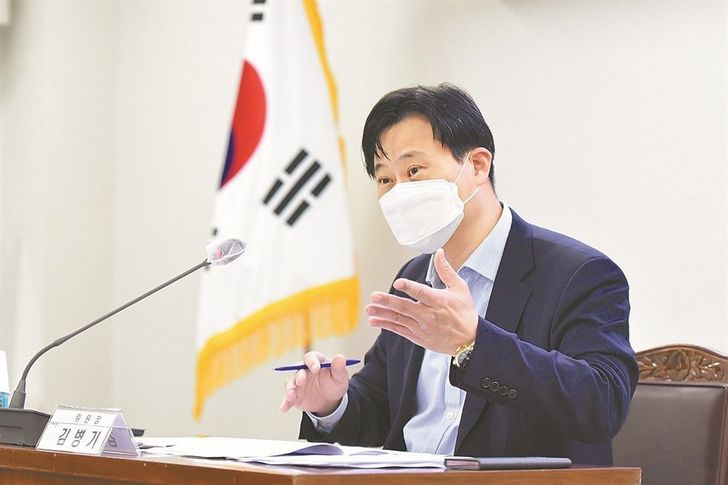
Kim Byoung-ki, vice-head of Busanjin District, the central district of Busan / Courtesy of Jin District Office
But when he got back to Busan and headed the city government's bureau in charge of new growth industries in 2017, he was unwillingly tasked with giving English presentations for public events. After catering all by himself to the African Development Bank Forum held in the city in 2018, to public officials from Southeast Asian countries in a video conference, and being interviewed by American TV network CNBC, he found his confidence in English slowly getting better.
He still remembers nerve-wracking moments ahead of showing up in front of a crowd during a large-scale Smart City summit at Washington, D.C. in 2019, as one of the speakers for a panel discussion. He at first tried to give up the opportunity given after the city government granted him time to study abroad at University of Georgia's Carl Vinson Institute. But his superior at the school urged him to stick to the chance, using what he called, “a typical American pep talk.”
“I practiced for the big day with an old American friend of mine who helped me memorize a list of possible questions from the audience that ran for 50 pages,” said Kim. “I read it out loud. That got me to realize that speaking it out loud actually helped me listen better as well.”
Kim still hones his English by reading aloud scripts of English news reports from Korea's English TV channel, Arirang TV, or articles from The Korea Times.
Kim believes that the metaverse could be a key to helping Busan's young students learn English better by exposing them to people from other countries more often. He thinks such virtual studies should be employed at the city government's level to push the initiative more.
“Busan Metropolitan City and the city's office of education could form partnerships with many American schools, which could lead to our Korean students meeting many native instructors through their avatars,” suggested Kim. He also envisioned using virtual reality (VR) equipment that could enable students to talk to people in other countries.
“If such practices persist for 10 years or so, there will be many in Busan who can use the language comfortably. I disagree with Busan going the same path as Singapore or Hong Kong where English was designated the national language alongside Chinese,” he said.