INTERVIEW 'English will be widely spoken in Busan'

Busan Mayor Park Heong-joon, left, takes a selfie with Busan Port Authority President Kang Jun-seok during the opening ceremony of the 15th Busan Port Festival on July 2. Courtesy of Busan Metropolitan Government
Mayor's educational vision extends to attracting foreign talent, companies
By Ko Dong-hwan
BUSAN ― The southeastern port city of Busan with a population of more than 3.3 million has been a popular destination for tourists from overseas. Beaches, food and nightlife drew people from across borders who arrived by land and sea. But the comers and goers were not enough to sustain the country's second biggest city, which is actively seeking foreign capital and talent. With all the infrastructure to support an ideal work-and-vacation lifestyle and a warm, breezy climate, Busan still seems to be missing something.
Park Heong-joon, a second-term mayor of the city who won the June 1 local election this year, has concluded that what has been missing in the city was the public use of English among city dwellers. As more residents become familiar with the language, the city will not just attract foreigners but also boost the level of education for students, according to the mayor. That is why the 62-year-old former journalist, educator and politician pledged to standardize the language as the city's second official language during the election campaign.
“For Busan to become a global hub, there shouldn't be any inconvenience in using English here,” Park, who was the ruling People Power Party's (PPP) candidate in the city's mayoral election last June, told The Korea Times. “For global talent to come to Busan, education for children must be on a par with international levels.”
His vision is already on track to becoming a reality.
A British international school is scheduled to open in 2024. For more schools for foreigners to open in the city, the central government must amend existing regulations, according to Park, who was the former presidential senior secretary for political affairs under Lee Myung-bak in 2009-2010.
Every aspect of the city will have to support English speakers ― from private and public workers to volunteers and government information that is produced for the public. What it takes to realize that, the mayor said, is rather simple ― revving up public English education at an early age.
“In 10, 20 or 30 years, those kids will be fluent in that language,” said Park.
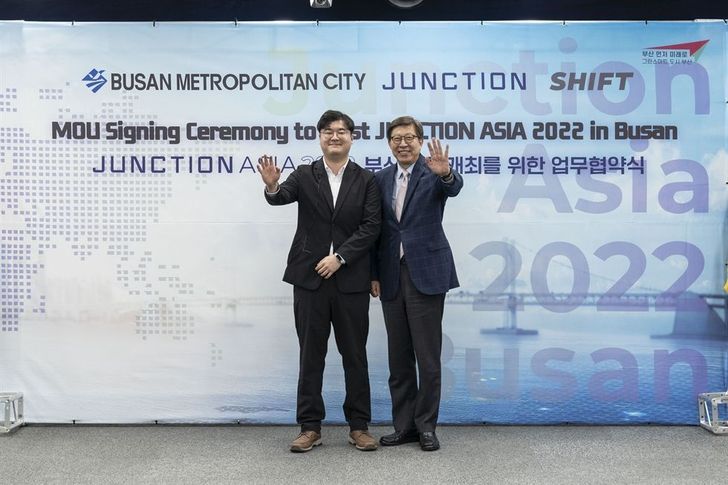
Busan Mayor Park Heong-joon, right, and Shift President Lee Hyun-sae, pose after signing an MOU on May 3 to host Junction Asia 2022 in Busan in August. Shift is the Seoul-based operator of Junction. Courtesy of Busan Metropolitan Government
Busan has been attracting foreign talent through major international events. One of them is G-STAR, an annual gaming competition and trade show that has been held since 2005. Seeing it as a fundamental base for the city's game industry, the city, in April this year, signed a deal with DigiPen Institute of Technology in Washington ― the “Harvard University of the games industry,” according to Park ― to establish a branch in Busan. A concert at the Busan Exhibition and Convention Center or BEXCO in May this year, which orchestrated the music from the globally popular computer game “League of Legends,” also drew thousands of fans, cementing the city as a mecca for gamers.
The mayor expects Junction Asia 2022 in Busan, a hackathon hosted this coming August by Europe's biggest hackathon organizer Junction, will also attract hundreds of people. They will take part in workshops to solve hackathon challenges, team-building and networking between participants, ideation and development, as well as mentoring sessions about launching and operating startups.
“We have put a major emphasis on innovative finance and supporting startups, where creativity will play a key role,” said Park. “I believe an event like Junction Asia will be a great stimulator for such directions.”
Busan on par with Seoul
Becoming a politician in 2004 by winning a constituency in Busan representing the Hannara Party, the predecessor of the PPP, Park isn't afraid to go up against Seoul and its surrounding regions including Incheon and Gyeonggi Province. Together called the “capital region,” it is the country's centrifugal core where everything from businesses to culture, jobs and foreign investment are concentrated. The former professor at the Graduate School of International Studies at Dong-A University in Busan firmly believes that if Korea's reliance on the capital region persists, the nation will not survive in the future.
His view was shared by many and its realization ― the special union of Busan, Ulsan and South Gyeongsang Province in the country's southeastern region ― is now taking the first step toward a new future starting January next year. The new megacity jointly formed by the local governments will focus on executing 70 pre-planned projects, which altogether will be worth 35 trillion won ($26.7 billion). This includes establishing new public transit routes and a transportation network for the logistics industry to make everywhere within the region reachable within an hour or so.
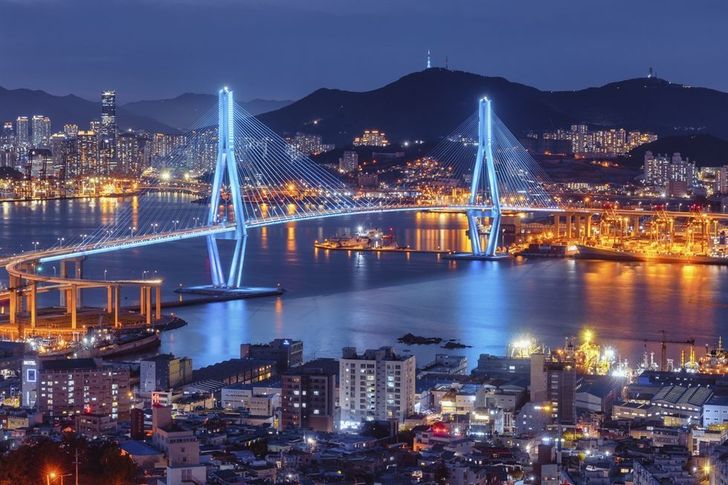
Busan Harbor Bridge shines in the city's nightscape this year. Courtesy of Busan Metropolitan Government
“There are concerns that some parts of the unified Bu-Ul-Gyeong region will be left out from enjoying the megacity's benefits such as western Gyeongsang, or that Ulsan and South Gyeongsang will get sucked into the comparatively greater Busan region during the process of unifying,” said Park. “But I believe those concerns can be resolved by jointly carrying out those projects. We three local governments have agreed not to compete or fight against each other, but only do what's beneficial for all of us.”
For Park, the capital region with a population of almost 25 million is already a top-tier international megacity. But he also offered a word of caution about the region's monopoly over a majority of the country's businesses.
“Compare Japan with Germany and France with the United States. Japan and France rely on each of their sole megacities that center on Tokyo and Paris. And their GDPs have been almost still for the past 30 years. But look at Germany. It's not led by a single entity. Each local government has accomplished an economic improvement based on specialization. So has the U.S., where more than 20 core innovative sectors span across the country. For an economy the size of Korea, there needs to be at least two global hubs. If we don't revitalize a city with perfect business conditions like Busan and leave it as it is now, the city will perish.”
Park says the city (Busan), with the world's sixth-largest container port, must be developed further to become the country's main base for trade. Developing Gadeok Island south of the city will help Busan achieve that goal. Relocating state-run Korea Development Bank's headquarters from Seoul to Busan will give leverage to the city to become an international financial hub. The mayor is preparing to brand the city as the country's first blockchain special zone and digital asset exchange. Where finance prospers, according to the mayor, trade will soon follow in abundance.
“Busan has been strong in manufacturing and shipbuilding. But it started late in improving sectors like digital industries and the hydrogen economy,” said the mayor. “The central government is considering setting up a free economic zone around Bukhang (the northern harbor area of the city) where foreign firms can enjoy incentives like tax exemptions. Besides, the city is a good place for both work and leisure. Companies exiting Hong Kong right now are headed to Singapore or Dubai. We must let them come here.”