INTERVIEW K-magazine founder seeks to connect Latin America and Korea

Lucero Santiago, founder and editor in chief of K-magazine / Courtesy of Lucero Santiago
K-magazine becomes go-to platform for Spanish-speaking hallyu fans
By Dong Sun-hwa
Lucero Santiago from Mexico was dubbed a “crazy girl” when she was young, just because she loved Korean music and drama. People around her did not understand why she was fond of the seemingly odd content from the opposite side of the planet.
But much has changed over time.
These days, a lot of her friends get hold of her to ask about K-pop juggernaut BTS and Netflix's original Korean series “Squid Game” (2021), knowing that she is one of the most reliable sources when it comes to Korean content.
Santiago is the founder and editor in chief of “K-magazine,” a Spanish-language online media outlet dedicated to promoting Korean culture that has over 480,000 monthly visitors. The founder, who has been a big fan of K-pop act Super Junior, used to be a journalist at a Mexican newspaper and a magazine. But she quit her job after a few years and in 2015, began writing about Korean content on her blog, which later got the name, K-magazine.
“My family and friends said I was crazy to love the things that nobody else liked,” Santiago told The Korea Times at the newspaper's office in central Seoul, May 31. “The global success of singer PSY's 2012 release, 'Gangnam style' led them to know about K-pop and understand why I had been so obsessed with Korean culture, although most of them believed the song was just a one-hit-wonder. But then, the Grammy-nominated BTS and Netflix's Korean series became the game changers. Now, all my friends, newspaper editors, teachers and professors are eager to learn more about Korean culture.”
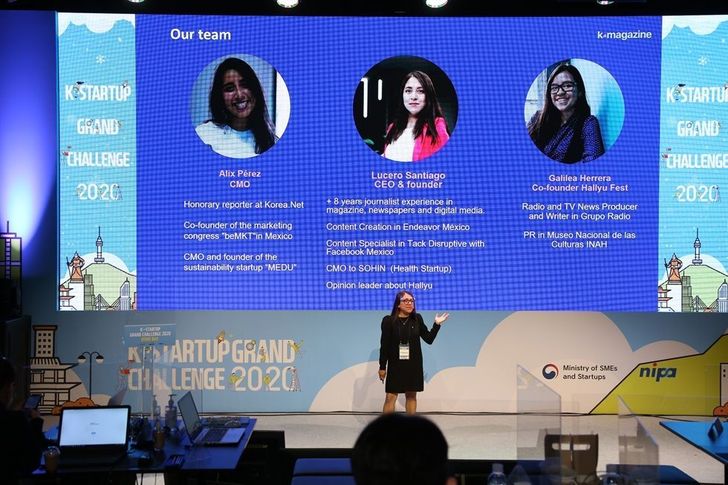
Lucero Santiago introduces her K-magazine team in front of a crowd during the K-Startup Grand Challenge 2020. Courtesy of Lucero Santiago
In 2020, she got the chance to expand her business through K-Startup Grand Challenge. Hosted by the Korean government, K-Startup Grand Challenge is a startup accelerator aimed at attracting global startups to the Korean market.
K-magazine is one of the few platforms for Spanish-speaking “hallyu” fans where they can keep abreast of the latest Korean Wave news and read exclusive interviews featuring A-list stars. As a result, it was chosen among 60 companies to receive the Korean government's support. A total of 2,648 startups applied that year, according to Santiago.
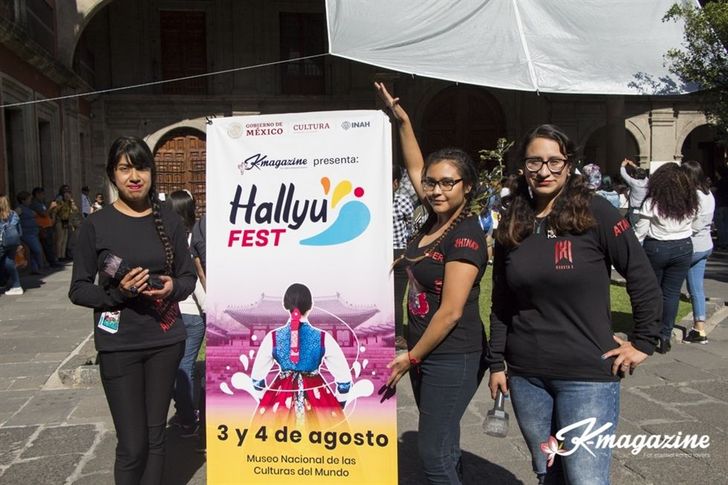
Visitors to the “Hallyu Fest” pose at the National Museum of World Cultures in Mexico City in this 2019 photo. / Courtesy of Lucero Santiago
“K-magazine is the first and the only well-rounded media company promoting hallyu in more than 20 Spanish-speaking countries,” Santiago explained. “I think we were selected as one of the runner-ups because we had a big number of daily visitors on our website. We also had a good understanding of the Latin American market, but above all, we were writing about Korean content in Spanish even before it became very popular in Latin America. Although there are many platforms that deliver the news about hallyu in English like Soompi, there were not enough sources for Spanish-speaking people, which could help them explore various aspects of Korean culture.”
Santiago's team of 50 writers also introduced Korea's staple foods like kimchi and provided information about different visas. And their concerted efforts have come to fruition ― the total number of website visits was 191,000 in 2017, but surged to 5 million in 2021.
K-magazine also runs a series of hallyu-related events such as “Hallyu Fest” to connect young Latin Americans with Korea. After attracting more than 5,000 people for the event in Mexico in 2019, Santiago plans to organize another one in Korea later this year.

Visitors look at merchandise during the “Hallyu Fest” at the National Museum of World Cultures in Mexico City in this 2019 photo. / Courtesy of Lucero Santiago
However, Santiago believes more can be done, as there are millions of hallyu fans in South America. South America is also one of the world's fastest-growing music markets, where the revenue growth rate of recorded music stood at 31.2 percent in 2021, according to the latest global report by the International Federation of the Phonographic Industry (IFPI). In the same year, the U.S. and Canada registered growth of 22 percent, while Asia saw growth of 16.1 percent.
“I hope Korean content producers do not solely focus on the U.S. market,” she said. “The U.S. has a big and lucrative market, but the South American market has huge potential, too. A lot of people love Korean culture and content creators are craving to join hands with Koreans. So one of my goals is to help more Koreans learn about this continent and promote collaboration.”
As Santiago said earlier, people in Latin America used to have a deep-seated prejudice against Korean content. K-pop, for instance, was often thought of as something subpar.
“In the past, the majority of people did not understand the K-pop industry at all, believing K-pop singers are untalented young people artificially manufactured by their management companies,” she said. “But now they know how great their music is and how aesthetic their music videos are. They now recognize that K-pop is a hot trend that they should not turn a blind eye to. Honestly, the winners of today are Koreans, not us.”
Santiago said the uniqueness of Korean content offers a competitive edge in Latin America.
“Korean content is so distinctive from that of Latin America,” she noted. “This has fascinated numerous people, prompting them to become more curious about Korean music and dramas. In the case of dramas, many people find their stories very inventive and imaginative and some producers here are actually remaking some Korean dramas, as can be seen from the Mexican adaptation of the 2012 Korean drama, 'My Husband Got a Family.'”

People attend “Hallyu Fest” at the National Museum of World Cultures in Mexico City in this 2019 photo. / Courtesy of Lucero Santiago
Santiago, who fell in love with Korean culture when she was 12 after watching the 2002 drama, “Winter Sonata,” hopes more people recognize her passion and affection.
“I am not doing this for fun,” she underscored. “After falling under the spell of 'Winter Sonata,' I have come across a series of other creations and even studied Korean culture for a year after finishing college and ended up becoming a journalist who could interview my long-time favorite stars like Super Junior.”
She added, “I also talked with BTS in 2017 when they came to Mexico to perform for the KCON (an annual event held by entertainment behemoth CJ ENM to spread Korean culture and lifestyle). Back then, I did not expect the septet would grow this big. Like many other K-pop acts, they were surprised by passionate Mexican fans, who screamed throughout their show, making it impossible for the members to hear what they were actually saying. But BTS was still an amazing performer. I wish I could have another interview with the singers in the coming days or see them again in Latin America.”