Yoon's plan to attend NATO summit causes stir

President Yoon Suk-yeol gives a speech at a Memorial Day ceremony held at Seoul National Cemetery in Seoul, Sunday. Yonhap
Ruling party leader's Ukraine visit raises concerns about Seoul's ties with Russia, China
By Nam Hyun-woo
The presidential office is reportedly reviewing President Yoon Suk-yeol's proposed attendance at the North Atlantic Treaty Organization (NATO) summit to be held on June 29 and 30 in Madrid, Spain.
If confirmed, it will be Yoon's first overseas trip as Korea's head of state.
An official said in a media interview that the presidential office is reviewing various issues related to Yoon's possible trip to Spain for the NATO summit. “A president's first foreign visit itself has a symbolic meaning, so we're looking into whether the NATO summit is suitable or not and whether his attendance there can benefit or hurt our national interest or not,” the official said, noting that Yoon's participation in the summit has yet to be confirmed.
News about Yoon's possible participation in the NATO summit came amid ruling People Power Party Chairman Lee Jun-seok's visit to Ukraine. Departing Korea on Friday, Lee and the ruling party delegation arrived in Ukraine, where they met with activists from a local NGO on Saturday. Kyiv Governor Oleksiy Kuleba uploaded a photo of the PPP's delegation to social media on Sunday.
During his weeklong trip to Ukraine, Lee is scheduled to meet Ukrainian President Volodymyr Zelenskyy.
The timing of the news about President Yoon's possible visit to Spain for the NATO summit and the ruling party leader's arrival in war-torn Ukraine have raised concerns from liberal politicians in Korea as those two events could stir up tensions with Russia and China.
“For Lee to go visit the battlefield in Ukraine and view the current situation there is equivalent to the ruling party and government doing the same thing, so that could give the wrong signal to the international community and Ukraine,” Rep. Kim Byung-joo of the main opposition Democratic Party of Korea said during a symposium co-hosted by Asan Institute for Policy Studies and the U.S. Embassy in Korea, Friday.
Kim continued that the government must also give prudent consideration to President Yoon Suk-yeol attending the NATO summit, saying that such a high-level visit could also send the wrong signal.
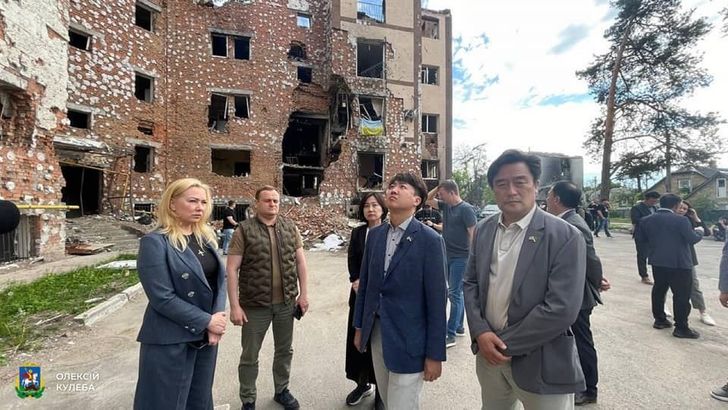
In this photo uploaded on the Facebook page of Governor Oleksiy Kuleba of Kyiv, Ukraine, Sunday, People Power Party Chairman Lee Jun-seok, second from right, and the governor, second from left, look at a bombed building at an unidentified location in Kyiv. Screenshot from Governor Kuleba's Facebook page
According to sources, the presidential office sent an advance team, comprised of officials from the office, the Presidential Security Service and the foreign ministry, to Spain, to prepare for Yoon's possible attendance at the NATO leaders' meeting.
“The main agenda of the NATO summit will be how participating countries will respond to the threats of Russia and China,” Kim said. “And regarding the responses to Russia, these will include military options as well. If the president attends the meeting, that could send a different signal, so the government should consider the ramifications of such a visit very cautiously.”
During the summit, NATO will invite key U.S. allies in Asia ― namely Korea and Japan ― and adopt its new Strategic Concept, which the organization says “will define the security challenges facing the alliance and outline the political and military tasks that NATO will carry out to address them.”
In an op-ed in media outlet Pressian, Park Byeong-hwan, director of Institute of Eurasian Strategic Studies and a former Korean minister-counsellor to Russia, wrote that Yoon's attendance at the NATO summit will “clearly show Korea's hostility to Russia, which will strengthen NATO's pressure on Korea to assist Ukraine.”
“The Yoon government's strategy will have the effect of bringing Russia and North Korea closer to each other, which will increase Seoul's national security burdens,” Park wrote. “If Korea shows hostility towards Russia, will Moscow see the necessity of contributing to peace and stability on the Korean Peninsula?”
Russia and China have traded barbs with NATO in the wake of Russia's invasion of Ukraine and China's siding with Russia.
It is relatively recently that NATO has been wary of the rise of China. In a policy brief, titled “The Rise of China and NATO's New Strategic Concept,” released in April, NATO made it clear that it was watching for possible threats from China's rise. Secretary General Jens Stoltenberg was quoted as saying that “China does not share our values,” and “uses modern technology, social media and facial recognition to monitor, to do surveillance of their own population in a way we have never seen before.”
China, recently, has accused NATO of “messing up Europe.”
In response to the British foreign minister's comments at the end of April, Wang Wenbin, a spokesman of the Chinese foreign ministry, said that NATO “wantonly waged wars and dropped bombs in sovereign states, killing and displacing innocent civilians.”