Parties clash over establishment of Korean version of FBI

Lawmakers pass a revision to the Prosecutors' Office Act during a plenary session of the National Assembly on Yeouido, Seoul, Saturday. Yonhap
By Nam Hyun-woo
The ruling Democratic Party of Korea (DPK) has unilaterally pushed for the first phase of its proposed prosecutorial reform, and it is flexing its muscles to complete the process of limiting prosecutors' investigative powers before President-elect Yoon Suk-yeol takes office on May 10.
According to officials, Sunday, the National Assembly will hold a plenary session on Tuesday during which the DPK plans to pass a revision bill of the Criminal Procedure Act.
Since the DPK holds a majority in the Assembly, it can pass the revision without support from the other parties.
On Saturday, the DPK embarked on the initiative to establish a Korean version of the Federal Bureau of Investigation (FBI) which will take over some of investigative rights from the prosecution. The ruling party passed a measure to form a special judiciary committee to prepare legal procedures for the new agency over the next six months. The new agency will assume the other remaining investigative rights from the prosecution one year later. The main opposition People Power Party (PPP) protested but the DPK, in collaboration with the minor Justice Party, went ahead with launching the subcommittee.
On Saturday, the National Assembly held a plenary session and passed a revision bill of the Prosecutors' Office Act, with 172 out of 177 attending lawmakers approving it. It took less than 10 minutes to pass the bill.
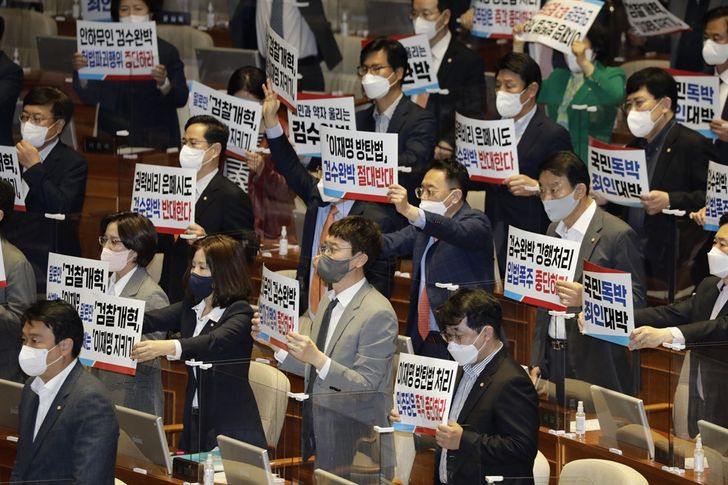
Members of the main opposition People Power Party hold banners to protest the Democratic Party of Korea's passing of a revision to the Prosecutors' Office Act, during a plenary session at the Assembly on Yeouido, Seoul, Saturday. Joint Press Corps
The PPP staged filibusters in a vain attempt to prevent the DPK from passing the revision unilaterally, following the DPK's tactic of cutting the plenary session into shorter one-day sessions.
Following the revision, prosecutors will be allowed to investigate only corruption and economic crimes. The current Prosecutors' Office Act stipulates that prosecutors can open investigations in six significant crime categories ― corruption, economic crimes, crimes perpetrated be public officials, election crimes, defense industry crimes and those related to catastrophes.
The revised act also stipulates that prosecutors cannot prosecute a case that they investigated themselves. This is interpreted as a clear separation of prosecutors' investigative powers from their authority to indict.
Though chances are high for the DPK to pass the Criminal Procedure Act in Tuesday's plenary session and wrap up its prosecutorial reform push, its conflict with the PPP will likely be amplified further in upcoming Assembly sessions.
An imminent clash is anticipated over the organization of a special committee related to judicial reform, which will review the DPK's plan to set up an investigation agency that will take over the prosecution's investigative powers.
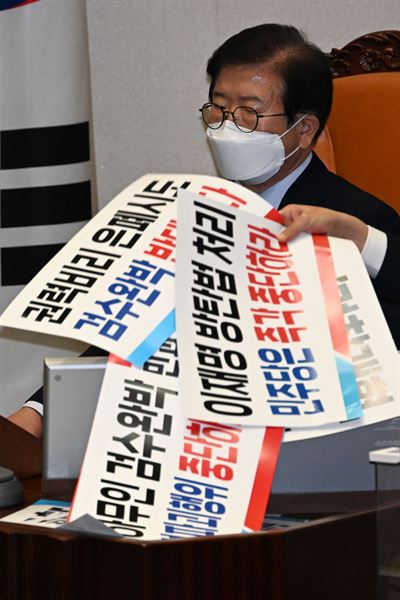
An unseen official removes banners opposing a revision to the Prosecutors' Office Act from Speaker Park Byeong-seug during a plenary session at the National Assembly on Yeouido, Seoul, Saturday. Joint Press Corps
Dubbed the “Korean version of the FBI,” the DPK seeks to set up the agency to investigate major crimes in lieu of the prosecutors. This was included in an initial agreement between the DPK and the PPP on the prosecutorial reform, but the PPP has reversed its stance and is refusing to join the debate for organizing the committee.
Since the DPK wants to strip prosecutors of their investigative powers on corruption and economic crimes after the agency is set up, the PPP's resistance is anticipated to continue.
The scheduled Assembly hearings on President-elect Yoon's minister nominees are also expected to be mired in mudslinging fights.
Today, the Assembly will hold hearings on Prime Minister nominee Han Duck-soo, Deputy Prime Minister and Finance Minister nominee Choo Kyung-ho, Foreign Minister nominee Park Jin, Land Minister nominee Won Hee-ryong and two other Cabinet nominees.
Of them, Han's hearings were initially scheduled for April 25 and 26, but the DPK boycotted the sessions, saying the nominee had neglected to provide important documents for the hearings.
Han's hearings will continue on Tuesday and three other minister nominees will also appear at the Assembly to face questions from lawmakers. Among them is Health Minister nominee Chung Ho-young, who has been hit by snowballing allegations that he used his influence to exaggerate his children's academic achievements.
On Wednesday, hearings will be held on Justice Minister nominee Han Dong-hoon and three others. Education Minister nominee Kim In-chul will stand for a hearing on Friday. Han and Kim are also candidates that the DPK has been grilling.
DPK floor leader Park Hong-keun said Friday that “all 19 of the minister nominees named by President-elect Yoon should be sent off.”