Ambassadors in Korea offer cultural lessons as tourism returns

Italian Ambassador to Korea Federico Failla starts off this year's program by Seoul Open City University that invited four ambassadors in Korea to share information about their countries. He will be followed by ambassadors from Saudi Arabia, Mexico and China. Courtesy of Embassy of Italy in Korea
Embassies join Seoul to open annual culture program as COVID restrictions ease
By Ko Dong-hwan
Seoul Open City University, a school for continuing education in Jongno District run by Seoul Lifelong Education Institute under the city government, jointly launched this year's program on Tuesday in collaboration with the Ministry of Foreign Affairs. The program this year, free to all Seoul residents, is joined by the ambassadors of Italy, Saudi Arabia, Mexico and China. Starting with Italy, participating students will learn about each country in weekly classes over five weeks. Classes for Saudi Arabia open in June, and those for Mexico in August and China in October.
This year's program comes as the country dropped social distancing regulations on Monday based on the country's central disease control agency's decision that daily COVID-19 infection cases have significantly subsided and the country is finally approaching normalcy after hitting its peak. With the easing of regulations, the central government has lowered the warning level for travelers heading both overseas and domestic destinations.
The city government expects that the shift across the country will aid in the resumption of global cultural trade and international travel after more than two years since the pandemic hit the country in early 2020.
Classes on Italy will explore the European nation's history, cultural heritage, lifestyle, and globally acclaimed operas and traditional songs. A professor from Hankuk University of Foreign Studies will focus on the country's roots of culture with examples such as “David” by Michelangelo. A Changwon University professor will talk about the country's ancient political environment, Machiavellianism and modern political philosophy. A lecturer from Sungkyunkwan University will teach about the country's history of musical development in the field of opera that had reached its renaissance and brought Italy to renown as a country of musical genius.
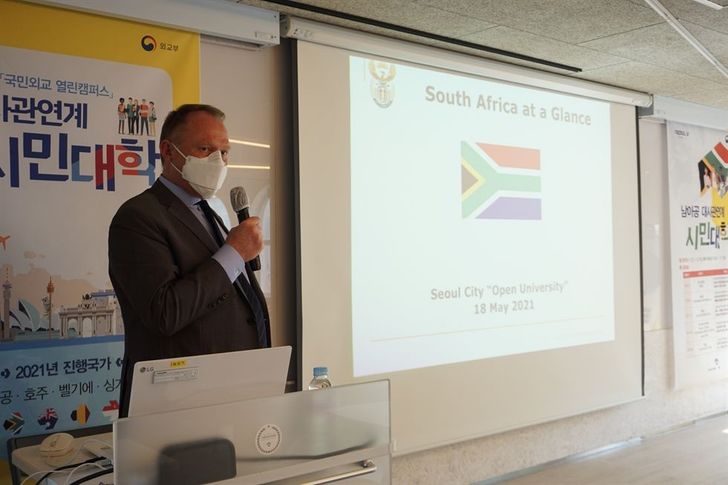
Gert J. du Preez, an official from the South African Embassy Seoul, talks to participants of the program by Seoul Open City University in May 2021. Courtesy of Seoul Open City University
Italian Ambassador to Korea Federico Failla joins the program in its second week and will talk about the country's current domestic situations and its pressing international issues. The country's space technologies, not well-known to Koreans but worth noting ― the country has launched the world's third highest number of satellites into space ― will also be introduced by the ambassador.
A senior official from the Western Europe Division of European Affairs Bureau under the foreign affairs ministry will talk about Italy's current international status and the present and the future of Italy's diplomatic relations with Korea.
Seoul Open City University has planned the classes for Italy to be carried out online. But they expect that if they manage to have at least one class offline thanks to the country's eased quarantine regulations, they will arrange a tour to the Italian Embassy in Seoul's Yongsan District.
“The program with ambassadors in Korea is an outcome of Seoul city's superb infrastructure,” Lee Kyung-ah, who heads the program this year, told The Korea Times. “I expect the program will raise participating students' awareness on different countries and encourage them to develop the mindset of global citizens.”
The program selected embassies of Saudi Arabia and Mexico this year because they both mark their 60th anniversary of forming diplomatic ties with Korea, according to Lee. China also marks its 30th anniversary of bilateral ties this year.
The Minstry of Foreign Affairs is responsible for selecting the embassies that join the program. When making an offer to embassies to join the program (four embassies per year), it prioritizes embassies representing countries that have a significant number of years of diplomatic relations with Korea.
The Australian embassy in Korea joined the program in 2021 when the two countries' bilateral ties marked their 60th anniversary. Embassies representing countries that were highly requested by participating students were also considered for the program.
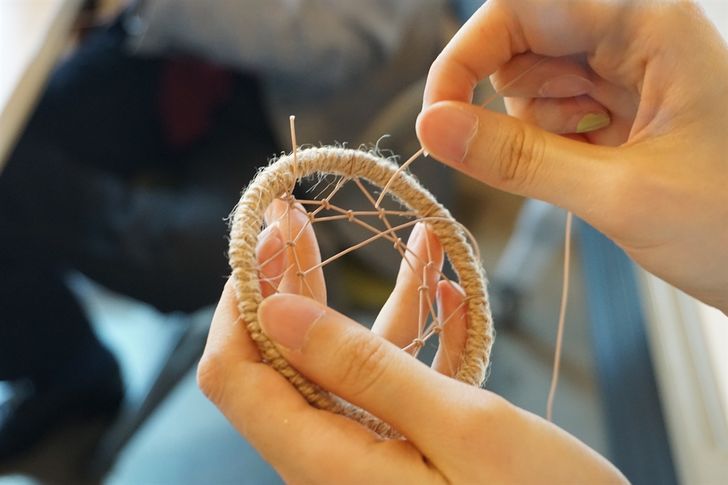
One of the participating students of Seoul Open City University's program led by the South African Embassy Seoul makes a traditional "dream catcher" in May 2021. Courtesy of Seoul Open City University
The program made its start in 2019 but following COVID's arrival in 2020, the classes could no longer be held in the embassies due to the country's quarantine measures. Kim Jong-sun, Executive Director of Planning and Coordination Department under Seoul Open City University, headed the program from 2019 until 2021. She said attending the program offline and online feels “quite different.”
“When classes were offered offline, we visited embassies and toured the place and met the ambassadors in person,” Kim told the Korea Times. “The experiences were so much more fun for the participants. And they appreciated the program's unique merits.”
Participants liked the program because they could learn more about the countries beyond the level of merely experiencing them as a tourist. “They liked in-depth studies about the countries under various different categories,” Kim said.
The program began from a coincidence involving several parties that later became the business' major stakeholders. In 2018, when Seoul Open City University opened its branch in Seoul's Seodaemun District, the Embassy of Switzerland was being built nearby. Kim thought her new school branch and the embassy could come up with something wonderful together.
Her idea came around the time when the Ministry of Foreign Affairs introduced its People Diplomacy Center, which promoted civic programs for those interested in learning about international relations. While Kim was looking to introduce a new program for her school beyond the traditional content focused largely on humanities subjects and practical activities, the diplomacy center was also looking for ways to connect members of the public with diplomatic institutes and related personnel.
Kim and the center's president discussed their common interests. It led to the Seoul Metropolitan Government and the Ministry of Foreign Affairs signing an agreement to introducing the program involving embassies in Korea.
“The Swiss embassy then gladly accepted our proposal to join the program,” Kim said. The Swiss embassy joined the program in 2020 along with Russia, Egypt and Malaysia. In previous year, the program was joined by Vietnam, Brazil, Denmark and the United States. South Africa, Australia, Singapore and the Netherlands joined the program the following year.