Indian ambassador shares insights at Incheon Global Campus

Sripriya Ranganathan, ambassador of India to Korea, gives a lecture titled "Life of a Career Diplomat" at the Incheon Global Campus, Thursday. Korea Times photo by Ahn Seong-jin
By Kwon Mee-yoo
Ambassador of India to Korea Sripriya Ranganathan shared her thoughts on diplomacy and Korea-India relations at a lecture program co-organized by the Incheon Global Campus Foundation and The Korea Times, Dec. 9.
"As a national project established by the Korean government and Incheon city, the Incheon Global Campus is growing as a pioneering educational model of a shared campus of foreign universities, the Korea's first to nurture the next generation of global leaders," Yu Pyung-ryun, CEO of the Incheon Global Campus Foundation, said in welcoming remarks.
The Incheon Global Campus (IGC) is a shared campus for extended branches of prestigious global universities, located in Incheon's Songdo. Currently, the IGC is home to five universities ― State University of New York (SUNY) Korea Stony Brook, SUNY Korea Fashion Institute of Technology (FIT), George Mason University Korea, Ghent University Global Campus and University of Utah Asia Campus ― as well as the Stanford Center, Stanford University's research center.
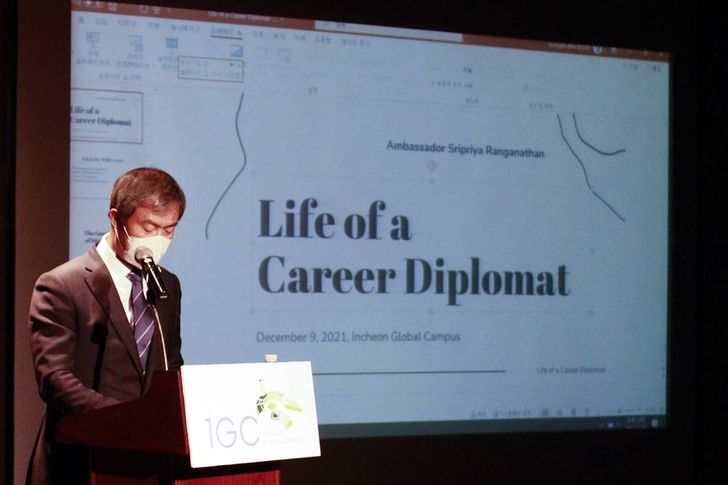
Incheon Global Campus Foundation CEO Yu Pyung-ryun gives welcoming remarks ahead of Indian Ambassador to Korea Sripriya Ranganathan's special lecture at the Incheon Global Campus, Thursday. Korea Times photo by Ahn Seong-jin
Due to the recent spread of the Omicron variant, the special lecture was presented in an online-offline hybrid format.
"I wish I could have seen some of the young students of the universities in person, because I think the life and the vibrancy of a campus comes from the students. But this is the world that we live in today, where we have to make the most of our television and computer screens," the ambassador said, hoping to connect with the students both online and offline.
The ambassador's lecture, titled "Life of a Career Diplomat," covered the conventions and language of diplomacy as well as the structure of the diplomatic community based on Ranganathan's experiences.
Among definitions of diplomacy, the ambassador picked a quote that best matches her beliefs.
"The one that I really love and what I swear by, I would say not only in my professional life, but also in my personal life, is 'Diplomacy is the art of letting someone else have your way.' And that's, I think, the cutest way of describing diplomacy that I know," Ranganathan said.
The ambassador also explained why the conventions through which diplomats and governments address each other focus on courtesy, politeness and niceties.
"The bluntest of messages are couched in very formal and polite language ... There are prescribed conventions that we use ― we present our compliments and we assure each other of our highest consideration at all times. And these are even for very mundane matters, like scheduling or just conveying a change in policy,” she said.
"But these are useful in the sense that they are ways in which sometimes the difficult messages that have to be conveyed, and we are required to convey these messages, both verbally and officially in writing. So these are ways of softening the blow so to speak."
Then she moved on to the fundamental role and responsibility of diplomats ― negotiations.
"What we try to do in the process of negotiations is really to narrow the differences to the maximum extent possible, to try and understand what is comfortable, agreeable or acceptable at the very least to the other side and at least get on to that level so that you're able to build on that platform and ultimately reach an outcome which is of value and is meaningful to the stakeholders on both sides.”
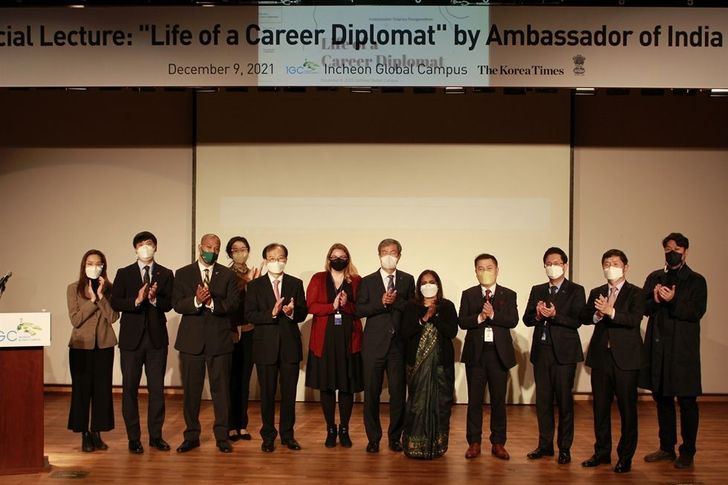
Indian Ambassador to Korea Sripriya Ranganathan, fifth from right, The Korea Times President-Publisher Oh Young-jin, second from right, and Incheon Global Campus Foundation CEO Yoo Byung-yoon, sixth from right, pose with other dignitaries ahead of the ambassador's special lecture at the Incheon Global Campus, Thursday. Korea Times photo by Ahn Seong-jin
The ambassador added that personalities matter in the field of negotiations as the world of diplomacy is also comprised of human beings.
"I really have seen in a very, very tangible sense, the difference that the personal chemistry between two people can make, the difference that the personal chemistry between two negotiators can make and the difference that the lack of chemistry can also make," she said.
"So when all these things come together in one place that is when we have outcomes that are long-lasting and meaningful. And that is why, again, as diplomats we take so much of time to cultivate our networks, cultivate our relationships, cultivate our friendship, because we understand very clearly that we can pave the way and we can make it possible for very impactful agreements and decisions to be reached, which would otherwise not even have been within the realm of being grasped."
Having served in Korea for more than three and a half years now, Ambassador Ranganathan understands the importance of public opinion.
"I've seen the vibrancy of the public debate on all the government policies, including your policies pertaining to your neighbors, to the relationships with the big powers, the issues that you're grappling with on the multilateral arena. Therefore managing public opinion or informing and securing public support for what you do is, I would say, as integral part of diplomacy as your engagement with a foreign partner," she said.
After the ambassador's talk, participating students avidly threw questions on the ambassadorship as well as Korea-India relations.
"I really found that (being an ambassador) is an amazing journey, it is just an enriching journey, it is a challenging journey," she said.
"Everywhere I've gone, I've always come back to at least two or three new things that we can explore and that we can try. Some of them have succeeded, some of them have not. There is constant ideation and there is constant opportunity for us to think outside the box and do something which could serve in some manner to bring the people of both countries closer together."