Moon, Yoon to seek compromise Monday at first meeting after election

On left, President-elect Yoon Suk-yeol talks to journalists at a makeshift press room set up in a tent near his temporary office in Tongui-dong, Seoul's Jongno District, March 24. On right, President Moon Jae-in bangs the gavel to start the cabinet meeting at Cheong Wa Dae on March 22. Korea Times
President-elect set to upend most of Moon's key policies
By Ko Dong-hwan
President Moon Jae-in and President-elect Yoon Suk-yeol will finally hold their long-delayed first meeting at 6 p.m. on Monday, according to their offices, hoping to achieve a smooth transfer of power after clashing over both personnel appointments and other issues.
The dinner meeting will take place 19 days after Moon's former prosecutor general was elected as his successor on March 9, which is the largest number of days ever taken for a president-elect to meet an incumbent president in Korean history.
Cheong Wa Dae's Chief of Staff You Young-min and Yoon's Chief of Staff Rep. Chang Je-won will accompany the two men at the dinner.
Moon has been trying to invite Yoon to Cheong Wa Dae for a casual meeting at the earliest possible date. But Yoon, who considered the meeting to be more strategic than casual, has been delaying it, saying that the terms of agreement to be discussed at the meeting had not been reached in advance. But Yoon gave in to Moon's invitation on Saturday evening, agreeing to converse freely instead of having strategic talks.
It is expected that the meeting, though toned down from any official purpose, will inevitably see the two to share words at least over the process and cost of Yoon's adamant plans to move the presidential office and residence to the Ministry of National Defense's headquarters in Yongsan and possibly a pardon for imprisoned former President Lee Myung-bak.
Following the meeting, Yoon is expected to push to change the key national policies of the Moon administration, including real estate and nuclear power policies. The presidential transition committee, which has been brainstorming the new administration's roadmap in Yoon's favor in seven different groups, has been briefing Yoon on which policies the new government should pursue. In those group meetings, which have been conducted since March 22, most of the suggested policies seek to drastically change existing policies put in place by the Moon administration.
Yoon said that the committee will announce the new policies in early May. His inauguration takes place on May 10.
The Ministry of Strategy and Finance briefed Yoon and proposed dropping Moon's main economic tools to incentivize consumers and regional economies by using local vouchers, coupons and other measures that were part of the outgoing leader's “Korean New Deal” framework. The country should also rely on private enterprises more firmly to influence national economic policies rather than the government fostering innovative growth and financial soundness, the ministry has proposed.
The Financial Services Commission suggested that Yoon allow people to borrow more money from banks than what was allowed at the end of the Moon administration by mitigating the loan-to-value (LTV) ratio and adjusting the debt service ratio (DSR).
In discussing the country's behemoth real estate issues laid out in a report by the Ministry of Land, Infrastructure and Transport, Yoon took particular interest, expressing his intent to “manage it myself.” Reintroducing the pledge he had made as a presidential candidate to build 2.5 million new homes nationwide, he ordered new guidelines to increase the number of available homes, mitigate regulations for owners of multiple properties, and expand the land available to build new homes.
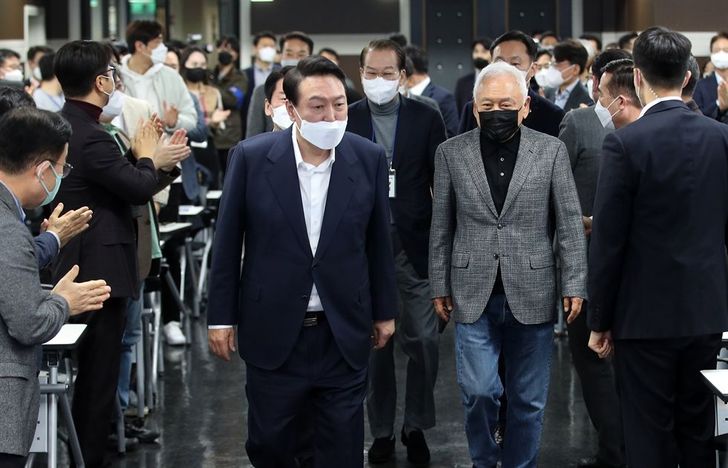
Yoon arrives at a conference hall inside Seoul Startup Hub in Seoul's Mapo District, March 26, to attend the Presidential Transition Committee's workshop. Right to Yoon is Kim Han-gil, who leads the national unity committee inside the transition committee. Newsis
Yoon's new government is also anticipated to revive the use of nuclear power plants, which, under the Moon administration, were to be gradually replaced with renewable energy in order to fight climate change. Yoon wants to resume the suspended construction of the Shin Hanul nuclear power reactors No. 3 and No. 4, and believes that the country's nuclear power generation must pick up speed, which he ordered in a meeting with the Ministry of Trade, Industry and Energy and the Nuclear Safety and Security Commission. The ministry said they will “completely reorganize the country's nuclear power policies” under the Yoon administration.
Abolishing the Ministry of Gender Equality and Family, a pledge that had earned him the support of young males along with a major backlash from female voters, still remains on Yoon's agenda.
“I think the ministry is done with,” Yoon said after being elected. The transition committee said that they will review what the ministry's is responsible for and redistribute this list to different ministries.
The Serious Accidents Punishment Act, introduced in last January to hold employers responsible for safety accidents in the workplace, is also under review after Yoon's meeting with the Ministry of Employment and Labor. Although Korea has one of the lowest industrial accident rates in the OECD, complaints against the act have been stirred up by leaders of the country's private business groups who, in their meeting with Yoon on March 21, bucked the law and demanded it be repealed.
Behind this full-throttle reshuffle of policies and positions, there are Yoon's two keywords that he revealed during a workshop for the transition committee on March 26. In the first workshop held for the committee, he said that to smoothly take over the work from the incumbent government and launch a new one, the most important things are “pragmatism and the interests of our people.”
“The two objectives we must remember in this workshop: the economy is important, and the incoming government has the responsibility to further advance and update our industrial structure,” Yoon said during the three-hour workshop held in Seoul's Mapo District. He told the 200-odd committee members who were participating in the workshop to ponder the reasons behind the incumbent government's policies that went wrong, as well as which policies they should accept from the incumbent government and continue in the new government.
Transition committee Chairman Ahn Cheol-soo, who also joined the workshop, instructed the members to “take new roads unchartered by the previous governments for the sake our people.” He also told them to “look at the forest instead of a tree” when designing state policies.
Before his meeting with Moon, Yoon announced, Sunday, that he will send a team of representatives to the United States to discuss bipartisan diplomacy. The team is to meet the U.S. federal government, chambers of the Congress and think tank agencies to discuss the Seoul-Washington alliance, North Korea and pending affairs in economy and security in the East Asia.
Led by People Power Party lawmaker Park Jin, the team will consist of five experts. The team will depart, according to Yoon's spokesperson Kim Eun-hye, as soon as possible.