Future of K-pop: Will it follow in taekwondo's successful global footsteps?

All-Japanese K-pop girl group NiziU / Courtesy of JYP Entertainment
K-pop producers hope to export knowledge and skills ― just like Korean taekwondo coaches once hoped and did
By Dong Sun-hwa
Taekwondo originated in Korea, but it is no longer a sport only for Koreans. Today, it is practiced by tens of millions of athletes across the globe, with many non-Korean players etching their names into history by winning big at major sporting events. At the Tokyo Olympics earlier this year, Panipak Wongpattanakit from Thailand bagged the country's only gold medal in the women's 49-kilogram category, while Uzbekistan's Ulugbek Rashitov claimed gold in the men's 68-kilogram competition.
The athletes undoubtedly dedicated their blood, sweat and tears to pull off these feats. But behind their success were pillars like Choi Young-seok and Kim Jin-young, the Korean coaches who headed for Thailand and Uzbekistan, respectively, to train the young people there using the recipe for success they learned from taekwondo's birthplace.
All this drops a hint about the future of K-pop, according to experts. As K-pop revs up its global presence, Korean producers are keen to export their knowledge, techniques and effective systems, which music labels in other countries can utilize to write their own success stories.

Thai taekwondo athlete Panipak Wongpattanakit, right, and her Korean coach Choi Young-seok / Yonhap
“In the near future, Korean producers will simply sell their 'recipes' to create a new group and make licensing revenues, maybe even without going abroad,” Kim Jin-woo, head researcher at Gaon Chart, told The Korea Times. Produced by the Korea Music Content Association, Gaon is one of Korea's most trustworthy album and streaming charts.
“We are highly likely to witness a mushrooming of different local groups made in different countries, which have a touch of K-pop,” he said.
This phenomenon, he says, can be thought of as the fourth stage of K-pop's globalization. According to his theory, in the first stage, the majority of K-pop groups did not include foreign members.
“These acts of the late 1990s first set their sights on the domestic industry and then gradually made forays into overseas markets,” he said. “In the second stage of globalization, K-pop companies began recruiting foreign members who could captivate the fans of their home countries. And right now, we are in the third phase where Korean producers travel to different countries to debut local K-pop acts, as evidenced by the case of NiziU, an all-Japanese K-pop girl band launched by Park Jin-young, founder of Korean record label JYP Entertainment, in partnership with Japan's Sony Music Entertainment. But as I said earlier, the trend will evolve further and these producers will merely export their knowledge without producing the groups firsthand.”
Lee Gyu-tag, a professor of cultural anthropology at George Mason University Korea, believes this might bring up identity questions about K-pop.
“Whether NiziU is a K-pop group has been a hotly debated issue,” Lee said. “The arrival of more K-pop-inspired local groups is likely to challenge the existing notions on K-pop, prompting people to redefine the genre. However, in Korea, the demographic cliff will make it inevitable for Korean labels to add more foreign members because the country will have a smaller pool of idol trainees.”
But K-pop, which is often characterized by its emphasis on choreography and blending of assorted genres, should still keep its unique edges, says Edward Leary, managing editor at U.S. media outlet KpopStarz.
“K-pop can evolve and grow, but to take away the essential parts of what makes K-pop the hugely popular genre it is today could do more harm to the image than good,” Leary noted. “It risks becoming inauthentic and saturated.”
'Target Billboard charts first'
Surviving in the competitive K-pop industry is not a piece of cake, to say the least ― and the competition has been intensifying in recent years in what many see as an oversaturated market. Every year, around 50 to 100 groups are known to debut.
Jeff Benjamin, a K-pop columnist at Billboard, pointed out that this oversaturation partly stems from a lack of unique strategies and guerrilla tactics.
“In the K-pop universe, the same strategies are being used over and over,” he said. “It has become so tiresome and is ultimately not helping any of the artists in the larger picture. I think teaming with the right partners may be a larger upfront cost for companies, but one that will pay for itself eventually. K-pop singers may also refer to the cases of some artists in the Latin and hip-hop spaces, who use very unique strategies to help their music break, whether that is with social media, streaming or the teams they create.”
Nonetheless, many companies still believe that there are good odds of winning the jackpot, if they can launch groups that appeal to global audiences. Statistically speaking, this is not a vain hope.
According to Gaon Chart, the sales of the 400 most popular K-pop albums around the world has recorded a steady jump since 2015. In 2015, 8.4 million albums were sold, but it almost tripled to 24.6 million in 2019. This year, more than 54.6 million copies were sold from January to November ― nearly a two-fold increase from 2019 ― and 60 percent of the sales came from abroad.
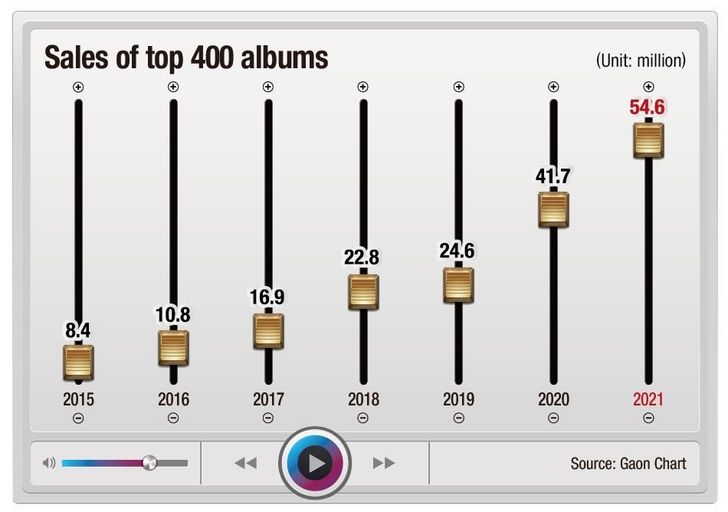
“This is a testament to the expansion of K-pop's global fan bases,” researcher Kim explained. “K-pop lovers not only buy the latest albums of their favorite stars, but also their old albums to walk down memory lane. This is what we call backward spillovers… Many people point out that Korean music market is oversaturated, but it looks like there is a niche in the international markets.”
He advised K-pop newcomers to target the Billboard charts first, explaining why it has become easier for them to rule the American charts.
“The size of the physical album market in the U.S. has shrunk over the years, with most people flocking to streaming platforms,” he said. “This implies that the entry barrier to the Billboard's main albums chart has become lower for K-pop stars. In fact, last year, the total number of physical album sales in Korea was 42 million, but in the U.S., it was around 31 million. This means that topping the Billboard 200 albums chart is not as demanding as it was in the past. Once K-pop stars succeed in making some accomplishments in the U.S., they will also be able to achieve a halo effect in Korea.”
Kim pointed to K-pop octet ATEEZ as a good example.

K-pop boy group ATEEZ / Courtesy of KQ Entertainment
“The eight-piece act first amassed international fans and then carved out its presence in Korea by collaborating with well-known singer Kim Jong-kook. This was a smart marketing playbook to serve two ends. In the future, I think many girl groups will also attempt to go global first and then return to the Korean market.”
Echoing this sentiment, professor Lee added that K-pop's global ascension has leveled the playing field for singers belonging to small management companies.
“In the past, when all singers were competing in the domestic market, those from small companies could not gain enough of a foothold to establish themselves, as most platforms were dominated by major labels. But today, thanks to the rise of global platforms like YouTube and Twitter, they can still build their fan bases outside Korea.”
But they should take a more cautious approach when targeting international markets, Leary says.
“K-pop stars often visit various countries without knowing their languages, cultural differences and safety protocols well enough,” he pointed out. “Money is often the first or only thing being considered. But K-pop companies can do more to prepare singers on stage who will speak and engage with the new market. A better impression will lead to a future of more success and better fan engagement. One way is to learn about negative words or gestures that could be offensive in one country, so incidents such as when B1A4 visited Indonesia in 2015 and hugged Muslim fans ― a big no-no for their religion ― can be avoided.”
Rise of singer-songwriters, more engagement with virtual reality
There is one more thing that K-pop lovers are likely to witness in days to come ― the rise of singer-songwriters.
“We will be able to come across as having more diversity of music styles, as K-pop singers become more hands-on with their music,” Lee said. “These days, a legion of stars are already raising their voices through their music… So I think more singer-songwriters are likely to gain global traction in the days ahead.”
The roles of cutting-edge technologies, such as virtual reality (VR) and artificial intelligence (AI) are likely to further expand, too. In fact, the protracted COVID-19 pandemic has triggered the K-pop industry to dive into the VR realm, where singers can interact with their followers without meeting face-to-face. Online concerts equipped with advanced media technology are only one such example.

Members of K-pop girl group aespa and their virtual avatars / Courtesy of SM Entertainment
“Girl group aespa ― which consists of four human members and their digital avatars ― gives us an exciting insight into how K-pop can become even more multidimensional with their avatars and larger metaverse concept,” Benjamin said. “Numerous K-pop acts currently utilize some type of animated or cartoon characters ― such as BTS's BT21, TWICE's Lovelys and TREASURE's TRUZ ― but maybe moving ahead, we will see entirely digital ways of utilizing their artists in ways that go beyond what the artist can do in-person.”
Leary elaborated, “With the lead of virtual concerts paving a new form of how we consume entertainment, it is not impossible to already imagine virtual idols being the only ones left on the stage. The need for human interactions and genuine attraction will prevent total AI domination, but virtual groups like ETERNITY and concerts held by famous Japanese Vocaloid idol Hatsune Miku propel the idea one step closer to being a reality.”