Works of world's most influential masters fill Korean galleries

Henri Matisse's “Etude pour la Vierge, Tete voilee” (1950-51) / Courtesy of Succession H. Matisse / Life and Joy
By Park Han-sol
The end of 2021 has become an exciting time for art enthusiasts across Korea. Works of some of the most influential creators of the 20th century ― Henri Matisse, Salvador Dali and Roy Lichtenstein, among others ― have begun to fill Seoul's galleries, with many being the artists' first or largest retrospectives to date in the country.
At the Hangaram Art Museum of the Seoul Arts Center, “Henri Matisse: Life and Joy” presents over 200 original works of the pioneering French painter and sculptor who revolutionized 20th century visual arts, along with Pablo Picasso.
As his largest retrospective in Korea, the show features Matisse's drawings, prints, illustrations and books that explore his oeuvre beyond the early label as a leader of Fauvism ― an avant-garde movement in the early 1900s that strove to break away from Impressionism with bold brushstrokes and strong colors.
While he was an “alchemist of lines” with his simple yet expressive usage of curves in drawings and etchings, the artist also worked in the field of graphic design and even experimented with paper cut-outs, especially during the final decade of his life. His artistic influence continues to reach contemporary masters like David Hockney.
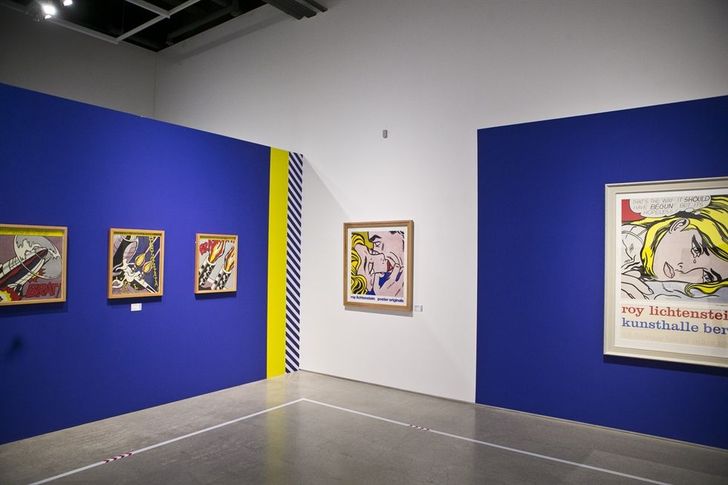
Installation view of “Roy Lichtenstein: The Scent of Tears” exhibition at Seoul Forest Art Center in Seongdong District, eastern Seoul / Courtesy of Made in View
A peek into pop art icon Lichtenstein, whose style is defined by visual appropriation and parody, is offered at Seoul Forest Art Center's “Roy Lichtenstein: The Scent of Tears,” Seoul's largest retrospective of the prominent creator.
On view are his hallmark pieces like “Hopeless,” “Whaam!” and “Kiss V” that enlarged and exaggerated Ben-Day dots to reproduce the scenes from comic strips featuring themes of war, materialism and love.
But the topic of his parody extended beyond comics, especially during the early 1960s, as he reproduced masterpieces by Picasso, Mondrian, Monet and Van Gogh. In reference to these works, the artist once said, “The things I have apparently parodied I actually admire” ― viewing pre-existing content as an ingredient for his tongue-in-cheek recreation.
Another king of American pop art, Andy Warhol, has become the center of focus at two separate shows, specifically through his lesser-known pieces that nevertheless remain important in understanding the artist.
“Andy Warhol” at the Page Gallery in eastern Seoul brings in the artist's early drawings and illustrations that ultimately laid the groundwork for his aesthetics and thematic concerns. On display are works featuring blotted line techniques, a combination of drawing with basic printmaking developed by Warhol during his time as an advertising illustrator, as well as his 1950s sketches of young male bodies.
Espace Louis Vuitton Seoul's “Andy Warhol: Looking for Andy” features silkscreen prints and Polaroid self-portraits produced from the late 1960s to the 1980s as he created persona after persona for himself.
Other notable exhibits include “Salvador Dali: Imagination & Reality” at Dongdaemun Design Plaza, Korea's largest retrospective of the eclectic Surrealist master; and My Art Museum's “Chagall and the Bible,” which brings to light the modernist painter's biblical and Jewish motifs through more than 220 original artworks.
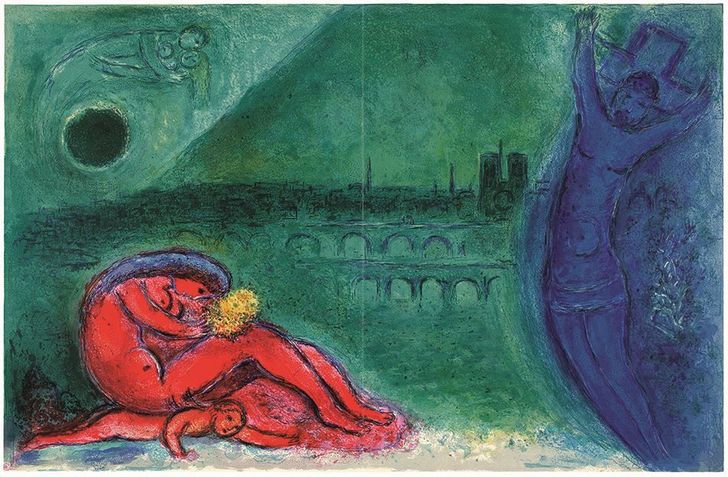
Marc Chagall's “Quai de la Tournelle, from Regards sur Paris” (1960) / Courtesy of Marc Chagall / ADAGP, Paris ― SACK, Seoul, 2021