Businesspeople and experts in Korea, Africa discuss cooperation

Participants in the 4th Seoul Dialogue on Africa, hosted by the Korea-Africa Foundation, pose for a photo at a hotel in Seoul during the event, Dec. 10. Courtesy of the Korea-Africa Foundation
By Lee Hyo-jin
Businesspeople and experts from various fields in Korea and African countries discussed ways to boost economic, cultural and academic cooperation in a series of forums hosted by the Korea-Africa Foundation (KAF).
The KAF is an affiliate of the Ministry of Foreign Affairs that aims to promote partnerships with African countries.
As a part of its efforts, the foundation held the Korea-Africa Business Forum on Dec. 9, followed by the Seoul Dialogue on Africa (SDA), Dec. 10, attended by experts, government representatives, academics and participants from the private sector. The forums were held in a hybrid online-offline format with the speakers from Africa participating online due to the COVID-19 pandemic.
The business forum provided participants with an understanding of the African Continental Free Trade Area (AfCFTA), a trade pact that commenced Jan. 1, as well as information on the changing market situation in African countries.
The forum kicked off with an opening speech by Lyeo Woon-ki, president of the KAF, who said, “The African continent is a young continent with high potential, shown by the growing number of investments for startup companies there, despite the coronavirus pandemic.
“I hope this forum will serve as an opportunity for policymakers and businesspeople to come up with new strategies for economic ties between Korea and African countries in the rapidly changing international environment,” he added.
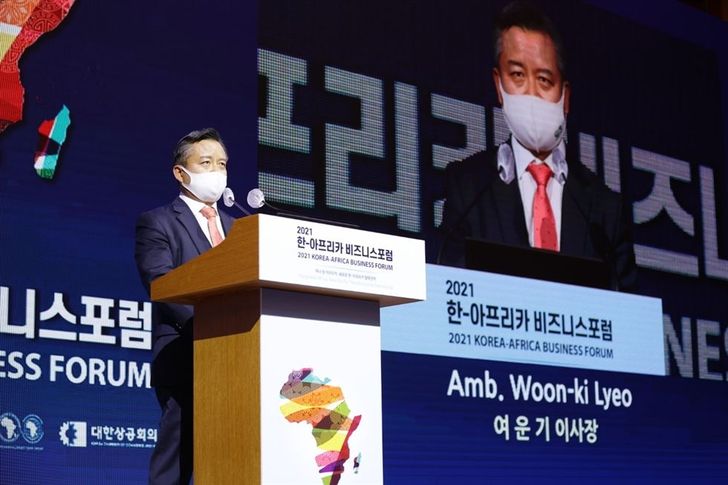
Lyeo Woon-ki, the president of the Korea-Africa Foundation, delivers an opening speech during the Korea-Africa Business Forum at a hotel in Seoul, Dec. 9. Courtesy of the Korea-Africa Foundation
It was followed by a welcome speech by Choi Jong-moon, the second vice minister of foreign affairs, who emphasized the need to strengthen Korea-Africa cooperation in various fields, including climate change and the healthcare sector in overcoming the COVID-19 crisis.
Albert M. Muchanga, the African Union commissioner for economic development, trade, industry and mining, noted that the implementation of the AfCFTA should lead to the promotion of investment in African countries, which should accelerate cooperation in many areas, including inter-Africa trade, along with global trade with other countries.
The SDA, which aims to facilitate the strategic partnership between the two sides, was held under the theme, “Rethinking Solidarity: Korea-Africa Partnership in the Interconnectivity Era.” It was the fourth such event since the program was launched in 2018.
The opening ceremony was attended by prominent figures, including Ban Ki-moon, former U.N. secretary-general and chairman of the Ban Ki-moon Foundation for a Better Future, First Vice Foreign Minister Choi Jong-kun, Ambassador of Gabon to Korea Carlos Victor Boungou and Rep. Shin Hyung-young of the ruling Democratic Party of Korea.
In his opening remarks, KAF President Lyeo said, “I hope this event will serve as a useful forum in discussing ways to respond jointly to common challenges facing Korea and Africa.”
This was followed by a keynote speech by Ban, who said, “Global interdependence is increasing in various fields including healthcare, environment, security and trade. We should put more efforts into tackling these problems through multilateral cooperation between Korea and African countries.”
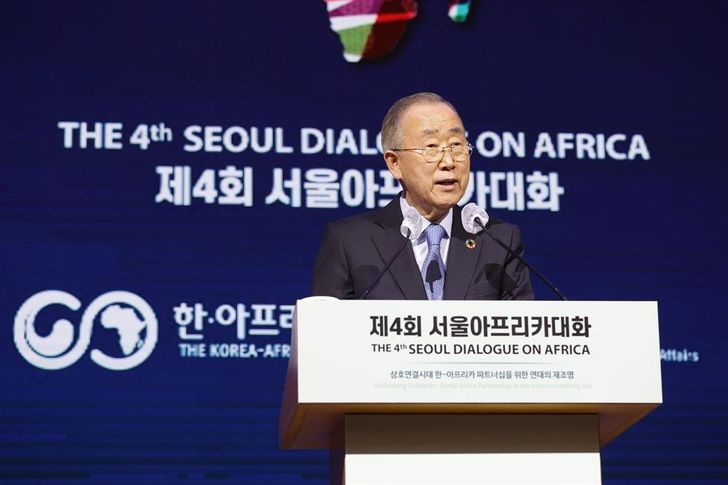
Ban Ki-moon, the former U.N. secretary-general, delivers a keynote speech during the 4th Seoul Dialogue on Africa, hosted by the Korea-Africa Foundation at a hotel in Seoul, Dec. 10. Courtesy of the Korea-Africa Foundation
The first session kicked off with a presentation from Ahmed Ogwell Ouma, the deputy director of the Africa Centres for Disease Control and Prevention (Africa CDC).
Explaining that the African region is facing an increasing burden of infectious diseases, including COVID-19, due to population growth and accelerated urbanization, he said that the Africa CDC will focus more on strengthening continent-level healthcare governance and expanding professional manpower in the field.
Other panelists of the session included Kim Eun-mi, a technical officer of the World Health Organization; Fred Binka, a professor of clinical epidemiology at the University of Health and Allied Sciences in Ghana; and Kim Eok, secretary-general of the Africa Future Foundation.
The second session focused on “Climate Change Adaptation, Peace and Security in the Interconnectivity Era.”
Andrew Herrup, the minister-counsellor for economic affairs at the U.S. Embassy, analyzed the impact of the U.S.' climate initiative on the African region and suggested the possibility of cooperation with Korea, while Lim Gi-dae, director of the African Studies Center at the Busan University of Foreign Studies, stressed the need for a swift response to climate change in order to prevent conflicts in the Sahel region