Umbrella union's planned strike meets criticism

This photo shows posters on display at Sungkyunkwan University's Seoul campus, put up by the New National Council of Student Representatives and a coalition of self-employed individuals, criticizing the planned strike of the Korea Confederation of Trade Unions. Courtesy of the New National Council of Student Representatives
By Lee Hyo-jin
Criticism is growing against a major umbrella union here over its plan to stage a mass rally on Wednesday, prompting fears over a possible virus resurgence that could disrupt the country's path towards a “Living with COVID-19” scheme.
A group representing conservative college students and a coalition of self-employed individuals across the country have put up banners at around 100 university campuses that criticize a demonstration being organized by the Korea Confederation of Trade Unions (KCTU).
The KCTU plans to launch the walkout to demand the improvement of working conditions for irregular workers, a minimum wage hike and revisions to labor laws, despite the government's repeated warnings that it will be in violation of the social distancing measures to manage the spread of the coronavirus.
“The KCTU says that it will hold a general strike involving 550,000 participants in downtown Seoul at this point of time when many people across the country are struggling due to the prolonged social distancing rules,” read the poster created by the New National Council of Student Representatives (NCSR), which is named after a different student activist group that was active from 1987 to 1993.
The NCSR argued that the union, with its 1.1 million members, has “established itself as an undisputed political power,” which goes beyond its role of fighting for the improvement of labor rights and working conditions.
“We plan to file a police report if they push ahead with the strike on Wednesday, and hold a press conference in front of the KCTU office building,” NCSR head Kim Tae-il, a student at Hankuk University of Foreign Studies, told The Korea Times.
The group of self-employed individuals denounced the union's planned action, expressing concerns over a possible virus resurgence that may disrupt the government's plan gradually to return to normalcy.
“We are looking forward to the beginning of the living with COVID-19 policy in November, which has been achieved through the people's efforts and the sacrifice of medical workers, along with the self-employed,” it said in a statement.
“But the KCTU is threatening public safety with its general strike, ignoring the hopes of 7 million small business owners.”
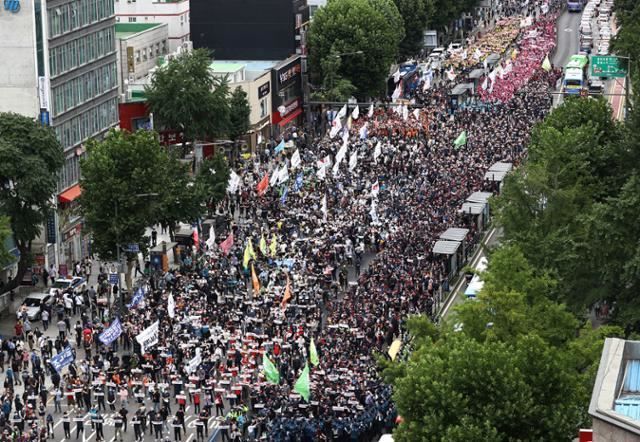
Members of the Korean Confederation of Trade Unions held a mass rally in central Seoul on July 3, demanding law revisions to improve working conditions for irregular workers, a minimum wage hike and safer working conditions. Yonhap
The government, for its part, has urged the KCTU to refrain from the holding the rally.
“We ask the leaders of the unions to cancel the rally for the safety of the public. If held, it may lead to cluster infections, which will inevitably cause delays to the country's path to returning to normalcy,” Prime Minister Kim Boo-kyum said, Oct. 15.
He warned that if the KCTU launches the walkout, the government will respond to the full extent of the laws.
This rally is not the first time the union has pushed ahead with organizing major rally during the pandemic and amidst stringent social distancing measures.
It held a mass rally on July 3 calling for the improvement of labor rights, where around 5,000 members of the union gathered in central Seoul's Jongno District in violation of the social distancing measures. Three KCTU members tested positive for COVID-19 about two weeks after the July 3 rally.
Yang Kyung-soo, head of the KCTU, was arrested on Sept. 2 on charges of violating the Assembly and Demonstration Act and the Infectious Disease Control and Prevention Act.
Shortly after Yang's arrest, the union said in a statement that it would take strong actions against what it claimed was an “unjust arrest,” with a full-scale strike in October.