'Fake news' laws only in 'authoritarian countries:' International Press Institute

Rep. Choi Hyung-du of the conservative main opposition People Power Party (PPP) speaks during a press conference held by seven media organizations in front of the main building of the National Assembly, Aug. 30, to protest the ruling party's push to revise a law to allow punitive damages against media outlets or reporters allegedly producing "fake news." The organizations view the bill as an attempt to prevent reports critical of those with political and economic power. Yonhap
'Media reform bill should be completely withdrawn'
By Jung Da-min
The International Press Institute (IPI), a global network of editors, executives and journalists dedicated to the protection and promotion of media freedom, has called for the withdrawal of a bill being pushed by the liberal ruling Democratic Party of Korea (DPK) to punish media outlets producing alleged “fake news,” noting that many such laws are promulgated in “authoritarian countries.”
“In recent years, there has been a rapid growth of so-called fake news laws around the world. Many of these laws have been passed in authoritarian countries,” Scott Griffen, deputy director of the IPI, said in a recent email interview with The Korea Times

International Press Institute Deputy Director Scott Griffen / From website of the International Press Institute
“These laws are extremely problematic for freedom of the press, as vague concepts like fake news can easily be abused to censor critical media coverage. We urge democratic countries like South Korea not to join this trend.”
Concerns surrounding the DPK's revision bill to the Act on Press Arbitration have been rising at home and abroad. The bill is aimed at imposing punitive damages against media outlets or reporters allegedly producing “fake news.” The amount of compensation claimed can be up to fivefold the financial damage allegedly suffered by the person from the “false coverage.”
Despite criticism from the conservative opposition bloc, media organizations and civic groups that the new regulation could infringe on freedom of expression and opinion, the DPK has sought to pass the bill using its supermajority in the National Assembly.
The National Assembly Culture, Sports and Tourism Committee endorsed the bill Aug. 19, followed by the Legislation and Judiciary Committee in the early morning of Aug. 25 (both committees are dominated by DPK members). The ruling party then attempted to have the bill approved at a plenary session later in the day, but the session was delayed to Aug. 30 following a procedural problem. The DPK and the main opposition People Power Party (PPP) then agreed to delay the vote on the bill to Sept. 27, and until that time, review it by forming an eight-member consultative body composed of lawmakers and media experts.
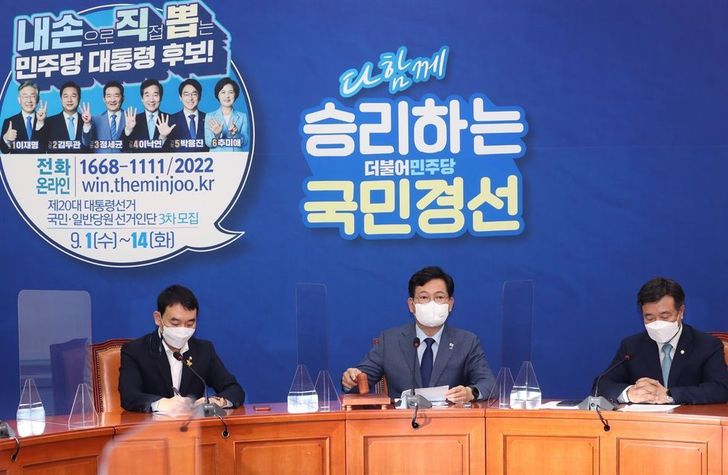
Liberal ruling Democratic Party of Korea Chairman Rep. Song Young-gil, center, convenes a Supreme Council meeting of the party at the National Assembly on Yeouido, Monday. Joint Press Corps
The IPI and other press organizations that are concerned over the content of the bill as well as the procedural issues, said that it was appropriate for the Assembly to delay the vote. They also requested much of the bill's content to be changed.
“This was a very problematic bill that should not be rushed through the legislative process. In its current form, the bill should be completely withdrawn,” Griffen said. “It is essential that any changes to existing legislation take fully into account the views and concerns of media outlets and journalist associations. The role of the consultative body, which should be comprised of independent experts, is to ensure that this proposed legislation does not infringe on freedom of expression and that it respects international standards.”
The conflict is expected to continue within the consultative body ― the members include four lawmakers, two each from the DPK and the PPP, and four media experts, two each recommended by the parties. Both the DPK and the PPP have appointed their respective lawmakers, but have yet to appoint media experts.
As the four lawmakers are expected to voice the views of each political party, political watchers predict that the parties are likely to remain in parallel in their discussions. In their earlier agreement to form the consultative body, they agreed to hold discussions by Sept. 26 and to put the bill to a vote at a plenary session scheduled for the following day. The DPK says that it will introduce the bill regardless of the outcome of the discussion, whereas the PPP says the bill cannot be introduced if the consultative body does not reach an agreement.