Controversy growing over price paid for COVID-19 treatments

gettyimagesbank
Goverment moving fast to secure new medicines
By Jun Ji-hye
The government is working to preemptively secure oral COVID-19 treatments that are expected to be commercialized within the year.
The authorities are moving fast, bracing for fierce competition between countries around the world, as seen in the cutthroat race to secure COVID-19 vaccines.
The government said closed meetings with a global pharmaceutical company have been held to pre-purchase COVID-19 treatments.
“What has been discussed is confidential for now. We will unveil several details after a contract is completed,” Koh Jae-young, a senior official from the Central Disease Control Headquarters, told reporters, Wednesday.
Among global pharmaceutical companies, Merck has been ahead of its competitors in developing oral COVID-19 treatments, with the firm expected to seek the emergency use authorization of its Molnupiravir (MK-4482) from the U.S. Food and Drug Administration in October at the earliest.
Molnupiravir is an “investigational oral antiviral candidate for treatment of mild to moderate COVID-19,” according to the company.
Officials said the government is considering pre-purchasing COVID-19 treatments from multiple pharmaceutical companies in a bid to reduce the risk of any supply problems and side effect issues.
Securing COVID-19 treatments is essential for the government's plan to shift to a “living with COVID-19” phase at the end of October at the earliest.
“COVID-19 treatments will make it possible to treat virus patients in the early stages and prevent them from becoming seriously ill, which will improve the country's COVID-19 management,” Korea Disease Control and Prevention Agency (KDCA) Commissioner Jeong Eun-kyeong said in a National Assembly session, Sept. 7.
The government has allocated 16.8 billion won ($14 million) to purchase COVID-19 treatments for 18,000 people this year and 19.4 billion won to buy the medicines for 20,000 next year.
Experts said the government should try to secure more treatments in preparation for possible supply problems amid the public health crisis around the world.
“If about 2,000 virus patients continue to be reported every day, treatments for 38,000 people will not be sufficient,” said Chon Eun-mi, a professor of respiratory medicine at Ewha Womans University Mokdong Hospital. “The government should work to purchase treatments in large quantities, as the U.S. government did.”
Regarding this, Park Chan-soo, who is in charge of financial affairs at the KDCA, said the government will utilize reserve funds next year to buy additional treatments, if necessary, after monitoring the situation involving daily new virus cases.
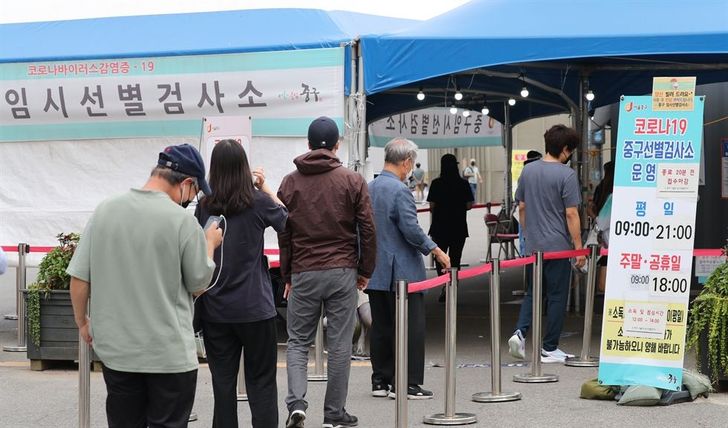
People wait in line for a COVID-19 test at a temporary center in Seoul Station, Sunday. Yonhap
Price issues
Meanwhile, questions are being raised about the price for treatments, with some claiming that it is too expensive.
When calculating the price based on the fact that the government has allocated a total of 36.2 billion won to buy treatments for 38,000 people, the price per person is estimated at about 950,000 won, which is way more expensive, compared to other medicines in general.
The health authorities refused to clarify the price in details, citing confidentiality obligations, but noted that even if it is true, the 950,000 won would not be expensive when economic losses that would have been caused if a patient did not take the medicine are considered.
“If a patient does not take the medicine, they would have to be hospitalized or admitted to a community treatment center. We should think about the costs for this, in addition to possible losses to be caused when a patient is unable to perform economic activities while in a hospital or at a community treatment center,” Bae Gyeong-taek, a senior official from the Central Disease Control Headquarters, said during a radio show, Friday.
“Oral treatments would make it possible for a patient to stay home and watch the progress of his condition there.”
Online commentators have differing opinions, with some saying the government should move more actively to pre-purchase new medicines even if the price is expensive, while others claim it should take a cautious attitude when spending taxpayers' money.
“We should accept the fact that prices for new medicines are always expensive until generic drugs are produced,” one internet user wrote in Naver's news section.
However, another user wrote, “Oral COVID-19 treatments are still in clinical trials, which means nobody knows about their efficacy and side effects. I think the government has gone too far in already allocating a budget to buy such medicines.”'
The user added that the government had previously appeared to have a vague attitude when calls grew to buy COVID-19 vaccines that were way cheaper than oral COVID-19 treatments, thus its active move to pre-purchase the treatments was not understandable.
According to the KDCA, the country added 1,755 COVID-19 cases for Saturday, including 1,725 local infections, raising the total caseload to 272,982.
The latest number was down from the over 1,800 cases over the previous two days, however, it was the second-highest figure for a day on the weekend.