Critically ill patients, deaths surging amid Delta variant spread

People wait to get COVID-19 vaccines at a vaccination center in Suwon, Gyeonggi Province, Thursday, when inoculations for people aged 18-49 began nationwide. Yonhap
Vaccinations for people aged 18-49 begin
By Bahk Eun-ji
Korea is seeing a rapid growth in the number of critically ill people and deaths from COVID-19, with the fourth wave of infections here showing no signs of subsiding and the highly transmissible Delta variant becoming the dominant strain here.
This is raising concerns that the rapid increase may lead to a shortage of hospital beds, especially in intensive care units (ICUs), and increase the risk of collapse of the nation's medical system.
Korea has reported four-digit daily new infections for 51 consecutive days, with 1,882 cases for Wednesday, according to the Korea Disease Control and Prevention Agency (KDCA), Thursday.
As the number of daily new cases increases, the numbers of patients in critical condition and deaths are also increasing.
As of Wednesday, 434 patients were classified as seriously or critically ill, meaning they were undergoing intensive treatment such as high-flow oxygen therapy, respirators or extracorporeal membrane oxygenation (ECMO).
This is the highest number recorded so far during the pandemic. The number also increased by 14 from the previous day.
Deaths are also on the rise. Twenty deaths were reported on that day, marking the highest number since the fourth wave of infections began early last month. It is also the second-highest number of daily deaths following 40 on Dec. 29 during the third wave.
The average daily death toll in the past week was 8.4, up from 6.1 in the previous seven days between Aug. 12 and 18 and more than double the 4.1 between Aug. 5 and 11.
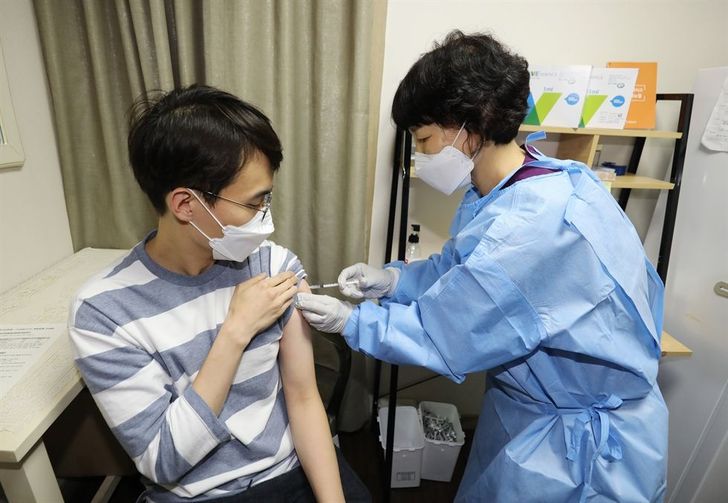
A man receives a COVID-19 vaccine shot at a medical facility in Seoul, Thursday, as health authorities started to inoculate people aged from 18 to 49 across the country. Yonhap
Under these circumstances, concerns are rising over possible shortages of hospital beds or medical workers.
According to the Central Disaster and Safety Countermeasures Headquarters, of the 833 hospital beds for critically ill patients across the country, 252, or 30.3 percent, were available as of 5 p.m., Tuesday. However, in some areas such as Daejeon, Sejong and South Chungcheong Province, there were almost no beds left.
“We have a sufficient number of beds so far, but if the nation sees more than 2,000 new patients every day continuously, there may be no capacity to spare in the medical system,” a health official said in a press briefing, Wednesday.
The Korean Society for Preventive Medicine and the Korean Society of Epidemiology have formed a joint COVID-19 response committee, and released a statement calling on the government to increase the number of frontline medical workers.
“The Korean government's quarantine system, which consists of tracking, testing and epidemiological investigations, has been barely maintained by the dedication of health and medical workers without expanding human resources. It is relying solely on our sacrifice, and we are on the verge of collapse,” the committee said in the statement.
The committee reiterated that the government should focus more on expanding the capacity for treating critically ill patients, and make all efforts to fully expand the supply of vaccines.
“It's time to make sure that people are actively getting vaccinated,” the committee said.
On Thursday, vaccinations for people aged between 18 and 49 started. Among 15.16 million people of the age group eligible for the inoculation program, about 67 percent have made a reservation for their first COVID-19 vaccine dose.