Doctors up in arms over bill on surveillance cameras in operating rooms

Medical personnel talk in an operating room equipped with surveillance cameras at Gyeonggi Provincial Medical Center Suwon Hospital, Monday. The provincial government has installed surveillance cameras in operating rooms at government-run hospitals. Yonhap
Largest doctors' group plans to file petition with Constitutional Court
By Bahk Eun-ji
Doctors are strongly protesting a contentious bill that will mandate the installation of surveillance cameras in operating rooms as a part of measures to prevent medical malpractice.
Citing the possibility of the surveillance affecting doctors' surgical procedures and the leakage of video recordings, the nation's largest doctors' group said it will seek a constitutional petition if the bill is approved.
Their protest came after the National Assembly's Health and Welfare Committee passed the revision bill to the Medical Service Act, Monday. The Assembly plans to approve it at a plenary session on Wednesday.
According to the bill, hospitals must video-record medical procedures upon the patient's or guardian's request when an operation is conducted while the patient is unconscious such as under anesthesia. They have to save the recording for more than 30 days for future reference in case of legal disputes, and viewing the recording will be allowed upon request by an investigative body or a court, or when the patient and the hospital agree.
There are exceptions where recording is not required if there are “valid reasons,” such as for emergency operations or operations involving high risk to save a patient's life. There will also be a two-year grace period before full implementation.
In response, the Korean Medical Association (KMA) issued a statement, also on Monday, and warned to take legal action against the bill.
“Under the system where all doctors struggling to save patients' lives are placed under surveillance and their every procedure is subject to judgment, it is very likely doctors will want to avoid high-risk procedures,” the statement read.
It said video surveillance of medical personnel also violates their human rights and privacy and leads to distrust between patients and doctors.
“If the bill is passed at the plenary session, we will make every effort to clarify its unconstitutionality and block the implementation of the bill, including filing a petition with the Constitutional Court.”
The KMA further pointed out that it is not alone in its objections, as the international medical community, including the World Medical Association, has pointed out that surgical surveillance is extremely inappropriate because it could damage the health, safety and personal dignity of patients.
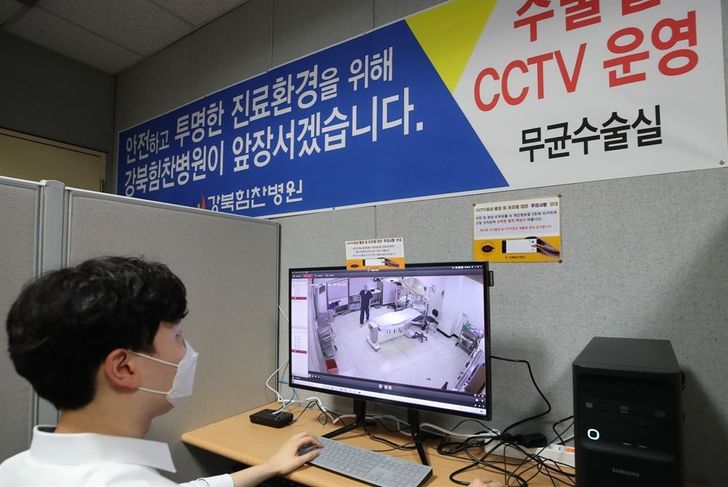
A medical worker looks at a screen showing an operating room at Gangbuk Himchan Hospital in Seoul, Monday. Yonhap
In contrast, the Korea Alliance of Patients Organization (KAPO) welcomed the move.
But it called for some changes to the current revision bill, saying the clause allowing exceptions for “valid reasons” can be interpreted arbitrarily by hospitals, so the clause should be removed.
It also said not only investigative bodies and courts but also the Korea Consumer Agency should be given the right to request viewing of recordings.
Calls for the installation of such monitoring systems in operating rooms began in December 2014, in response to photos of medical workers at a famous plastic surgery clinic in Gangnam, Seoul, who were having a birthday party in an operating room, eating cake and playing with implants, while a patient under anesthesia was lying on the table.
The government and some politicians have since moved to introduce the system but failed due to strong protests from doctors' groups.
But calls for cameras have been increasing in response to further medical malpractice cases, including “proxy surgeries” where operations were performed by unlicensed people, even medical device salespeople. Some hospitals have installed cameras voluntarily in recent years.
In a survey by the Anti-Corruption and Civil Rights Commission in June, 97.9 percent of 13,959 respondents agreed on the need to install surveillance cameras inside operating rooms.
“We look forward to active cooperation between both patients and the medical community to create a safe operating environment,” a KAPO official said.