New minimum wage draws backlash from both labor union, business

Park Jun-sik, head of the Minimum Wage Commission, leaves the commission's final meeting held at Government Complex Sejong, Tuesday, during which the minimum hourly wage for 2022 was set at 9,160 won. Yonhap
Hourly minimum wage for 2022 set at 9,160 won
By Lee Hyo-jin
The country's hourly minimum wage for 2022 has been set at 9,160 won ($7.98), a 5.1 percent increase from the current 8,720 won, which did not satisfy either the union or business sectors.
Unions expressed anger over President Moon Jae-in's unfulfilled campaign pledge to hike the minimum wage to 10,000 won per hour during his five-year-term, as this year's negotiations were the last to be held during his term.
Representatives from business were equally unsatisfied, as they had been calling for a virtual freeze of the minimum wage considering the problems facing small- and medium-sized enterprises due to the COVID-19 pandemic.
Around midnight, Monday, the 27-member Minimum Wage Commission, a trilateral panel composed of nine members each from the union, business and public sectors, voted on the new wage during its final plenary session held at the Government Complex Sejong.
Only 14 members participated in the vote as all nine members from the business sector and four union representatives left the room in protest against the proposed wage hike.
The final proposal of 9,160 won, made by representatives for the public, made up of professors and experts in labor issues, passed the vote with 13 in favor and one abstention.
The unions had proposed an increase of 14.7 percent to 10,000 won, while the business side insisted on a 1.5 percent rise to 8,850 won. The two sides failed to narrow the gap as both were firm on their demands.
The union representatives insisted that the 10,000 won rate was the bare minimum to ensure the livelihoods of low-paid workers and their families.
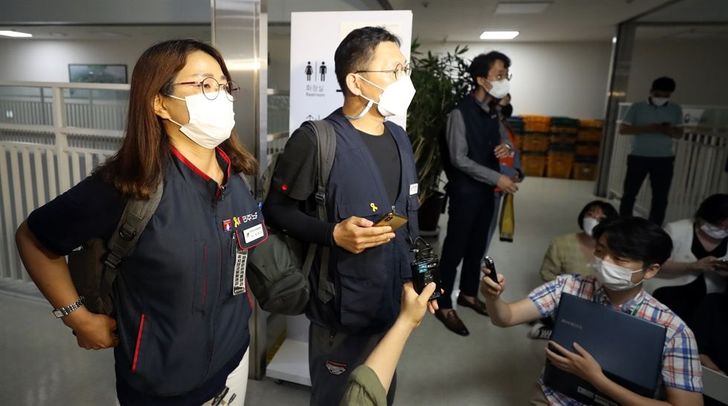
Union representatives speak to reporters after leaving the Minimum Wage Commission's plenary session at the Government Complex Sejong, Monday, to protest a proposed minimum hourly wage hike to 9,160 won. Yonhap
“The increase in the minimum wage is inevitable to alleviate the inequality and polarization that have worsened due to the COVID-19 pandemic,” said Park Hee-eun, a senior official at the Korea Confederation of Trade Unions.
“President Moon Jae-in administration's earlier promise to raise the wage to 10,000 won has in the end been broken,” she said, expressing fury over the administration for “giving false hope to low-paid laborers.”
The wage hike also provoked a backlash among members of the business sector, who said that it would place a heavy burden on small business owners and make the job market worse.
“The new wage clearly exceeds the payment ability of small- and medium-sized enterprises,” said Ryu Ki-jung, a business representative and senior member of the Korea Enterprises Federation.
“Labor representatives who have engaged in their selfish fight while ignoring the reality, as well as public representatives who supported their moves, should take responsibility for the problems that may arise from the wage increase,” he stressed.
The Korea Chamber of Commerce and Industry (KCCI) also expressed deep concern. “The rise in the minimum wage may aggravate the difficulties being experienced by small- and medium-sized enterprises and worsen the situation in the job market,” it said in a statement.
The wage approved by the commission will be submitted to the Ministry of Labor and Employment, which must make an official announcement by Aug. 5. If approved it will take effect from Jan. 1 next year.