Polish cuisine reflects country's turbulent history

Cod and beet green rolls called “golabki” with horseradish sauce and baby roast potatoes, by chef Bartosz Kaczmarczyk, served at the Polish Ambassador's residence in Seongbuk-dong, June 22. Courtesy of the Embassy of Poland to Korea
By Kwon Mee-yoo
Located on the crossroads of the historical trade routes between Europe and Asia, Poland boasts of a cuisine is known for its rich use of a variety of meats, as well as herbs and spices.
"Polish cuisine is indissolubly connected with culture. What we eat speaks for ourselves and it speaks to our soul and spirit," Polish Ambassador to Korea Piotr Ostaszewski said ahead of a luncheon introducing the essence of Polish cuisine at his residence in Seongbuk-dong, Seoul, June 22.
The historian-turned-ambassador explained how the country's cuisine is closely related to its history.
"I would say a few words about my country. After 123 years of being occupied and partitioned by three countries (Russia, Prussia and Austria), we got our independence in 1918. However, World War II devastated Poland completely as we had the two armies crossing back and forth," the ambassador said.
The communist system also influenced Polish cuisine.
"Communism changed to make dishes in the simplest way ― you have cabbage with bacon, cooked for a couple of minutes or hours. And you have a little bit of potatoes and chopped pork. This is something like a typical proletarian dish, and it was a lunch or dinner for workers. You can see how, when people are impoverished in history, more things are homemade, and when you have fewer and fewer ingredients, you have to use substitutes.
"When we opened up to the market in 1989, people were much more entrepreneurial and started to import lots of food, and new ingredients appeared. The variety of our cuisine and menu has changed dramatically."
Polish Chef Bartosz Kaczmarczyk of The Artisan prepared the light summer lunch, adding a modern twist to traditional Polish cuisine.
The lunch started with smoked duck breast and asparagus adorned with hazelnut and aronia dressing. Chef Kaczmarczyk makes smoked meats and sausages such as kielbasa by himself, using Korean meat but in traditional Polish style, and smoked duck breast for this dish is no exception.
"The flavor of aronia is very dry, but it goes nicely with the salty, smoky flavor of the duck and brings out the citrusy, zesty flavor of the summer to the dish. To bond all these flavors together, we have a bit of hazelnut, where you get this nutty flavor," Kaczmarczyk said. “I am not making any compromises when it comes to ingredients I'm using.”
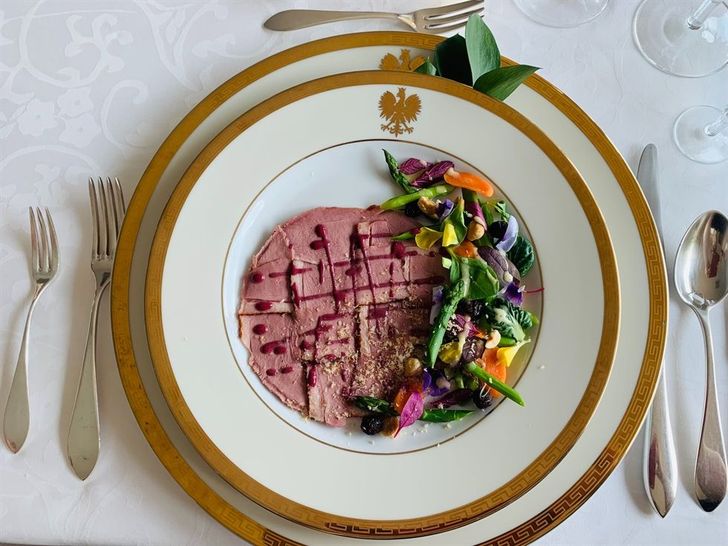
Smoked duck breast and asparagus with hazelnut and aronia dressing by Chef Bartosz Kaczmarczyk is served at the Polish Ambassador's residence in Seongbuk-dong, June 22. Courtesy of the Embassy of Poland to Korea
The lunch continued with a cream of chanterelle mushrooms soup. Chanterelle mushroom, also known as “kurki" in Polish, is a type of bright yellow mushroom easily found in Poland.
The chef explained the seasonal aspect of the chanterelle mushroom. "Unlike, for example, porcini mushrooms, it cannot be dried, as it loses all its flavor and quality when dried. So we can eat dishes only when it's in season. The season is right now, starting in the beginning of June. I have personal memories of picking chanterelles in early summer," chef Kaczmarczyk said.
The main dish ― cod and beet green rolls with horseradish sauce and baby roast potatoes ― was Kaczmarczyk's interpretation of “golabki,” or Polish stuffed cabbage rolls.
"The most basic home version is made with cabbage, rice and pork. This is the fish version where, instead of cabbage, I used beetroot leaves and instead of rice, barley,” Kaczmarczyk explained.
Ambassador Ostaszewski also explained the significance of the ingredients in typical Polish cuisine.
"Cod is a very popular fish everywhere and there are different types of cod. European cod is a substantial food, especially for us northern countries," the ambassador said.
“The potato is the basis of our cuisine, like rice is here. You cannot imagine Korean cuisine or life without rice, and you can make many things from rice. … Our cuisine is based on potatoes."
For dessert, Chef Kaczmarczyk created a rhubarb pie and a cream cheese vanilla mouse. Rhubarb is not a familiar ingredient in Korea, but it is a popular, tart summer vegetable in Poland.
"Another nostalgic memory from my childhood is going to the fields in my neighborhood on a hot summer day and picking wild rhubarb with my friends. In Poland's climate, we don't have many tangy, citrus fruits. The citrusy flavor is something we cannot achieve without green apples, strawberries and definitely rhubarb," the chef said of the ingredient.