INTERVIEW 50 years on, Yonsei Cancer Center continues pioneering path

Yonsei Cancer Center's Director Keum Ki-chang, M.D., Ph.D, speaks during an interview with The Korea Times, Nov. 20, at his office in Seoul. / Korea Times photo by Shim Hyun-chul
By Anna J. Park, Kim Eil-chul
First established in 1969, Yonsei Cancer Center celebrates its 50th year anniversary this year. The center was South Korea's very first medical institute that solely focused on cancer patients. During the last five decades since its launch as an affiliate institute of the Severance Hospital, Yonsei University Health System, Yonsei Cancer Center has now grown into a 15-story medical complex where approximately 638,000 patients from in and outside Korea visit and are treated annually.
Marking the half-century anniversary of the center, The Korea Times sat down with the center's director, Keum Ki-chang, M.D., Ph.D. (Radiation Oncology), on Nov. 20 at his office in Seoul and talked about the medical center's past development, current endeavors and future goals. Keum has been leading the center since March this year.
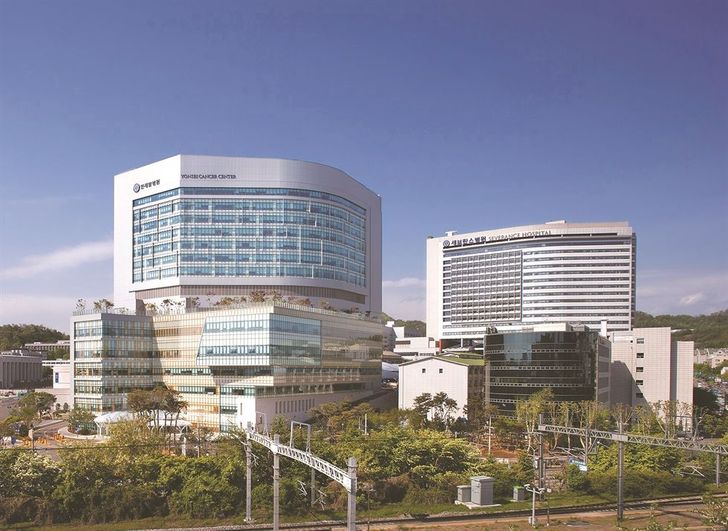
Founded in 1969 as Korea's very first medical institution focusing solely on cancer treatment, Yonsei Cancer Center marks its 50th anniversary this year. Courtesy of Yonsei Cancer Center
Q. First we'd like to express congratulations for Yonsei Cancer Center's 50th anniversary. Please tell us more about the center's development and achievements during the past fifty years.
Back in April 1962, Severance Hospital of Yonsei University Health System started Korea's very first cancer treatment program focusing on gynecologic cancer. In 1969, Yonsei Cancer Center officially opened as part of a national cancer treatment center with the help of foreign financial aid.
The center introduced the concept of a multidisciplinary approach in cancer treatment for the first time in Korea; multidisciplinary care means an integrated team of doctors of multiple specialties discussing the optimal treatment for a patient. The center underwent renovation and a fresh start in 2014 after ten years of meticulous preparation.
Now looking back, it is like we created a rich forest, where there were no trees. The center began its operation when people in Korea barely knew how to treat cancer patients. During the past five decades, Yonsei Cancer Center has established a standard cancer treatment system, constantly developing the institution's capability. Now the center's clinical treatment level parallels that of any globally-advanced medical center in major countries.
Q. Since earlier this year, you have assumed a crucial role of spearheading another 50 years of further development at the center. What do you value the most when managing the entire operation of the center? What are your main goals for the center's future directions?
I think the time when a hospital's reputation was dependent on some famed, individual doctors is gone. Now no one knows who is the general director of the hospital; from now on; I think it is all about a hospital's capability to further advance its system in a more patient-oriented direction. My role as a director is to help the hospital's system to head towards that direction.
Now we need to focus on a qualitative growth, not quantitative. In that sense, we don't regard our center as just a tertiary hospital, but the nation's significant quaternary hospital. It means that while the center's standardized cancer treatment continues at its highest level for sure, now we focus more on treating difficult and incurable cancers.
About 90 percent of cancer patients are now known to be medically curable in Korea, but the remaining 10 percent suffer from rare and incurable cancers, and we often tell them they are in God's hands.
We aim to focus on those difficult cancer patients by expanding expenditure on our R&D studies and also by systemically logging patients' clinical records and forming them into big data. In addition, we are continuing our extensive partnerships with global pharmaceutical companies in clinical experiments, and planning to introduce Korea's first Heavy Ion Therapy System by 2022.

Director Keum has been leading Yonsei Cancer Center since March this year. Korea Times photo by Shim Hyun-chul
Q. Please tell us more about your background prior to becoming the director at the center.
Well, I decided to become a doctor, because I hoped to be a pioneer of my own life. I wasn't interested in pursuing what everyone else was aiming at. I always like to challenge myself where there is no trail left, and I don't have a competitive nature; I also don't like being spotlighted.
That's why I decided to study radiation oncology, because the department was not at all popular at that time.
I started as an intern at the Severance Hospital, I spent time as a resident, and a fellow at Yonsei Cancer Center and Yonsei University Medical School. I also spent a year at Yale University Medical School as a research professor from 2003 to 2004.
After returning to Korea, I resumed my work at Gangnam Severance Hospital, helping the institute to expand its Department of Radiation Oncology, while I mainly focused on treating patients with head and neck, and breast cancers.
Later, as a professor at Yonsei University Medical School and a vice head of Yonsei Cancer Center, I have been deeply engaged in the cancer center's direction.
Q. During the time as you work at hospitals, we heard you also once attempted to run a bio venture business. Please tell us more about that experience.
In early 2000s, I made a bio venture company with two other medical experts: a professor and a plastic surgeon. The business was based on developing tumor markers as a diagnostic tool for cancers as well as scar removal products.
We sold the company in 2006 to a bigger company, hoping to raise more funds for research and development, but that didn't go as planned, so I left the business.
(Yonsei Cancer Center is currently known for its excellent tumor marker and scar removal programs. It seems director Keum's previous efforts, in the end seem to have borne fruit at the center and improve the center's service to patients and improve their quality of life.)
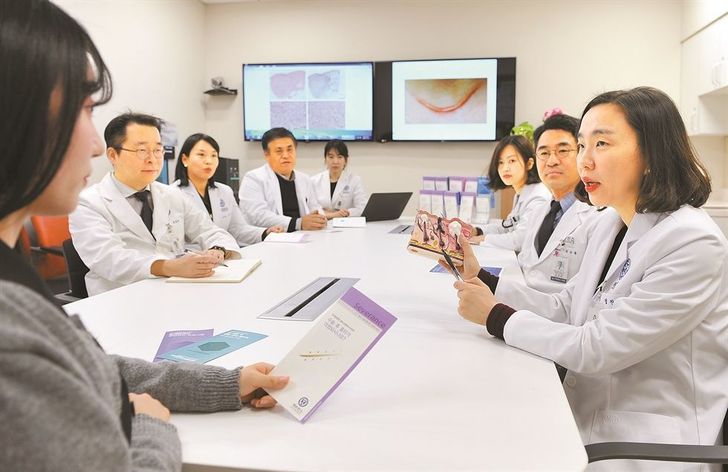
Yonsei Cancer Center provides joint treatment by dermatologists and plastic surgeons to remove patients' scars from cancer surgery. Courtesy of Yonsei Cancer Center
Q. Against the backdrop that the Yonsei Cancer Center will be introducing the nation's first Heavy Ion Therapy System by 2022, I guess your expertise in radiotherapy facilities probably play a key reason in assuming the leadership role at this important point of the cancer center's development.
Radiation treatment takes up about 30-40 percent of all cancer treatments. The treatment of cancer is consisted of surgery, radiation as well as systemic drugs. As the three main pillars need to be combined and well-leveraged together to treat patients, keeping a good balance among the three modalities is an absolute necessity.
Also as you said, I think part of the reason of my appointment at this head position has to do with the planned set-up of the Heavy Ion Therapy System by year 2022, which worth more than $210 million, or some 250 billion won.
Q. Tell us more about the center's plan to introduce the Heavy Ion Therapy System. How does it benefit cancer patients in the nation?
It is part of the center's efforts to further focus on incurable cancers, such as pancreatic cancers, esophageal cancer, as well as terminal cancer patients. In order to treat these difficult cases, current clinical treatments have their limits; extensive in-depth research should be preceded.
For that matter, we are focusing on utilizing big data technology to analyze numerous cases of cancer patients. These data will help us to build new arms to treat new patients. The Heavy Ion Therapy System will also contribute greatly in treating cancer patients whose tumors could not be treated with the current X-ray radiation technology.
(The heavy ion cancer therapy is known to be very effective in treating difficult diseases like osteosarcoma, chordoma, colorectal cancer, as well as pancreas, liver and lung cancers. Yonsei Cancer Center aims to introduce the heavy ion treatment as South Korea's first medical center to do so by December 2022.)
Q. The center is also closely cooperating with pharmaceutical companies of both in and outside of Korea to secure new drugs for patients with incurable cances. How are those clinical cooperation projects going on?
Currently over 620 cancer cases of clinical experiments are ongoing at various departments of the center; we are jointly conducting clinical cases with global pharmaceutical companies like Novartis, Pfizer Pharmaceuticals Korea, Bayer Korea, as well as domestic pharmaceutical companies and bio ventures.
Such cooperation is also the center's efforts to reach out and effectively treat incurable diseases. In addition to establishing a comprehensive system utilizing patients' big data, we need to get a wide access to the latest research and discoveries of new drugs. We are aiming to attract more global or domestic pharmaceutical companies to jointly conduct clinical trials and secure our pipelines to receive new innovations of medications for patients.
Q. Many international patients are coming to the center annually to get treatments. Where do they mostly come from?
Last year alone, more than 3,300 international patients received treatment at the center, and approximately 1,880 of them were hospitalized at the center. The patients come from various countries, but mostly from Kazakhstan, followed by Russia, the Ubited Arab Emirates, the U.S. and China.
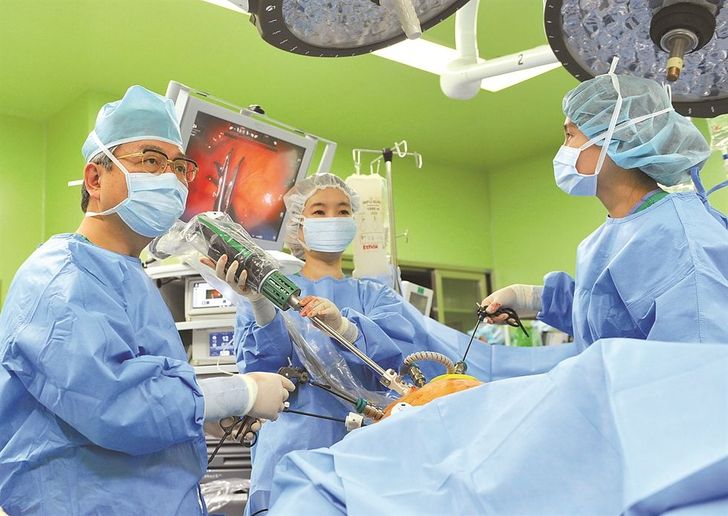
Professor Kim Nam-kyu, left, conducts laparoscopic surgery on a patient with colorectal cancer. Courtesy of Yonsei Cancer Center
Q. What are Yonsei Cancer Center's special expertise that have reached the world's top levels?
We have so far clearly established standardized treatment system for cancer patients. Now except for a few special cases, Korean patients do not need to go abroad to get cancer treatments. As I said earlier, many international patients come to our hospital to get treatments. Many Koreans or Korean Americans living in the U.S. come, too, because our treatment level parallels that of the U.S., but at a more reasonable price.
In terms of basic research and new drug, we are still lagging behind countries like the U.S., and that's why the center aims to expand the number of jointly operated clinical trials with global pharmaceutical companies.
Regarding clinical treatment, we stand at the global level. For example, robotic surgery started in the U.S., but professors here have published textbooks on robotic surgery. As recent OECD statistics show, Korea now has the world's top records in curing stomach cancer and colon cancer. In case of thyroid cancer, we don't even leave a scar.
Q. Yonsei Cancer Center is also known for its active exchanges with fellow hospitals at the international level. Could you explain more on this?
The center has a close relationship with the University of Texas MD Anderson Center since 2004. As sister hospitals, we exchange medical doctors, staff, and have been held audit board meetings. We are very open to global cooperation and embracing advanced systems to achieve further development through active international exchanges.
Q. As it did during the last five decades, we hope the center continues to lead the nation's cancer treatment through its exemplary system. What0 are the cancer center's strategic goals for the next 50 years?
At this point where we are heading for another half-century of achievements, one of the foremost and significant project is, as I said earlier, to well establish the Heavy Ion Therapy System by 2022.
We will focus on making the new heavy ion therapy system work for incurable cancer patients, and also further develop big data of patients with AI technology to provide more optimal treatments for each patients.
During my term, I will make sure these key parts of the center are clearly systemized. I see myself as a conductor, thus I hope to achieve a harmonious development of the center.