Seoul City supports traditional markets to offer online shopping

A customer looks around at dried fish products in Namdaemun Traditional Market in downtown Seoul, Feb. 9. Korea Times file
By Bahk Eun-ji
Traditional markets are regarded these days as being inconvenient to shop at, despite offering lower prices than larger supermarket chains, as they usually lack parking spaces, facilities where shoppers can rest or eat, and online shopping and delivery services.
But markets in Seoul are changing, especially for that last part ― online shopping ― as the Seoul Metropolitan Government (SMG) has helped shopkeepers introduce online shopping and delivery service platforms last year. This program, adopted in April of last year, has helped them to overcome the economic hardships brought by the pandemic to some extent.
Kim Ye-seul, a 36-year-old homemaker living in Gangdong District, said she recently began to use traditional markets more actively than before thanks to these expanded online shopping and delivery services.
“Although I liked shopping for groceries and visiting eateries at Gildong Bokjori Market, I did not visit there often because there were not enough parking spaces. And COVID-19 made me feel more reluctant to go to spaces where many people gather,” Kim said.
Kim said she makes purchases from the traditional market through the delivery food app Coupang Eats, which sends her the groceries purchased quickly.
“Of course I use the service because I agree with the government's mission to revitalize the local economy by encouraging consumers to use traditional markets, and at the same time, the quality of food and groceries is generally satisfactory,” Kim said.
A merchant at Yeongcheon Market in Seoul's Seodaemun District said that despite the continued pandemic, the local economy is recovering thanks to the online shopping service.

One of the entrances of Tongin Market in Jongno District, Seoul. Korea Times file
“At one point, I was forced to close the store temporarily, but recently, sales have recovered, as the online shopping platform went viral,” he said.
According to the SMG, traditional markets gained 6.42 billion won in sales through the online shopping service over the course of a year, since opening in April last year.
Three mobile platforms ― Naver, Coupang Eats and Come to Play Market (Noljang) ― offer online shopping services for traditional markets. Users can simply select the goods they want, and have them delivered to their homes.
“There is no big difference compared to the services of large supermarkets or online shopping malls, as groceries are delivered on the same day customers order. Sometimes a delivery takes only 20 minutes, depending on where the customers live,” said Kang Seok, head of the Small Business Policy Department in the SMG.
Kang said that the biggest advantage of this service is that customers can receive products from multiple shops in one market.
For example, if a customer orders kimchi from one store, fruit from another store, and rice cakes from another all in the same market, they can get them all at once.
A delivery person will go around to each store, pick up the ordered items, put them in a box and deliver them together.
Monthly sales exceeded 100 million won ($89,940) in just four months, following the service's introduction, and recorded 1 billion won last December. Monthly sales have declined slightly since March of this year, but remained at around 900 million won per month, according to the SMG.
More and more consumers are using the service, too. The number of uses exceeded 10,000 last October and reached 52,170 in January, compared to 52 in April of last year, the first month of the service.
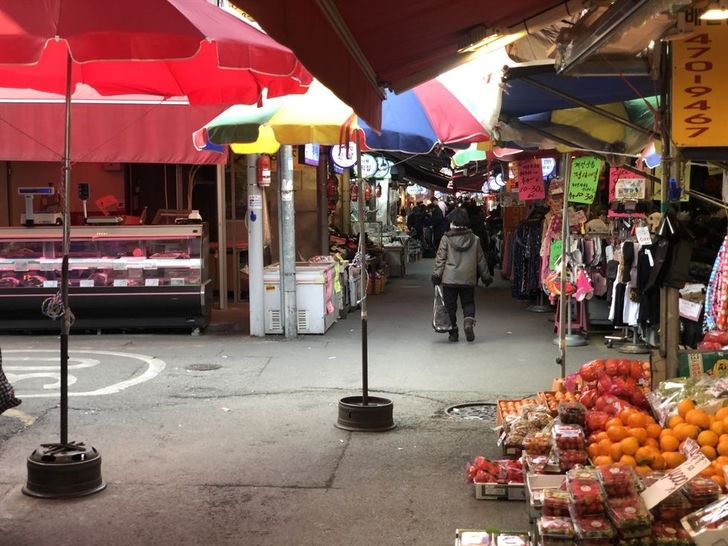
A variety of fruit and goods are on display in Dunchon Market in Seoul's Gangdong District, in this Feb. 15, 2020 photo. Korea Times photo by Lee Seung-yup
“Things were difficult due to the virus outbreak, as the main customers of the market previously had been foreign tourists. It was hard for us to pay rent, but thanks to the online shopping platform, we've become busy again. Our stores are open during holidays as well,” said a merchant at Tongin Market in Jongno District.
Currently, there are 71 traditional markets in Seoul at which online shopping is available. The SMG plans to add 70 more by the end of the year.
Traditional markets participating in the service are provided with various kinds of support, the SMG said. Merchants are also given training on how to sell goods online.
The platforms on which the service can be used will also be expanded.
“In addition to the Naver, Coupang, and Noljang apps, customers can purchase goods from traditional markets through the mobile app, WeMakePrice O, starting from the middle of this month,” Kang said.
“This project is aimed at helping traditional markets that are struggling in the competition with large supermarkets, by opening new sales channels for them.”
Starting in July, the city government will expand promotional activities so that more citizens can learn about the online shopping services of traditional markets.