Ex-UN chief calls COVID-19 pandemic 'last warning from nature'

The Korea Times and Hankook Ilbo Chairman Seung Myung-ho, front row second from right, and former U.N. Secretary General Ban Ki-moon, second from left, walk to an outdoor stage at the Cultural Depot Park in Seoul's Mapo District where the Korea Forum 2021, co-hosted by the two dailies, took place Wednesday. From left are main opposition People Power Party floor leader Rep. Kim Gi-hyeon, Ban, National Assembly Speaker Park Byeong-seug, Seung, and Seoul Mayor Oh Se-hoon. Korea Times photo by Hong In-ki
By Jun Ji-hye
The ongoing COVID-19 pandemic may be the “last warning from nature” that is urging humanity to respond immediately to the climate crisis, former U.N. Secretary General Ban Ki-moon said Wednesday.
Ban, who currently chairs the Ban Ki-moon Foundation for a Better Future, made the remark during the Korea Forum 2021, co-hosted by The Korea Times and its sister paper, the Hankook Ilbo.
“The COVID-19 pandemic is a phenomenon of the climate crisis,” he said in a keynote address at the forum held at the Cultural Depot Park in Seoul. “Following the virus outbreak, humans have realized the need to fundamentally resolve environmental problems for their sustainable survival.”
Ban mentioned his meeting with Pope Francis in Vatican City, during which the latter said, “God always forgives, and men sometimes forgive, but nature never forgives.”
The former foreign minister stressed the need for people to be aware that the destruction of the ecosystem resulting from climate change has caused outbreaks of viruses and their spread.
“If people had taken climate issues more seriously and realized the preciousness of nature earlier, we might not have suffered from the COVID-19 pandemic,” Ban said.
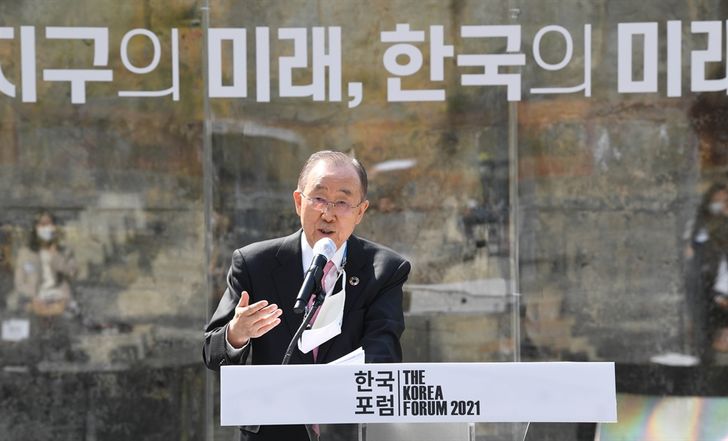
Former U.N. Secretary General Ban Ki-moon delivers a keynote address during the Korea Forum 2021, co-hosted by The Korea Times and its sister paper, the Hankook Ilbo, at the Cultural Depot Park in Seoul's Mapo District, Wednesday. Korea Times photo by Bae Woo-han
Amid a growing awareness of the seriousness of environmental issues, 195 countries adopted the Paris Agreement at the 21st Conference of Parties of the United Nations Framework Convention on Climate Change, pledging to limit the average increase of Earth's temperature to below 2 degrees Celsius, preferably 1.5 degrees Celsius, compared to pre-industrial levels, by 2100.
Ban, who led the adoption of the international treaty as the then U.N. chief, said the international community should continue to join forces to achieve carbon neutrality.
“We should also pay attention to the recent trend that mitigation, which focuses on cutting emissions of greenhouse gases, is now paralleled by adaption, aimed at minimizing the damage caused by climate change and helping vulnerable countries better adapt to climate change,” he said.
During the forum, Environment Minister Han Jeoung-ae talked about Korea's goal of achieving carbon neutrality by 2050, saying the country must achieve this, though it would not be easy, considering that the nation has achieved growth mainly through the development of heavy and chemicals industries that emit lots of greenhouse gases.
“Various experts are now working to draw up possible scenarios to achieve carbon neutrality,” she said. “Once those scenarios are produced, the government will carry out in-depth discussions with the interested parties, including businesses, to make detailed plans and set our target figures in October at the earliest.”
For his part, The Korea Times and Hankook Ilbo Chairman Seung Myung-ho said in his welcoming remarks, “All countries, regardless of whether they are developed or underdeveloped, and all people, regardless of their religion and race, should join hands to resolve the climate crisis.”
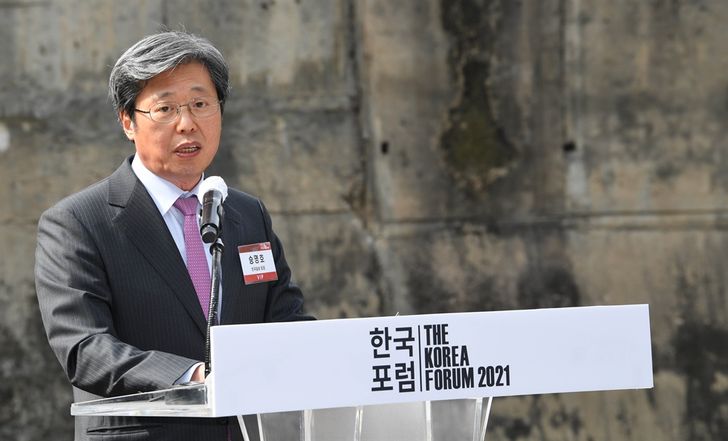
The Korea Times and Hankook Ilbo Chairman Seung Myung-ho delivers a welcoming speech during the Korea Forum 2021, co-hosted by the two dailies, at the Cultural Depot Park in Seoul's Mapo District, Wednesday. Korea Times photo by Bae Woo-han
In his congratulatory address, National Assembly Speaker Park Byeong-seug noted that Korea will host the P4G Seoul Summit from May 30 to 31, to suggest new paradigms for green growth.
P4G stands for “Partnering for Green Growth and the Global Goals 2030,” which is a public-private initiative to tackle climate change and other challenges to sustainable development.
“The National Assembly will actively support the government's policies aimed at achieving carbon neutrality,” he said.
Seoul Mayor Oh Se-hoon stressed the role of metropolitan cities, such as Seoul, saying the capital has vowed to cut emissions of greenhouse gases by 40 percent by 2030.
“This goal requires the participation of and cooperation from companies and citizens, as we will all have to endure many inconveniences to reach the goal,” Oh said.
Meanwhile, Jeffrey D. Sachs, a world-renowned economics professor and director of the Center for Sustainable Development at Columbia University, participated in the forum through a video call, and stressed the importance of regional cooperation in developing renewable energy.
“To what extent can Korea benefit from its connection with neighbors, with China, Japan and the rest of Asia, in an interconnected energy system strategy?” he asked, noting that a large continental scale interconnection can make a lot of sense when it comes to renewable energy, because one place would be sunny when the other is windy.
“There is better chance to have renewable energy through this,” he said.