INTERVIEW Pulitzer-winning photojournalist stresses value of long-lasting visual stories

Maria Meza, a 40-year-old migrant woman from Honduras, part of a caravan of thousands from Central America trying to reach the United States, runs away from tear gas with her five-year-old twin daughters Saira Mejia Meza, left, and Cheili Mejia Meza, right in front of the border wall between the U.S and Mexico, in Tijuana, Mexico, Nov. 25, 2018. This is a winning photography at the Pulitzer Prize's breaking news photography award for 2019. Reuters-Yonhap
By Park Ji-won

Photojournalist Kim Kyung-hoon / Photo by Kim Jung-sun
Tear gas was fired by the United States border guard to repel a caravan of migrants near the border between the U.S. and Mexico on Nov. 25, 2018. The Central American asylum seekers, most of whom left their homes to give a better life to their children, had to run from the tear gas. Kim Kyung-hoon, a senior photographer at Reuters who was at the scene, needed to put on a mask to protect himself from the gas. But he chose to cry instead and placed priority on capturing the moment of a mother rushing to grab her daughters' arms to run away. He knew that he captured an important moment of history in his photo.
“Through the wall between the U.S. and Mexico, the migrants could see the rich images of the U.S., such as a person going on a shopping spree wearing sunglasses. They wanted to become part of it. But the mother had to run away from the wall. For me, the whole situation appeared to be surreal,” Kim said during a Zoom interview with The Korea Times, Saturday. He has been working as a photojournalist in Korea since 1999 and has worked for Reuters based in Seoul, Tokyo and Beijing since 2002.
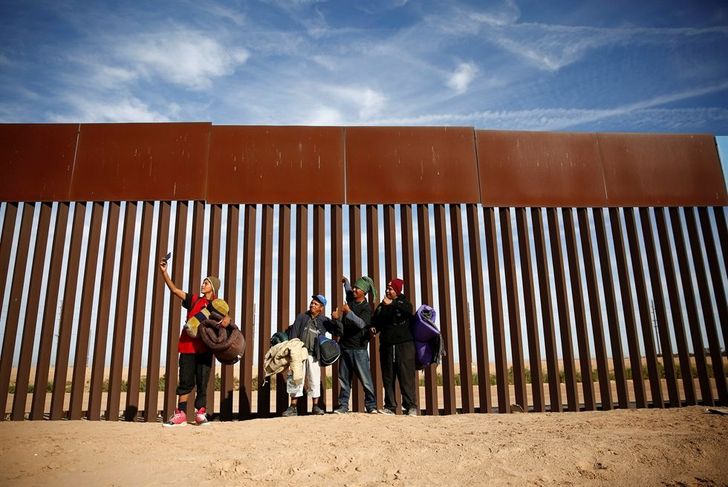
Migrants, part of a caravan of thousands traveling from Central America en route to the United States, take a selfie in front of the border fence between Mexico and United States while moving to a new shelter in Mexicali, Mexico Nov. 19, 2018. Reuters-Yonhap
He recalled he released the photos immediately on the spot. They went viral and covered the front pages of numerous international newspapers the next day. The moving and timely coverage was a show of the tough life of asylum seekers when then U.S. President Donald Trump was referring to the caravan as “gang” members and building walls to keep immigrants out. It was the moment of truth reversing the Trump administration's political frame of demonizing the immigrants. It also helped the family obtain refugee status in the U.S. as they received media attention.
With the photo, Kim made history by winning the Pulitzer Prize's breaking news photography award for 2019 along with 19 other works with his 10 colleagues from Reuters, which was the first such feat for a Korean photographer. “More than anything, I was excited about the fact that the one-year project had won the prize,” he said.
Even though his photo contributed to changing the world, instead of getting too excited about the accolade, the Tokyo-based journalist chose to go back to his daily routine of covering the news. The next job right after the announcement of the prestigious award was to take photos of a newly opened poop museum in Japan.
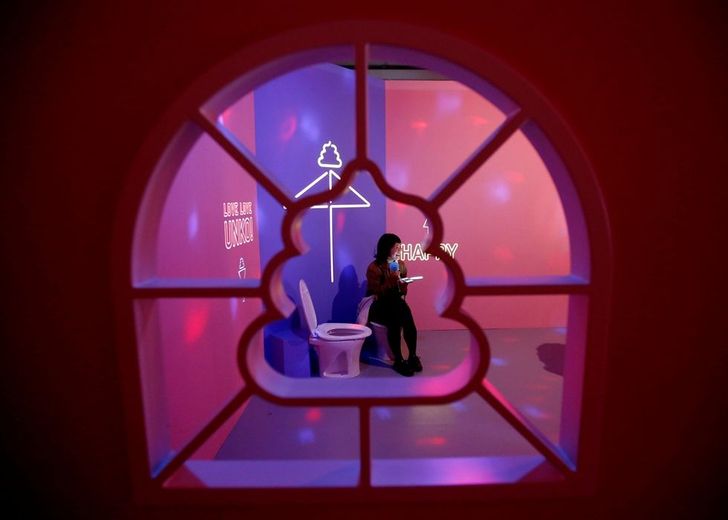
A visitor poses for her photo on a display toilet at the the Unko (“poop” in Japanese) museum in Yokohama, Japan, April 17, 2019. Reuters-Yonhap
“Of course, I was very happy about winning and felt honored for a while, but it doesn't change your job of finding stories and documenting them. Also, I kept telling myself to feel less pressured by the award because the burden of the prize may limit my views and make me arrogant. Anyway, I, an employee, am also one of many in the company who won the Pulitzer prize … Well, my colleagues still found it interesting that my first job as winner of the Pulitzer prize was to take photos of poop,” Kim said.
His philosophy of prioritizing good stories reflected well in his daily work. Apart from his daily straight news coverage, he takes the initiative in finding original stories that can be well-presented visually. He might be inspired by a line in a book, a blog post or a news story. But most of the time, he uses his imagination to find the moments with a human face between lines from documents, which are also visually aesthetic and fact-based, because those photos survive longer, he added. That is why he not only holds cameras when he goes to the scene, but also a pen and notepad so he can keep in touch with his interviewees afterwards and can track the changes in their lives and update it in his stories.
“When I think about moving photos that stay in my mind for a long time, I realized they all include dramas involving human beings. For example, on the occasion of the Rugby World Cup in Japan, I tried to find a person who represents the face of the largest aging society, which was an old veteran rugby player and his colleagues. Their photos won the third prize at the World Press Photo contest in sports stories last year. On the 75th anniversary of the liberation of Korea, I took photos of Chinese and Korean 'comfort women,' who had been alienated by society for many years. During this pandemic, I am trying to capture moments of how people suffer and live for a better future despite difficulties.”
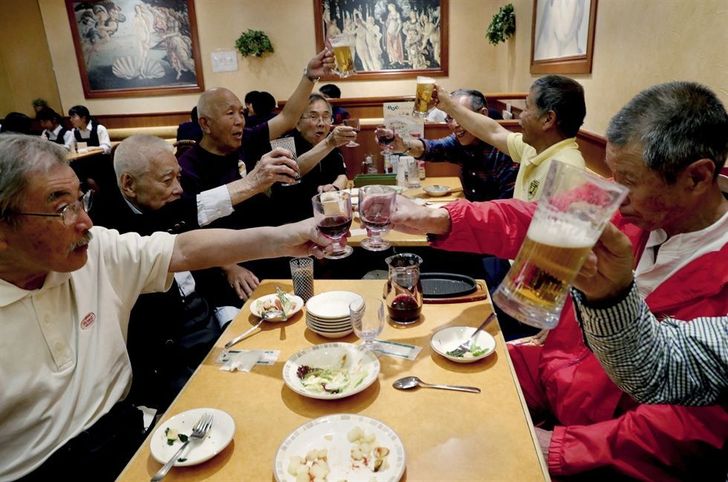
This image released by World Press Photo, April 16, 2020, by Kim Kyung-Hoon of Reuters, part of a series which won third prize in the Sports Stories category. Members of the Fuwaku Rugby Club team have a drink at a restaurant after a match in Kumagaya, Japan, on 3 May, 2019. Reuters-Yonhap
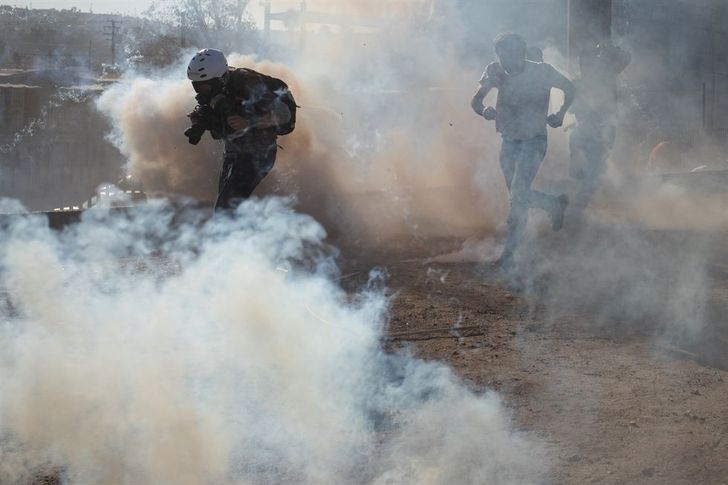
Reuters staff photographer Kim Kyung-Hoon works through a cloud of tear gas that was fired by U.S. Customs and Border Protection after migrants from Central America attempted to illegally cross the border into the U.S. from Tijuana, Mexico, on Nov. 25, 2018. Photo provided by Kim Kyung-hoon
The habit of cultivating a story didn't come overnight. He wanted to become a photojournalist like Robert Capa who died while covering a war. So he entered Chung-Ang University, Korea's top university for photography, and got a job at a sports newspaper in Korea in 1999.
After moving to Reuters in 2002, he started to cover a variety of general news in Seoul. To hone his skills and expertise in the coverage of Northeast Asia, he decided to move to Tokyo in 2007 and Beijing in 2013, covering various local stories occurring in the neighboring countries while traveling various continents to cover international news from time to time.
However, it was not always smooth to continue his task, as he faced numerous dangerous moments and traumatic situations that almost made him quit his job.
“I was planning to go to Afghanistan to cover the war in 2010. Before going there, I went to Bangkok to cover clashes between anti-government protesters and Thai troops on April 10 with my Japanese colleague, Hiro Muramoto, whom I considered a brother. But he was shot dead at the scene while I was there. I started to doubt my thoughts on photojournalism after his death. I asked myself whether it is worth risking lives to do what I do. I canceled the trip to Afghanistan and kept questioning myself about the value of work. I was thinking of quitting.”
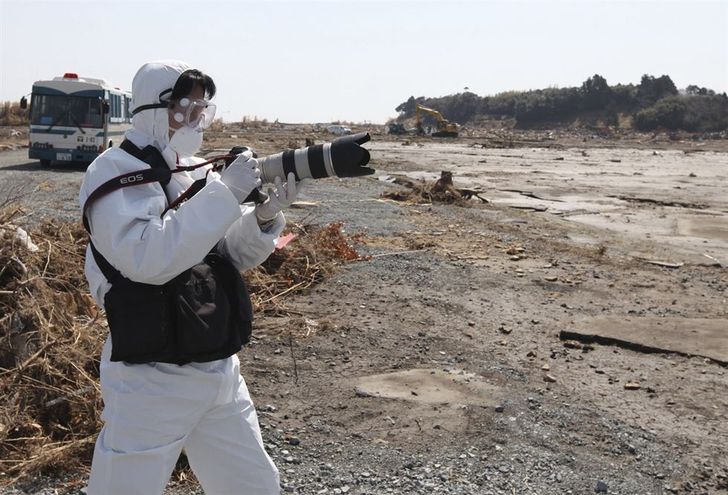
Reuters staff photographer Kim Kyung-Hoon in anti-radiation protection cloth takes a photo in Fukushima, Japan, in this undated photo after the 2011 Japan earthquake and tsunami disaster. Photo provided by Kim Kyung-hoon
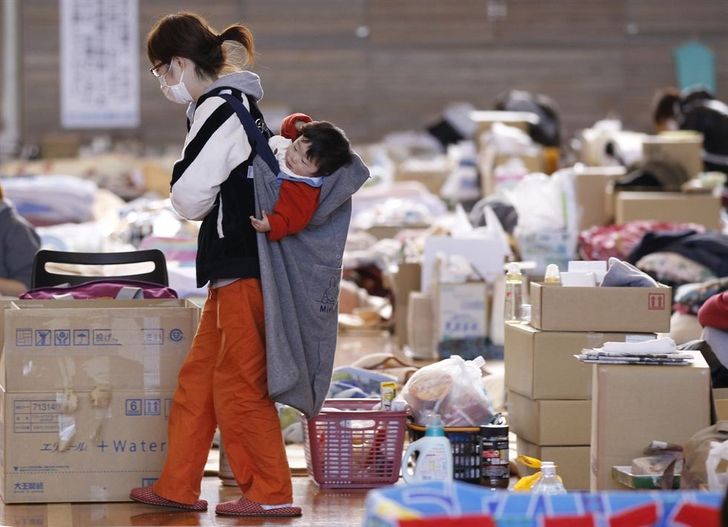
A woman carries her baby on her back at an evacuation center in Fukushima, northern Japan, March 28, 2011. Japan appeared resigned to a long fight to contain the world's most dangerous atomic crisis in 25 years after high radiation levels complicated work at its crippled nuclear plant. Reuters-Yonhap
The 2011 Japan earthquake and tsunami disaster helped him to get back on track.
“I was still questioning the meaning of my work. But, facing the worst natural disaster to hit Japan, I could sense my adrenaline pumping and thought that I needed to work to cover the stories.”
After his colleague's death, he decided not to risk his life in pursuit of a good photo.
“People misunderstand the nature of photojournalism. I don't think we should sacrifice ourselves to cover a story. If there are risks, we should be prepared beforehand. Taking a good photo doesn't necessarily mean being reckless. It is more important to continue to take quality photographs. Also, I try to forget negative memories and carry on. Once a senior photojournalist told me when I was in Korea that 'Our works will be printed in the newspapers and then flushed into the toilet after being used for wiping someone's butt the next day. You don't need to get too excited about an exclusive story or feel sad about the fact that you missed a story.' That line didn't resonate with me in the past, but now I've started to understand it.”
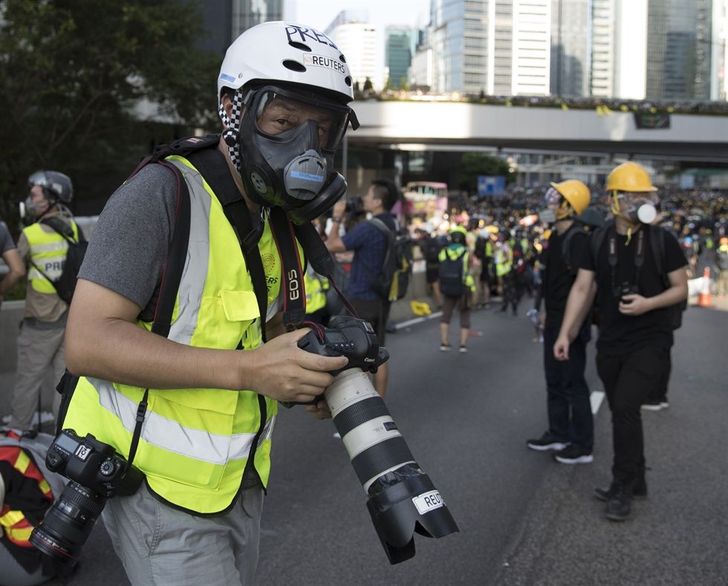
Reuters staff photographer Kim Kyung-Hoon poses during anti-government protests in Hong Kong in this undated photo in November 2019. Photo by Choi Won-suk of The Korea Times
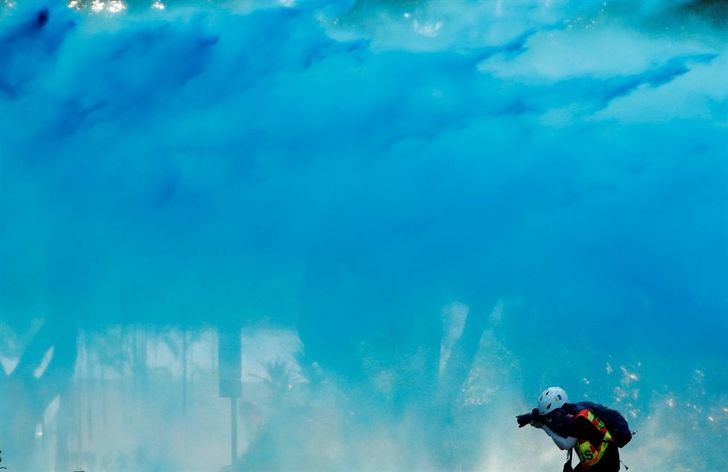
A journalist reacts as police spray water during an anti-government protest march in Hong Kong, China, Oct. 20, 2019. Reuters-Yonhap
Photography as means of storytelling
For him, photojournalism was something passive when he got his first job at the sports newspaper. But it gradually developed into something active or a way to tell stories as people started to take their own photos by themselves with smartphones and digital cameras.
“When I first started, my job as a photojournalist was to take one photo upon a request from my colleague for an interview which I didn't know. After some 20 years, most people got to have smartphones with AI technologies. DSLR cameras became common and automated and I am also depending on them. Taking a good photo used to mean that a person is good at focusing and lighting. But now those are default skills in taking a photo. Now my job is to find a story and document it with photos, as classic stories can survive when anyone can easily take a decent photo.”
He stresses that photography is one of the easiest ways to tell a story.
“It is very easy to take a photo. You don't need talent or complicated skills to take one. You can also easily learn how online. A photo can sometimes explain stories easily when it would take long sentences to describe them in writing. So photography can be the best way to deliver your stories.”
The changing trends in photography are well reflected in journalism as well especially with international photo awards. As anyone can take photos, people want more in-depth stories or storytelling by a group of photojournalists. Now more winning photos are collective works by many people.
“In the past, for example, the Pulitzer-winning photography was the outcome of a project by one photographer over just a few months. Recently, however, teams or groups of photojournalists are winning the prize together. It reflects a trend that readers are becoming smarter and more demanding. They want to see in-depth daily news. So the news agency sends reporters with various backgrounds to the scene so that readers can grasp the situation with accumulated information from different perspectives.”

Cover image for Kim Kyung-hoon's new book “Stories that Photography Wants to Tell” Courtesy of Sigongart
It is one of the reasons that he decided to write his second book, “Stories that Photography Wants to Tell,” (rough translation) which was released in February to share his thoughts about photography and help people to think about the meaning of photography in this era when anyone can easily take photos and share them with many. Featuring nearly 100 of his photos and historic photographs, it shares their behind-the-scene stories and stresses the power of storytelling with photos.
“One day I went to a Wednesday demonstration for 'comfort women' in Seoul. I felt touched by middle school students who were paying attention to the victims' voices. But after the demonstration, they approached the statue of the girl symbolizing the victims of sex slavery during the Japanese colonial period, and took selfies. After seeing them, I realized that there hasn't been a proper discussion about photography even though sharing photos became so common and a way to tell stories.”
Kim continues to learn the best ways to tell his stories. He is currently focusing on using cameras to take still photos, but he also uses many devices such as drones armed with video cameras, as technology is constantly changing.
“Some say it is inappropriate for photojournalists to take videos, claiming that it may sacrifice the authenticity of a photo. But I don't agree with that. For me, photography is a language. It is a means to tell a story. A camera is just like a pen to write a story. Drones and VR are tools to document a better presentation. What I do is storytelling by making the most of devices. Our title may change. After 10 years, I may be called a visual journalist, not a photojournalist. But the fundamentals of our job as a storyteller will continue. I hope that I could continue to work without mistakes and remain as a storyteller sharing my thoughts with others.”