Seoul City suffers e-scooter parking problem

Two electric scooters are parked in the middle of a sidewalk on a university campus in Seoul in this Nov. 3, 2020 photo. Korea Times photo by Lee Han-ho
City government seeks to tow e-scooters at no-parking zones
By Lee Hyo-jin
Electric scooters, an innovative eco-friendly form of transportation, have gained increasing popularity in Korea since their sharing platforms were commercialized in 2018.
More and more people are choosing e-scooters for travelling short distances, as they are faster than going on foot and a better option than crowded public transport. Currently, over 60,000 devices from various operators are deployed in the capital area, a hike from around 150 in 2018, according to the Seoul Metropolitan Government.
Users can unlock an e-scooter on the street by scanning a QR code using their smartphone, ride to their destination and park it there after their trip. Unlike rental bicycles, e-scooters do not have designated parking areas they should be returned to.
The “dockless” scheme is what makes the personal mobility devices convenient for riders, but on the other hand, it creates inconvenience for pedestrians, who frequently find pathways blocked by e-scooters left standing in the middle of sidewalks.
“The electric scooters on the streets sometimes get in my way, especially when the sidewalks are crowded during rush hours. I also get the impression that they are just abandoned there and poorly managed,” said Lee Ye-won, an office worker on Yeouido.
“E-scooters lying on the ground are not only annoying to see, but they could lead to accidents for people who do not look up while walking with their smartphones. But it seems inappropriate to move them out of the way without permission as they belong to the operators,” said Kim Seo-ro, 26, a resident in Seoul.
Due to the randomly parked e-scooters, people who use wheelchairs may experience limited access to sidewalks, and when left on tactile paving areas for the visually impaired people, they may lead to serious accidents.
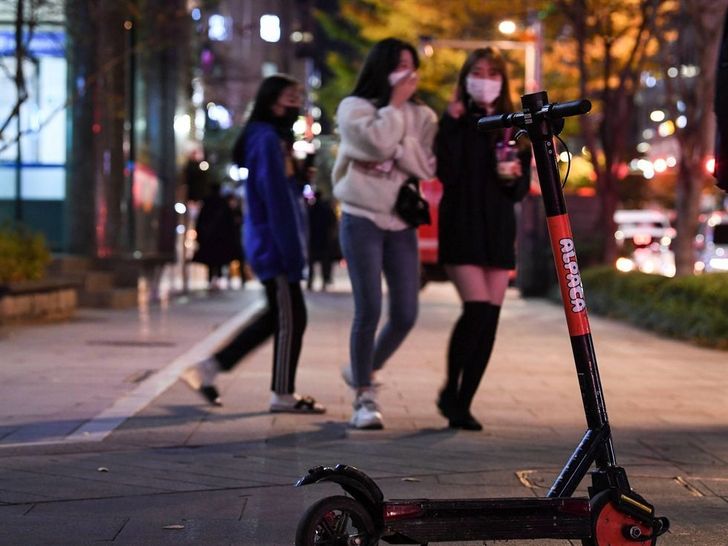
An electric scooter is parked in the middle of a street in Gangnam District in this Nov. 13, 2020 photo. Korea Times photo by Lee Han-ho.
E-scooter-related complaints from Seoul residents have been on the rise, according to a civil complaint center under the city government. A total of 235 complaints were filed in 2020, up from 44 in 2019 and one in 2018. Since January this year, 162 complaints have already been filed.
Following calls to remove the vehicle from the streets, the central and local governments are taking measures to ensure that e-scooters are parked in suitable locations.
In November 2020, the presidential committee on the Fourth Industrial Revolution introduced a set of guidelines on e-scooter parking, designating 13 places as prohibited areas for stopping or parking the vehicle.
Under the measures, no parking zones for e-scooters include the middle of a sidewalk, near crosswalks and traffic facilities for the disabled ― such as tactile paving areas ― and near subway entrances.
But so far, the guidelines have done little to stop illegal dumping as many users are not aware of the rules.
To increase awareness, Seoul City plans to take stronger steps. It is seeking to remove wrongfully parked e-scooters by revising the ordinance governing their use, which will come into effect as early as June following discussions with the city council.
Devices left in no-parking zones will be collected at the operator's expense of 40,000 won ($36). If the operator does not pick up the towed vehicle right away, they can face up to 500,000 won in impound charges depending on the number of days an e-scooter is left unclaimed.
The new measures are expected to remove randomly standing e-scooters from city streets, but personal mobility operators are far from happy with the proposal.
They view that setting parking zones may challenge the “dockless” concept of e-scooters which emphasizes user convenience. In addition, removal charges may take a toll on small businesses and startups in the ride-sharing services industry.
“The 500,000 won storage fee seems excessive compared with other countries. We understand that such rules are needed to ensure public safety, but the government has been making unilateral decisions on e-scooters without proper discussions with the operators,” an industry official told The Korea Times on condition of anonymity.
Another official said, “We will have to see how city officials actually carry out the new rules, but we don't think that the city will choose to implement excessive regulations lowering the convenience and accessibility of our services. Such regulations would not be welcomed by the public, many of whom are users of e-scooters.”
Both officials stressed that they are putting efforts into resolving the parking issues. They are relocating e-scooters parked in restricted areas, and encouraging users to properly park the vehicle by offering incentives, while subjecting those who leave them in banned areas to stricter penalties.