Journalists around the world discuss post-COVID era

Journalists from Korea participate in the annual World Journalists Conference 2021 at the Korea Press Center in downtown Seoul, Monday, with journalists from other countries taking part online. During the three-day event from Sunday to Tuesday, participants discussed the role of media in the post-COVID era and the global climate crisis. Yonhap
Post-COVID era, climate crisis issues top agenda of World Journalists Conference 2021
By Jung Da-min
Around 60 journalists from 50 countries met to discuss the role of journalism in the post-COVID era as well as global warming.
The World Journalists Conference 2021, hosted by the Journalists Association of Korea (JAK), kicked off Sunday for a three-day run.
The annual media event, which has been held since 2013, addressing various themes related to media as well as projections and strategies regarding prominent global issues, was held online for the second straight year due to the COVID-19 pandemic.
This year's event was held under two themes: “Prospect of the Post-COVID Era,” in line with the development of vaccines and the beginning of inoculations; and “Global Climate Issues” to discuss joint responses to climate change that affects society, the environment and life worldwide.
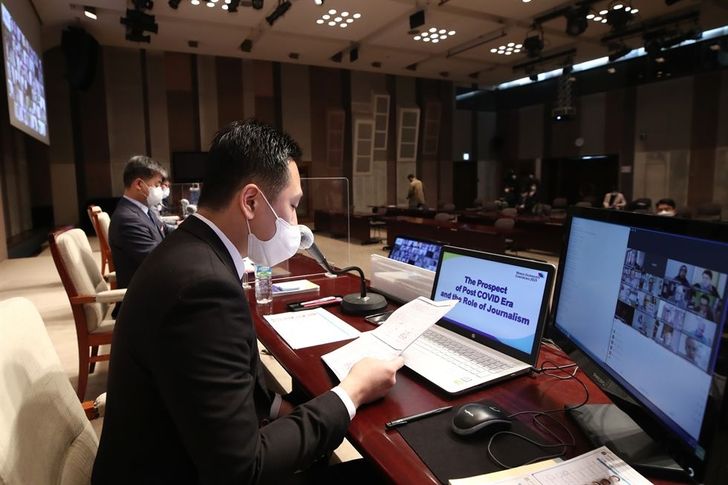
Journalists from around the world participate online in the World Journalists Conference 2021 that kicked off Sunday, at the Korea Press Center in downtown Seoul, Monday. Yonhap
Prime Minister Chung Sye-kyun delivered a congratulatory video speech, saying the conference provides a meaningful and valuable opportunity for the international community to find the role of the media in addressing important matters in times of uncertainty.
“As you may well know, COVID-19 has brought about a huge change around the world in the most painful way. The pace of change has accelerated and its range has expanded greatly. Indeed, an era of great transformation with maximized uncertainty has dawned,” Chung said.
“Climate change is the very issue where such changes and uncertainties are concentrated. This problem can never be solved by the efforts of a single country. Based on solidarity and cooperation, all countries should put their heads together across national borders in order to find solutions.”
The prime minister also stressed the media's role of delivering the truth, saying, “We are facing a new world where anyone can easily produce, distribute and consume information, thanks to the development of digital technology. As people's thirst for the truth becomes more unquenchable, the value of journalism becomes even more invaluable.”
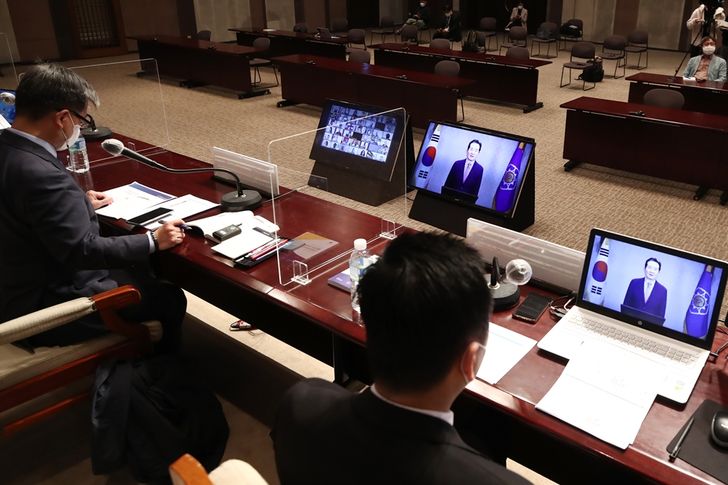
Prime Minister Chung Sye-kyun delivers a congratulatory video message at the World Journalists Conference 2021 hosted by the Journalists Association of Korea at the Korea Press Center in downtown Seoul, Monday. Yonhap
On the first day of the conference, journalists discussed what to expect in the post-COVID era and the role of journalism. Jung Min-ho, digital content editor of The Korea Times and head of the JAK's international relations department, joined as moderator.
About 26 speakers shared post-COVID scenarios in their countries and discussed the increasing need for the media's role of delivering the truth. They included Indonesian Journalists' Association public services director Mohammad Nasir, The Irish Times columnist Frank McNally, Ajou University psychology professor Kim Kyung-il and Nest Taller de Communicacion deputy director Rafael Robledo in Mexico.
“Despite all of the misinformation about the COVID-19 virus that is floating around, the pandemic has revealed an interesting twist in the form of an emerging truth,” said Flemming Ytzen, a columnist with the Danish newspaper Politiken. “Responsible media outlets have a duty to accurately report how our leaders are handling the situation and what the scientific community is advising, without succumbing to further hyper-politicization of events.”
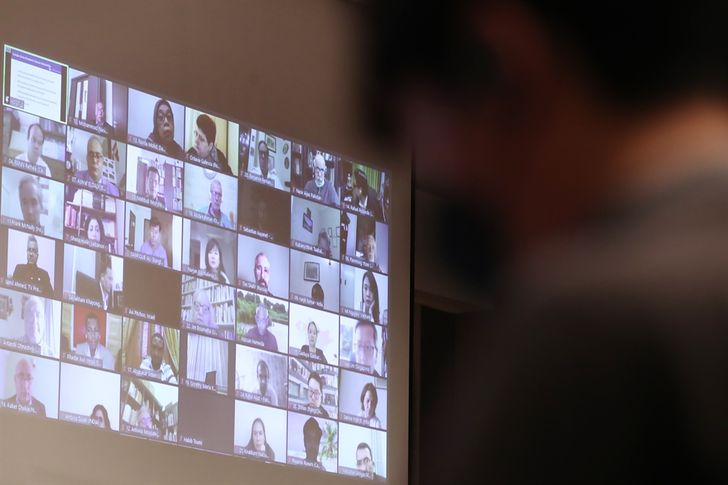
Journalists from around the world participating online in the annual World Journalists Conference 2021 are seen on a screen at the Korea Press Center in downtown Seoul, Monday. Yonhap
On the second day of the conference, about 22 speakers discussed the international community's joint responses to global climate issues and the role of journalism. The speakers included The Kabul Times deputy editor-in-chief Fathulbari Akhgar (Afghanistan), former The Daily Star journalist Md Tawfique Ali (Bangladesh), Segye Ilbo environmental reporter Yun Ji-ro (Korea) and Environment Communication of Singapore Chairman Ivan Lim.
“The task is truly formidable and complex, as it requires, at least in the beginning, Herculean efforts,” said Habib Toumi, a media advisor with the Bahrain News Agency. “It is not easy for journalists to understand the large-scale economic and intricate political factors and acquire the knowledge to formulate messages and engage public audiences amid a plethora of competing issues.”
Established in 1964, JAK is Korea's largest organization of journalists. It is celebrating its 57th anniversary this year and has about 11,000 members from 195 media companies across the country.