Traffic snarls downtown as city starts renovating Gwanghwamun Square

The six-lane road on the left side of Gwanghwamun Square in downtown Seoul is closed, Monday, after Seoul City started a project to expand the square. Yonhap
Traffic chaos inevitable for time being
By Bahk Eun-ji
Seoul City has started construction to widen Gwanghwamun Square in central Seoul by turning part of an adjacent thoroughfare into a pedestrian-only space.
The capital's most ambitious renovation project began on March 6, aiming to expand the square, which has been criticized for being pedestrian-unfriendly by sitting in the middle of the busy Sejong-daero thoroughfare.
The six-lane road in front of the Sejong Center for the Performing Arts will become a pedestrian-only space by being linked to the existing square in the middle of Sejong-daero. As a result, that section of the thoroughfare has been closed since March 6. The six-lane road on the other side of the square, in front of the U.S. Embassy and the National Museum of Korean Contemporary History, will be expanded by two lanes to allow north and southbound traffic to flow smoothly.
Traffic congestion has increased in the area as vehicles are being re-routed with half of Sejong-daero closed off for construction.
There was heavy traffic congestion especially on Monday, the first working day since the partial road closure, even though the city government deployed police officers in the area to control the flow of automobiles and guide drivers who were not fully aware of the changed road conditions.
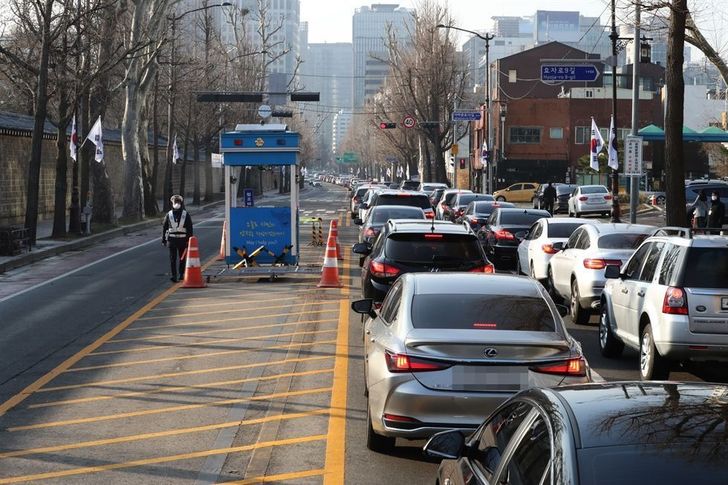
Bumper-to-bumper traffic seen on a road adjacent to Gyeongbok Palace in Seoul as the main thoroughfare in central Seoul was partially closed for the city government's project to expand Gwanghwamun Square. Yonhap
Many citizens complained about the congestion on their way to work.
“The bus I took was stuck in traffic for nearly 10 minutes near the Gwanghwamun intersection today,” said Lee Joon-tae, who commutes to his office in Jongno District from his home in Seodaemun District.
“I hope the city government will find measures to resolve the traffic congestion, such as opening more lanes in the direction where many people are headed,” Lee said.
Seoul city officials said they will try to minimize inconvenience for commuters, but urged residents to use public transport.
“We will carry out comprehensive transportation measures to ensure smooth traffic during the construction,” said Hwang Bo-yeon, head of the city's urban transportation department. “Citizens are advised to refrain from driving and use public transportation until traffic on Sejong-daero and its surrounding roads is stabilized.”
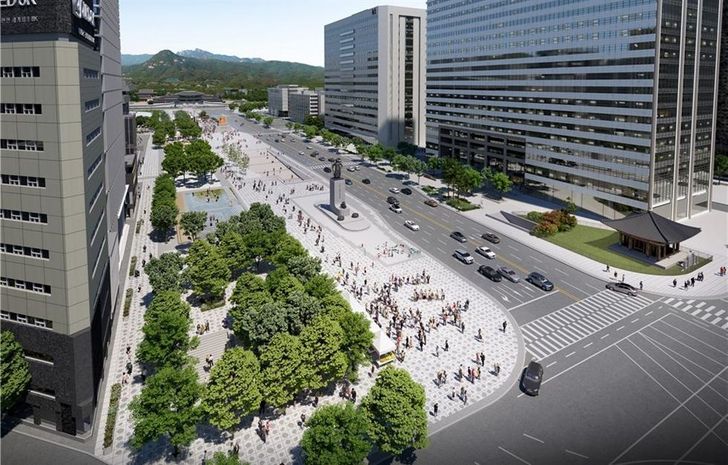
A computer graphic image of an expanded Gwanghwamun Square in central Seoul / Courtesy of Seoul Metropolitan Government
For more pedestrian-friendly Seoul
The construction plan was first announced in 2018. The city originally planned to expand the square to cover the entire Sejong-daero thoroughfare and create an underground road for vehicles connecting Gwanghwamun to Seoul City Hall.
But the city government opted for the current plan as many experts warned of major traffic congestion.
The construction, to be completed by October, will be carried out in several stages. The first stage involves the road closure on the western side of the square in front of the Sejong Center for the Performing Arts and the expansion of the road on the eastern side. In the second stage, the road on the western side will become a pedestrian-only space with more than 100 different kinds of flowers and trees. The statues of King Sejong and Admiral Yi Sun-sin inside Gwanghwamun Square will remain where they are.
In addition, a 550-meter-long bicycle path will be built on the eastern side of the square, while Haechi Madang and Sejong-ro Park will be remodeled to become more accessible from the square.
The city government said it plans to hold discussions with the Cultural Heritage Administration about whether to restore “Woldae (Moon Terrace),” a large rectangular platform from the Joseon Kingdom (1392-1910) that sits in front of Gwanghwamun Gate. Woldae is a part of Gyeongbok Palace where kings held public rituals and the city hopes to finish the restoration project by 2023.
“Gwanghwamun Square, the heart of downtown Seoul, will lift its gray color and turn into a green ecological space where citizens can sit and rest under green plants,” acting Mayor Seo Jung-hyeop said.