Parties gearing up for Seoul, Busan by-elections

Seoul and Busan, the nation's two largest cities, will have by-elections for selecting their mayors on April 7, 2021. Korea Times graphic by Cho Sang-won
By Yi Whan-woo
With about four months remaining before the 2021 by-elections to elect the mayors of Seoul and Busan, the rival parties are gearing up to search for potential candidates and are also developing winning strategies.
Scheduled for April 7, the by-elections are a result of the suicide of the former Seoul Mayor Park Won-soon in July and the resignation of former Busan Mayor Oh Keo-don in April after the two faced seperate sexual misconduct allegations. Both belonged to the ruling Democratic Party of Korea (DPK).
Oh admitted to molesting a City Hall employee, and the investigation is still ongoing. But with Park gone, the veracity of the allegations has been disputed by his supporters and those on the victim's side.
Accordingly, the majority of the potential candidates in Seoul are women, showing the rival parties' bid to promote themselves as women-friendly.
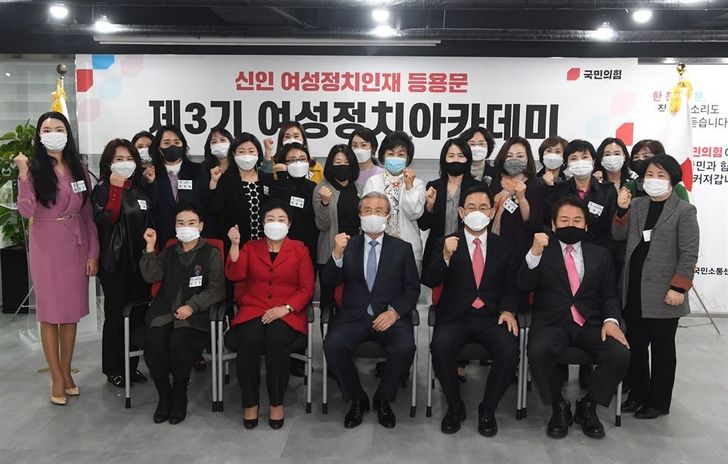
Main opposition People Power Party (PPP) interim leader Kim Chong-in, front row center, and party floor leader Joo Ho-young, front row second from right, pose with participants of a class organized by the party to support women in politics at the PPP headquarters on Yeouido, Seoul, Nov. 17. / Joint press corps
Three women from the main opposition People Power Party (PPP) so far have announced their Seoul mayoral bids.
They are former three-term lawmaker Lee Hye-hoon, Seocho-gu Office chief Cho Eun-hee and former Songpa-gu Office chief Park Chun-hee.
All three have been highlighting a need for female leadership, as well as a need to receive what they call the “bungled” real estate policies of the Moon Jae-in government that have led to soaring housing prices in the nation's capital.
Na Kyung-won, a former four-term legislator, is also being mentioned to possibly join the race.
The possible candidates from the DPK side are Minister of SMEs and Startups Park Young-sun and Anti-Corruption and Civil Rights Commission Chairwoman Jeon Hyun-heui.
“Feminism is a keyword for the Seoul mayoral by-election, and in that sense, the rival parties appear to be on the right track in their attempt to field a candidate,” said Shin Yul, a political science professor at Myeongji University.
Asked why male political heavyweights are also being touted as potential candidates by the parties, Shin noted that the 2021 by-elections involve the nation's two largest cities and therefore are considered a major litmus test for the 2022 presidential election.
“Women's empowerment is just a part of the bigger picture to win the 2022 election and finding a candidate, regardless of gender, is critical in laying the groundwork for a 2022 victory,” Shin said.
The possible male candidates from the DPK include Reps. Woo Sang-ho and Park Ju-in.
The PPP appears to be searching for outside figures, such as former lawmakers Ahn Cheol-soo and Keum Tae-sup, with them once forming an alliance with a DPK predecessor or being a DPK member, respectively, but later becoming outspoken critics against the party.
Former Deputy Prime Minister and Minister of Economy and Finance Kim Dong-yeon is on the possible mayoral candidate list, too.
An advocate of market-driven policy, he collided with President Moon's liberal-minded aides when he was in office, sources said.
“The parties will need a charismatic figure who can assuredly outrace the opponent and help bolster the party to gain momentum all the way to the presidential election,” Shin said.
The professor said the PPP especially may be unsatisfied with its female potential candidates, compared to Park Young-sun of the DPK, for instance, who is known for her “propulsive and aggressive nature” as a former four-term lawmaker.
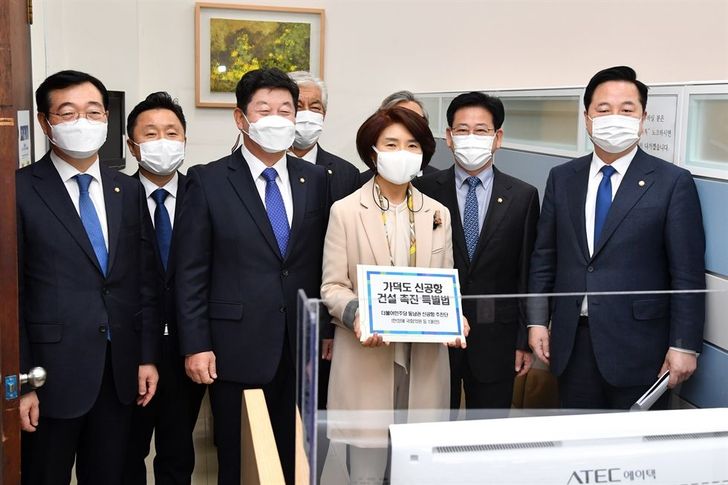
The ruling Democratic Party of Korea from Busan, Ulsan and the surrounding South Gyeongsang Province submit a bill for a special law to facilitate the construction of a new airport in Busan at the National Assembly, Seoul, Nov. 21. Yonhap
In Busan, the DPK is trying to divert voters' attention from its image, which was tarnished by Oh's sexual harassment allegations, by highlighting the ruling bloc's recent push to build a new airport on Gadeok Island within the port city.
Based on a report by a committee under the Prime Minister's Office, the Moon government announced on Nov. 17 to scrap a plan to expand Gimhae International Airport, also in Busan, which was intended to handle growing air traffic demand in the southeastern parts of the country.
The initial plan was announced in June 2016 under former President Park Geun-hye, which was a compromise between different opinions from the involved municipalities ― Daegu and surrounding North Gyeongsang Province had advocated for Miryang for a new airport site, citing its easier accessibility and sufficient demand, whereas Busan citizens demanded the new airport be built on Gadeok Island.
The Busan city government welcomed the decision to scrap the Gimhae expansion plan and the ruling bloc's push to build a new airport on Gadeok Island, demanding that an envisioned new airport should be constructed as soon as possible to increase the city's chance to win the bid to host the 2030 World Expo.
“The project is obviously a breakthrough for the DPK and its chairman Lee Nak-yon,” Park Sang-byung, a professor at Inha University, said, noting Lee is a leading presidential candidate for 2022.
Under the circumstance, National Assembly Secretary-General Kim Young-choon, lawyer Kim Hae-young, and Rep. Chun Jae-soo have emerged as possible DPK contestants for the Busan mayorship.
The three, all from Busan, are either active or retired DPK lawmakers.
Also a former ocean and fisheries minister, Kim Young-choon who became inactive on social media after ending his third legislative term in April 2020, has re-opened his Facebook account.
Kim Hae-young leads a think tank run by the DPK in Busan after finishing his term at the 20th Assembly, and is seen to have a good understanding on a range of regional issues.
Chun is serving two straight parliamentary terms since 2016.
In the local elections, Busan used to be a conservative stronghold before Oh became the first left-leaning candidate to be elected as mayor in 2018.
“In that regard, the PPP will be eager to win back the mayoral seat and look for a highly-competitive candidate,” Shin said.
Among the potential candidates of the PPP are three active and former lawmakers ― Suh Byung-soo, Lee Un-ju and Lee Jin-bok.
Suh is the party's most-elected lawmaker, serving four consecutive terms from 2002 to 2014 and the fifth from 2020. He was also the former Busan mayor from 2014 to 2018.
Serving two legislative terms from 2012 to 2020, Lee Un-ju was once a member of a DPK predecessor but later became a right-wing politician.
She is known for her strong attitude within the party, as seen when she shaved her head in 2019 in protest of President Moon's appointment of former Seoul National University professor Cho Kuk as the justice minister despite ethical lapses. Cho stepped down roughly a month after the appointment in September.
After ending his third consecutive term at the National Assembly, Lee Jin-bok has been leading a forum aimed at restoring the coronavirus-hit Busan economy since August.
Meanwhile, political analysts speculated the change in the COVID-19 situation and vaccination against the virus in other countries could influence the by-elections.
The United States seeks to begin a sweeping program of vaccinations within December, while the European Union members and Canada, among other Western countries, expect to start vaccinations in the first quarter of 2021.
But Korean health officials don't seem to be in a hurry to procure vaccines and it is said the earliest vaccination here will not take place until the second quarter of 2021.
“The voters may turn back against the government and the ruling party if the spread of the virus gets worse by the Election Day and vaccination is not available,” said Shin Yul. “A different scenario in favor of the DPK is also possible if the COVID-19 situation remains unchanged but vaccination in other countries turns out to have side-effects and other safety issues.”