US returns 12 military sites to South Korea, including some at Yongsan Garrison
Summary
The United States on Friday returned 12 military sites to South Korea, including two plots inside Yongsan Garrison in central Seoul. Seoul and Washington agreed to keep consulting on cleanup costs, decontamination procedures and other SOFA issues. It was the first time sites in the Yongsan complex were handed over to South Korean control, and Seoul plans to build a national park there.
Key Facts
- The returned sites include Camp Kim, four other USFK sites in Seoul, Camp Walker heliport in Daegu, Camp Jackson in Uijeongbu, Camp Mobile in Dongducheon, a golf course in Hanam, a Marine contingent site in Pohang and a shooting range in Taebaek.
- The return was discussed during a virtual joint committee session of the Status of Forces Agreement between Seoul and Washington.
- The two sides did not resolve who would pay environmental cleanup costs, but they agreed to continue consultations on decontamination procedures, base management criteria and other outstanding issues.
- Choi Chang-won said discussions are under way on the potential return of the remaining 12 U.S. military sites in South Korea.
- The government said South Korea will first carry out decontamination after the handover and then implement its planned projects, including possible public housing at Camp Kim and relocating the National Medical Center to the former U.S. Army Corps of Engineers site.

Ko Yun-ju, Director-General for North American affairs of the South Korean ministry of foreign affairs, left, and Lt. Gen. Scott L. Pleus, Deputy Commander of United States Forces Korea, fist-bump during a virtual joint committee session of the Status of Forces Agreement on Friday. Courtesy of the Ministry of Foreign Affairs of South Korea
The United States on Friday returned 12 American military sites to South Korea, including some in central Seoul, amid persistent concerns that an additional delay would further dampen regional development efforts.
During a virtual joint committee session of the Status of Forces Agreement (SOFA), Seoul and Washington agreed on the return of the sites, but failed to bridge differences on who and how to shoulder environmental cleanup costs, Seoul officials said.
But the two sides agreed to continue consultations on decontamination procedures, base management criteria and other outstanding issues going forward, they said.
Among the returned sites are two plots inside the Yongsan Garrison in central Seoul, Camp Kim and four other sites used by the U.S. Forces Korea (USFK) in the capital city.
It is the first time that sites at the Yongsan complex ― the erstwhile U.S. military headquarters ― have been handed over to South Korean control. Seoul plans to establish a national park there.
The other returned sites are the Camp Walker heliport in the southeastern city of Daegu; Camp Jackson and Camp Mobile in the northern cities of Uijeongbu and Dongducheon, respectively; a golf course in Hanam, south of Seoul; a Marine contingent site in the southern port city of Pohang; and a shooting range in the eastern city of Taebaek.
Seoul and Washington agreed on the return on the condition that they continue consultations on responsibilities for base decontaminations, ways to strengthen the environmental management of installations currently under USFK control and the revision of SOFA-related documents, according to the government.
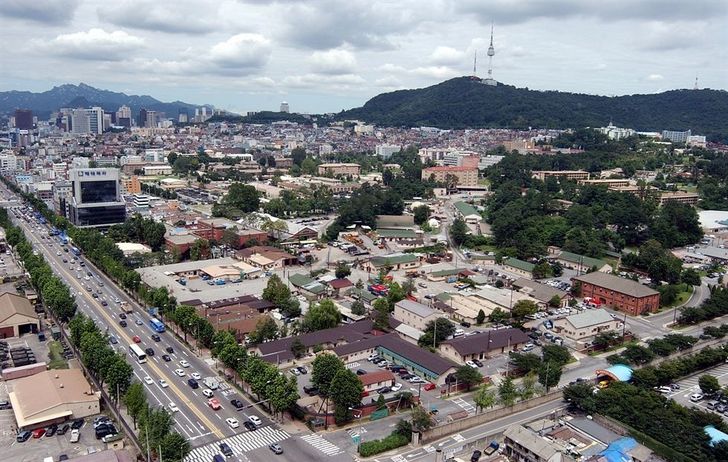
The United States Forces Korea's Yongsan Garrison in Seoul's Yongsan District. Korea Times file
SOFA governs the legal status of 28,500 American troops here.
"Discussions are under way on the potential return of the remaining 12 U.S. military sites in South Korea," Choi Chang-won, first vice minister of government policy coordination, said.
Talks about the return date back to 2003, but South Korea and the U.S. have made little progress amid disagreements over decontamination procedures, base realignment considerations and other complicated issues.
The current Moon Jae-in administration has been pushing for their swift return amid residents' worries that a further delay could complicate decontamination efforts for already vacated bases and regional development prospects.
"The two sides shared the understanding that if the return of the bases is delayed, local communities will face greater economic and social difficulties," the government said in a statement.
"We agreed to manage and resolve diverse pending issues related to SOFA so as to contribute to the Korea-U.S. alliance," it added.
After the handover, South Korea will first carry out the decontamination process and then implement its planned projects.
It is reviewing building public homes at the Camp Kim site, and relocating the National Medical Center in Seoul to the vacated site of the U.S. Army Corp of Engineers, according to the officials. (Yonhap)
Explore More
- Q.
- Q.
- Q.