Trump or Biden?

U.S. President Donald Trump points to a delegate after speaking during the first day of the Republican National Convention on Aug. 24 in Charlotte, North Carolina. AFP-Yonhap
US presidency to affect Korean Peninsula issues
By Do Je-hae
The U.S. presidential election campaigns are picking up speed.
The Democratic Party has named former two-time Vice President Joe Biden as its presidential candidate earlier this month and the incumbent President Donald Trump accepted the Republican Party's nomination to run for reelection this week.
The U.S. presidential election is drawing keen attention from Korean media and among foreign policymakers given the dominant influence the U.S. plays in Korea's national security and diplomacy as the nation's biggest ally.
Foreign policy experts raise a question over how Korea should prepare to deal with changes in the post-election period and adjust to either Biden's “pro-alliance” approach or Trump's “America-first” policy, as well as which candidate will better handle relations with China, as the escalating China-U.S conflict is emerging as a primary concern for Korea's diplomacy in the long run.
“Many people think that a Democratic president will handle China better. That's a common conceptual flaw,” Lee Seong-hyon, director of the Center for Chinese Studies at the Sejong Institute, told The Korea Times. “Even though the Democratic Party platform sounds out that it will engage China through dialogue and trade, many of the pending bilateral issues such as Hong Kong, South China Sea, human rights and technological competition are long-term thorny issues. Democrats will be tough with China on them. Even tougher on human rights issues.”
“The problem is that it is not clear whether the Democratic president has a better tool (than Trump) to restrain China effectively. The difference from the Trump administration is that it will strengthen alliances with like-minded countries. Putting the alliance system back in order may take some time, given how much damage Trump did to alliances. Another weakness for the Democrats is that some advisers to Biden are advocates for compromise with China. That means that the Democrats may loosen pressure on China at some point down the road. China is expecting this,” Lee added.
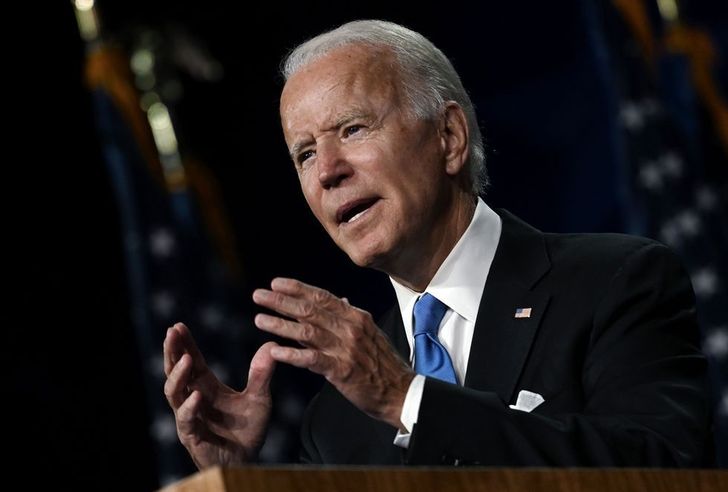
Former vice president and Democratic presidential nominee Joe Biden accepts the Democratic Party nomination for U.S. president during the last day of the Democratic National Convention, being held virtually amid the COVID-19 pandemic, at the Chase Center in Wilmington, Delaware, on Aug. 20. AFP-Yonhap
Regardless of who ends up in the White House, Korea will need strategies to ensure results that benefit national interests in complex bilateral issues, such as the Special Measures Agreement (SMA) negotiations for determining Korea's share of costs for the U.S. troops stationed here.
Aside from bilateral issues, the South Korean government has no choice but to keep a close eye on the results of the U.S. vote as the two candidates have different approaches to North Korea.
The Moon Jae-in administration has sought to improve relations with North Korea for more economic and other engagements, despite the U.S. focus on maintaining sanctions against Pyongyang while Washington sees no visible progress in North Korea's denuclearization. So uncertainties are expected for Moon's pro-engagement policy with the North.
Some experts say the timing of the U.S. election in November is also likely to affect Korea's push for Chinese President Xi Jinping's reciprocal visit to Korea this year. Speculations are rising that the Chinese side will be reluctant to arrange a visit by the Chinese head of state to a U.S. ally amid the rising U.S.-China rivalry.
In addition, some of Korea's new foreign policy goals, such as raising Korea's international stature by participating in an expanded G7, also depend on the results of the U.S. election as the G7 expansion is a specifically Trump idea which may very well be discarded if Biden takes office.
The Korea Times conducted some written interviews with experts on Korean issues on how a Biden presidency or Trump reelection could impact South Korea's diplomacy and national security policies.
Trump reelection

Donald Kirk
On Trump's reelection, Donald Kirk, a veteran correspondent and author on Korean Peninsula issues who divides his time between Washington and Seoul, shared the following insights.
Q
How do you see Trump's chances for reelection?
A
Trump is clearly behind in the polls, but he and his team are trying desperately to catch up. Claiming progress on a cure for COVID-19, and criticizing violent protests, speaking to his base around the country, he does have a chance. I would almost say an even chance ― though pollsters may disagree.
How will a second Trump presidency navigate the North Korea problem?
Trump may go for another summit with Kim Jong-un ― an effort at showmanship that would not result in North Korea giving up its nuclear program and would do nothing really to bring about long-range reconciliation. So in the end Trump would go on claiming that he is averting a second Korean War when in fact he is doing very little. We could expect Trump to try to navigate some form of reconciliation ― another deal that would raise false hopes while solving nothing.
How will a second term for Trump affect primary bilateral issues, such as SMA negotiations?
What Trump will do vis-a-vis South Korea in a second four-year term is quite unpredictable, but I'm not optimistic. His insistence on a huge increase in the already high amount that South Korea pays for having 28,500 U.S. troops on U.S. bases in South Korea is more than an irritant. It could lead to a sudden decision by Trump to withdraw a few thousand U.S. troops and undermine the U.S.-ROK alliance. Although President Moon would like to get away from reliance on the U.S. with the ROK assuming operational control (OPCON) of military operations in time of both war and peace, a sudden sharp disruption in U.S.-ROK relations would have quite a negative impact not only on defense but also on other aspects of the historic U.S.-Korea relationship, notably trade. Trump has already made an issue of the huge Korean trade surplus with the U.S. and may press hard for measures to open Korean markets still further while imposing measures for decreasing Korean exports to the U.S.
The rising U.S.-China rivalry is a huge challenge for South Korea. Which U.S. president do you think will better handle the conflict with China?
Whoever wins the election, the next president will face the whole problem of China's fast-rising influence in Asia and beyond. Both Biden and Trump would want China to restrain North Korea, to join in sanctions and pressure the North to give up its nuclear program. Neither would want to risk a war or any type of military conflict with China in flashpoints ranging from the South China Sea to Taiwan to the Korean Peninsula. Trump talks tough from time to time but has yet to support his bluff and bluster with real action. Biden might well do the same in a crunch, but perhaps Biden would be more inclined than Trump to try to rein in China's expansionist instincts by strong measures on trade. Frankly, it's very hard to say which of the two, Biden or Trump, would do better in conflict or disagreement with China.
Do you think Xi Jinping will be reluctant to visit Korea before the U.S. election?
There's so little time before the U.S. election that it would seem quite difficult to arrange for President Xi Jinping to come to Korea for a summit with President Moon before Nov. 3, the date of the U.S. election. In addition, both Xi and Moon would be concerned about the impact of the summit on the campaigning and voting. Advisers to both Trump and Moon could pick up on all they said and did, every sentence and gesture, raising questions about the significance of every detail on U.S. relations with both China and Korea. While a Xi-Moon summit in Seoul is still physically possible, it would inevitably enter into the American political debate at a critical time for the U.S. and the world. That's not to say that Xi and Moon will avoid meeting in Korea before Nov. 3, just that it would raise complications that might divert from what they hoped to discuss and accomplish.
Biden presidency

Brad Glosserman
Brad Glosserman, senior adviser of the Pacific Forum CSIS and noted author on regional security, shared his views on Biden.
How will a Biden presidency navigate the North Korea problem?
More traditionally. A greater skepticism of the North Korean leadership, a much greater emphasis on consultation with allies, and the demand for real actions, not the promises ― if that ― of Kim Jong-un. Absent a North Korean provocation, it will be much harder for a Biden administration to muster the international coalition to pressure Pyongyang, however, since Trump put his stamp of approval on the relationship.
How will a Biden presidency affect primary bilateral issues, such as the SMA negotiations?
Again I expect a return to normalcy. By that I mean that U.S. demands for more money will continue, but not the absurd and unjustified increases that the Trump administration wants. Talks will also begin from a different starting point: A respect and appreciation in the White House for the alliance and the contributions that South Korea ― and other allies ― make to the partnerships. But, and this is vital, the U.S. will not stop asking more from allies. The world has changed and alliances must change with it.
Which candidate do you think will better handle the conflict with China?
Biden, because he will be more stable, more strategic and more thoughtful in his approach. Both administrations will take a harder line toward China, but the current administration is inconsistent and erratic in its approach. It is difficult to discern what the U.S. wants and how China should change its behavior ― other than doing whatever the U.S. demands. That is not going to happen. I also expect the Biden administration will be more focused on building an international coalition against Chinese misbehavior, rather than going it alone and demanding that allies and partners get in line behind the U.S.
I doubt a visit will occur before the vote because it is a short period of time (the election is in November so only two months away and such visits usually require planning), the COVID outbreak is a distraction ― people will ask why a visit now? ― and there is the risk of infection itself. Beijing seems to be aware that it has to modify its diplomacy and especially if Biden wins, I would anticipate that China will adjust to a new reality. Trump has made it easy for China to make diplomatic gains and a Biden administration will force it to act differently.