Moon's offer for talks with Japan raises doubts

President Moon Jae-in speaks in a ceremony, Aug. 15, to mark the 75th Liberation Day at the DDP in Seoul. Yonhap
By Do Je-hae
President Moon Jae-in underlined Saturday during a speech to mark Liberation Day that Korea is open for talks with Japan to sort out pending bilateral issues.
But skepticism is rising that the offer for talks will not have much impact on improving the strained bilateral ties, given the negative reactions to Moon's speech.
During the speech to mark the 75th anniversary of Korea's liberation from Japan's 1910-45 occupation, Moon underlined the need for diplomacy, while repeating Seoul's resolute stance that it cannot intervene in a judiciary decision regarding the two countries' shared past.
“In 2005, four victims of forced labor filed a damage suit against Japanese companies that mobilized Korean workers in the colonial period. In 2018, the Supreme Court of Korea ruled in their favor,” Moon said. “A Supreme Court ruling has the highest legal authority and executory power within the Republic of Korea. My administration respects the judiciary's decision, and we have been engaging in consultations with the Japanese government on how to reach a satisfactory resolution to which the victims could agree. The door for such consultations remains wide open. My administration is ready to sit down with the Japanese government at any time to discuss these issues.”
He added, “At the same time, we will work with Japan to protect universal values of humanity, and the principles of international law and democracy based on the separation of powers.?I believe that joint efforts by Japan and Korea to respect individual human rights will become a bridge for friendship and future cooperation between the peoples of our two countries.”
This was a noticeable departure from the stern tone he took during his speech last year amid rising bilateral tension over history and trade disputes.
Tokyo did not react immediately to Moon's offer for talks. During a speech Saturday, Japanese Prime Minister Shinzo Abe did not make any apology for his country's past military incursions in the region and four of his ministers visited the Yasukuni Shrine. Abe did not visit in person, but sent a ritual offering for the war dead to the shrine.
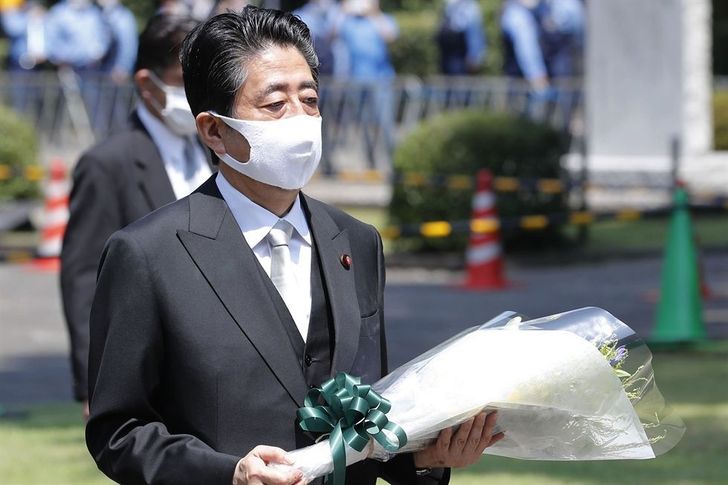
Japanese Prime Minister Shinzo Abe carries a bouquet of flowers to offer at the Chidorigafuchi National Cemetery for unidentified remains of the nation's war dead in Tokyo Saturday, Aug. 15. AP-Yonhap
The Japanese media underlined that Moon's remarks were aimed at extracting concessions from Tokyo, without mentioning any specific measures.
“This statement is believed to be a way of urging Japan to make concessions in the negotiations by stressing that Seoul's basic stance of respecting judicial rulings remains unchanged,” according to a Yomiuri Shimbun report. “A South Korean court is in the process of selling the assets of Nippon Steel Corp. ― formerly Nippon Steel & Sumitomo Metal Corp. ― which lost the lawsuit. Moon's remarks indicate his intention to seek a solution through negotiation between the governments before the sale order harms the Japanese company.”
Last week, Cheong Wa Dae named key presidential aide Choi Jong-kun as first vice minister of foreign affairs, a post overseeing policies for bilateral relations. Choi is known as a hardliner on Japan.
Tension on the rise
Speculations are rising that the replacement may impact how the foreign ministry deals with Japan ahead of more possible bilateral clashes.
The deadline for extending the General Security of Military Information Agreement (GSOMIA), a military intelligence sharing pact with Japan, falls on Aug. 24 and Seoul will have to make some sort of an announcement on what it will do with it, after it decided to delay its expiry in November 2019 following U.S. opposition.
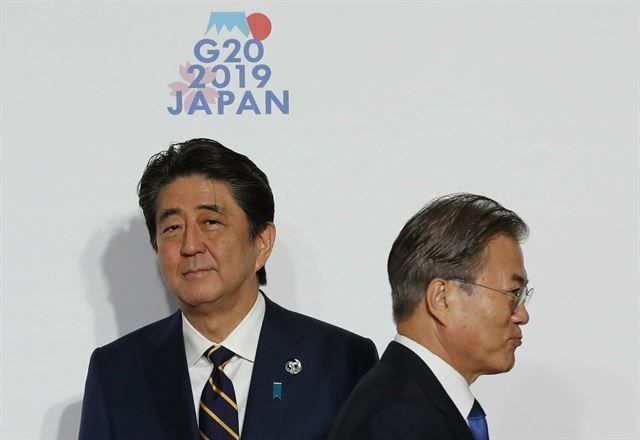
President Moon Jae-in, right, passes by Japanese Prime Minister Shinzo Abe during a welcoming ceremony for the G20 summit in June 2019 in Osaka, Japan. Korea Times file
Also the two countries could clash at the World Trade Organization (WTO) following Korea's filing of a complaint over Japan's trade restrictions on materials crucial to Korea's high-tech sectors imposed in July 2019.
Most recently, tensions have been rising after a local court in Pohang allowed the seizure of shares that Japan's Nippon Steel has in a joint venture with POSCO, in order to implement the 2018 Supreme Court ruling. The Japanese firm has appealed the notice.
Since summer 2019, the two countries have remained worlds apart on primary bilateral issues, such as the lingering differences over the South Korean Supreme Court's ruling which ordered Japanese companies to compensate surviving South Korean victims of wartime forced labor, and the dissolution of a foundation for the victims of wartime sex slavery, established based on a bilateral agreement during the previous Park Geun-hye administration.
In addition, the bilateral relations plummeted to the lowest level last year since the normalization of diplomatic relations in 1965 due to Japan's trade restrictions, which are seen here as “retaliation” against the Supreme Court ruling on the forced labor case. Subsequently, Korea announced a decision in August 2019 to terminate the GSOMIA.