More bugs found under gov't investigation into Incheon tap water

A resident of Hasang-dong area in Siheung, Gyeonggi Province, some 16 kilometers southeast of Incheon, reported on July 16 of finding a 4-5 millimeter-long larva, above, from household tap water in the washroom. Yonhap
By Ko Dong-hwan
More citizens have reported bugs in their tap water, after the Incheon government launched an on-site investigation of the city's water distribution system following earlier complaints.
The additional reports, 15 from Seo-gu and one from Ganghwa County, came in last Friday and Saturday. During the period, meanwhile, 24 new reports were made from the two regions.
After the first report of chironomus plumosus, also known as the buzzer midge, in the city's tap water on July 9, the number of complaints peaked at 55 last Wednesday, with reports coming from Incheon and Siheung. The daily figure from then on dropped to 16 until last Saturday.
The bugs, according to the city, seem to have originated from a purification plant in Seo-gu's Gongchon-dong area, where the eggs were laid. The authority said larvae could have been transmitted to water pipes that connect to households in the regions.
The city said Sunday that the bugs found in the Gongchon purification plant and those found from households were the “same species,” bolstering the theory the bugs were carried from the plant to the households.
Seo-gu and Ganghwa share the plant as a tap water provider.
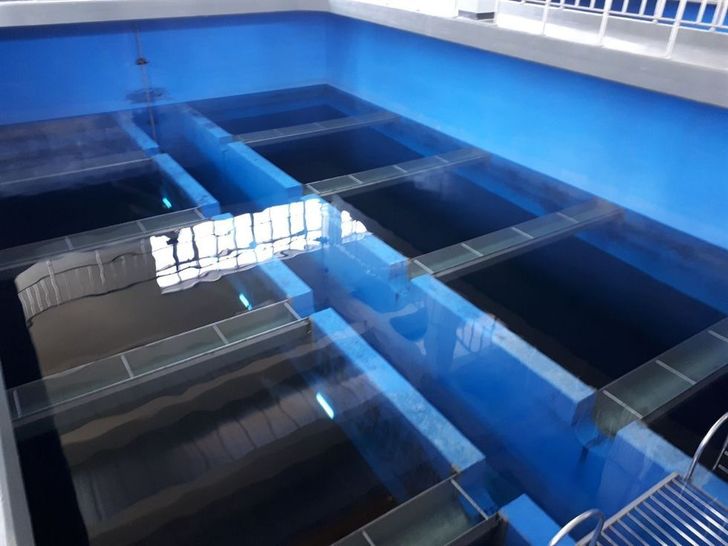
The purification plant in Incheon's Gongchon-dong, above, is believed to be the hotbed of the city's latest tap water bug infestation. Courtesy of Incheon City Government
The city said the larvae might have been hatched from a granular activated carbon (GAC)-based filtering pool connected to water supply pipes. GAC is used in an eight-step “advanced” purification process that is operated by 44 out of 484 purification plants nationwide. The others use a six-step “standard” method.
The Gongchon purification plant introduced the advanced purification process in 2019. An ozone-based filtering pool, another “advanced” purification feature, was also under construction.
Following the latest bug reports, however, the plant shut down its GAC pool and changed its operation mode to standard.
The series of bug sightings forced the Ministry of Environment to hold an emergency video-conference on July 17 with water supply division chiefs from city and provincial governments nationwide, major river basin environmental offices' chiefs and officials of Korea Water Resources Corporation. At the meeting, Vice-Minister Hong Jung-ki ordered safety checks on purification plants and distributing reservoirs nationwide.
The same day, Incheon and Han River Basin Environmental Office formed a 14-member special taskforce for on-site inspections.
The city cited water supply experts as saying that emergence of larvae “on a minor scale is understandable” as it could often be attributed to neglected maintenance of water tanks or distributing reservoirs but that it was “unusual if such an outbreak occurred at multiple households with outsourced tap water like those in Incheon.”