Mockumentary lambasts online urbex culture

"Min" helps "John" reach the roof of a building in Seoul for a photo shoot, in Alex G. Ringo's mockumentary "Inside Scoop from the Influencer. / Courtesy of Alex G. Ringo
By Jon Dunbar
There's no shortage of crazy rooftopping videos online, showing some thrill-seeker hanging off a ledge or climbing a perilous construction crane. It's all been done and netizens seem to have grown tired of them. But a new video, made by Russian urban explorer Alex G. Ringo, offers something different: it's a satirical mockumentary savaging the international jet-set urbex community, which he sees as having lost its soul to commercialism in the social media age.
Ringo decided it's finally time to let the world see
this year, now that it completed the 2019 festival circuit. It will be online this weekend.
It was nominated last year for “Best short film made for less than $5,000”
and for Best Experimental Short, Best Original Idea and Best Editing at the Spring 2019 Top Indie Film Awards. It also made the Coronet Selection in April at
. And Ringo himself won an Award of Recognition at the
in the Experimental category.
Under the tagline “How boring is urban exploration as a full-time job?” the 16-minute film follows the misadventures of a cast of fictionalized explorers and Instagram influencers, many of whom appear in the film credits under aliases due to the legal gray area of their pastime. It was shot on location in Korea, China and Russia, with the bulk of the action taking place in Seoul in a few locations aboveground and below that are well-known to local explorers.
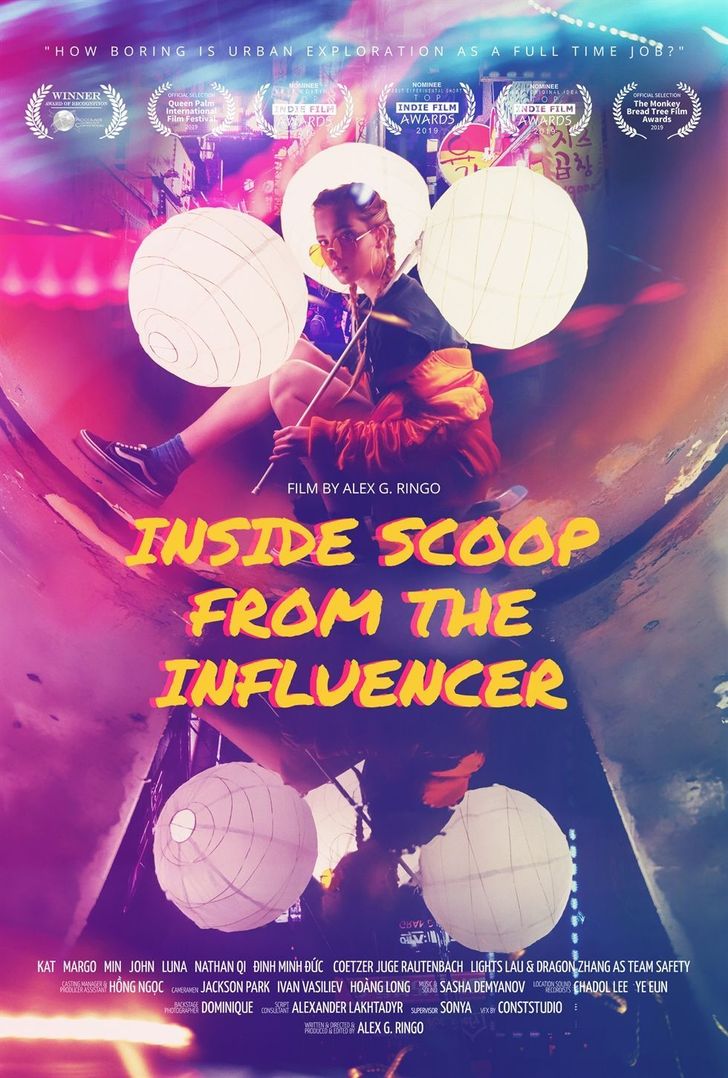
The poster for "Inside Scoop from the Influencer" by Alex G. Ringo/2020-01-08(코리아타임스)
“Korea seemed to be the perfect place for shooting most of the street scenes and exploration scenes because it was a place where we had amazing locations as well as a crew,” Ringo told The Korea Times. “A lot of work was done on pre-production stage to ensure everything would go smooth during the shooting days. The pre-production team arranged permissions, made location scouting, prepared costumes and props.”
The film follows Min, an aspiring model, as well as urban explorers Luna and John, as they fumble their way through the city trying to get that perfect shot involving increasingly ludicrous product placements.
When we meet them, John is photographing Luna leaping repeatedly under the giant sculpture in front of the DDP. It's unclear what they're trying to accomplish but they refer to it presumptuously as urban exploration. Ringo explained he used this image to underline how misrepresented urban exploration is online. “If you analyze the content of influencers of referred period, you would find a lot of content that is visually appealing but totally not related to urban exploration,” he said.
The characters try to go on a roof for a photo shoot, taking the stairs up 50 flights while telling Min not to sweat and ruin her appearance. At the top, they find a sign on the door warning them not to enter, to which Luna says “Legal, illegal, doesn't matter ― this is the Instagram business.”
For Ringo, this shows the approach of “commercial-oriented explorers of the new wave.” He added, “They didn't care about the sustainability of the hobby, thinking mostly short-term and caring only about getting content by all means possible.”
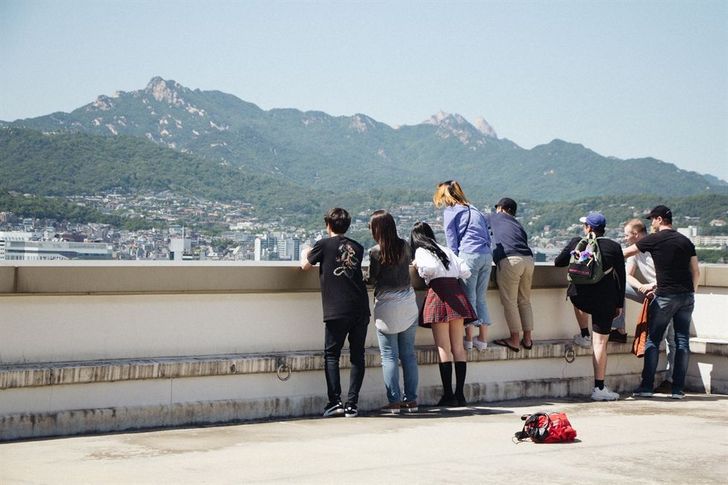
A behind-the-scenes shot showing the cast and crew of "Inside Scoop from the Influencer" on a rooftop in Seoul, with director Alex G. Ringo on the right. / Courtesy of Alex G. Ringo
John fails to pick the lock, so Luna uses bolt cutters to snip it off, only to find it leads into a classy restaurant (Top Cloud, which used to be on the highest level of Jongno Tower). It's a morality tale for urban explorers, who traditionally eschew such tools for illegally damaging private property.
The director relates an anecdote that helped inspire this scene. “I know the story about one teenager who came to Shanghai, did no research whatsoever, went to a high-rise building of interest and cut several locks to get to the rooftop,” said Ringo, a self-described “old-school explorer” who frowns on any property damage caused by explorers. “After that event security measures got tighter and building is inaccessible ever since. The most hilarious part of that story is that the roof was freely accessible through opened doors ― you just had to navigate to the right stairwell.”
Finally on a roof, they tell the model to undress and begin setting up a shot aping another picture they saw online, only to realize they need to have the model wear a jacket and telling her to get dressed again.
During their shoot, the characters get a call from their agent Margo, telling them about a new job to “shoot a cake in a dangerous way” and reminding them to reshoot a sneakers shot to be more “extreme.”
They enter a massive storm drain for their shoot, only to run into Margo and another urbex crew doing their own ridiculous photo shoot for “Super Shoes,” which accidentally becomes abbreviated to “UE Hoes.”
Ringo said the film was shot in 2018, to serve as a “time capsule” of urban exploration in the period from 2014 to around 2018, when people began to monetize what had once been a fiercely private hobby.
“What made the 2014-2018 period different?” he said. “Well, I think it's the approach to present the urbex hobby to a mass audience. Let me explain. Urban exploration has existed for a long, long time, and urban explorers took amazing pictures, they wrote deep, hilarious, touching books to share their excitement. Locations of interest were kept away from mass attention in order to keep them available for future generations of urban explorers. Authors before 2014 were amazing explorers, but they were bad at sales and marketing.”
But things started to change around 2013 and 2014 with the increasing influence of social media.
“Contrary to previous generations of explorers they used basic human emotions such as fear to get mass attention. Multiple YouTube videos of climbing high-rise buildings and cranes triggered a surge in popularity of urban exploration in 2013-2014, and I believe in that time salesmen knew that they on something of a hot streak. After that it became a gold rush. People started to practice urban exploration with the sole aim to earn some quick cash and quick fame. Literally anyone could have made some shots on the edge, sell them to the media and get mass followings because it was novel content. Those were the times when companies were pouring money to influencers in exchange for representation of the products. Influencers were paid to bring literally any product to the rooftop ― clothes, watches, alcoholic drinks, baked goods, medications for influenza, cosmetics, you name it.”
Ringo noted that public interest in urban exploration has fallen recently.
“I believe people got bored by the format by which urban exploration was presented to the mass audience. Since new-wave explorers were using the basic emotional response from the audience the content was actually quite uniform ― just some people climbing somewhere, with the video emphasizing the danger aspect of the climb. So mass audiences got tired of the monotonous content.”
The most successful of this generation of explorers, he says, adapted their content, focusing instead on travel videos or other forms of emotion-triggered videos, such as urban climbing or overnight challenges. “I think that such content triggers the same emotional response as MMA or prank videos, and have nothing in common with actual urban exploration,” he said.
The problem with this era of urban exploration was people were willing to take greater risks to get to the reward, which often could be a lot of money. Ringo describes this as a “goal-oriented approach contrary to the sustainable approach that was the norm of the hobby before.” This resulted in tightened security measures, increased legal punishment and even a few high-profile accidents resulting in death.

Alex G. Ringo pauses while climbing a ladder in Seoul in November 2016. / Korea Times photo by Jon Dunbar
“The purpose of the movie was not to show or promote good exploration techniques, but rather to catch an image and a vibe of commercializing the urban exploration scene. It was a time of low barrier of entry, of undemanding audience, of seemingly unlimited opportunities, of relaxed security, of overly naive and relaxed practitioners, of easy money for those who were willing to sell themselves out,” Ringo said. “So if you want to be good urban explorer ― don't use the movie as a tutorial and avoid acting like the characters in it.”
Watch the video online
.
“Inside Scoop from the Influencer”
at The Monkey Bread Tree Film Awards
the Queen Palm International Film Festival