Plan for bigger, sleeker Gwanghwamun Square sparks controversy

A computer graphic rendition of “Deep Surface,” the winning design for a new, expanded Gwanghwamun Square with an underground passageway, scheduled to be built by May 2021 / Courtesy of Seoul Metropolitan Government
Why some are not impressed with the city's planned transformation for central landmark
By Lee Suh-yoon
Gwanghwamun Square, the long strip in front of Gyeongbok Palace with daily sightings of Seoul's street democracy, is awaiting a major transformation that is planned to be completed by 2021.
The isolated plaza stretching down the middle of the 10-lane Sejong Street will be widened, spreading over the space occupied by the lanes on its western side. Six vehicle lanes will keep the traffic flowing on its eastern side ― mostly commuters from the north going to and from their jobs in downtown Seoul. The T-shaped intersection in front of the palace will be replaced by a 36,000-square-meter restored historic plaza and traffic will be diverted to a new U-shaped road separating it from the expanded Gwanghwamun Square to the south.

The current Gwanghwamun Square, created in 2009 by replacing eight lanes in the middle of a 20-lane road under former Seoul Mayor Oh Se-hoon. / Korea Times file
Together, the widened strip and plaza will increase the pedestrian area to 3.7 times the current size of Gwanghwamun Square. An underground passageway will provide easy connections to nearby subway lines, including the brand new high-speed GTX-A line that will cut through Seoul from Ilsan in the northwest to Dongtan in southeast Gyeonggi Province and allow commuters from either end to reach Gwanghwamun, Seoul Station or Samseong Station in less than 20 minutes.
But not everyone is happy with the plan. Civic groups that are monitoring the project say the possible social and cultural benefits do not outweigh the massive costs. Some say it reminds them of the last controversial makeover under former Seoul Mayor Oh Se-hoon. Gwanghwamun Square in its current state has been roundly criticized for its awkward isolation amid vehicle traffic, not to mention the large flower bed that some activists called a ploy to deter large political gatherings ― the square's best-known function.
Nam Eun-kyung, member of the Citizens' Coalition for Economic Justice, says Mayor Park Won-soon's plan to overhaul Gwanghwamun Square ― pouring in another 104 billion won ($88 million) just 10 years after Oh's reconstruction ― is too rushed. She claims the new blueprint does not reflect a truly pedestrian-centered design either, as six lanes of cars will still flow alongside and through the new square.
“It's a partial solution, and one that generates less resistance from those drivers, allowing the plan to be realized within the mayor's term,” Nam said.
“But such major construction projects should be able to provide more future-oriented solutions, envisioning a more pedestrian and public transport-oriented Seoul 50 to 100 years from now. Such a plan would take more time, of course, persuading people to participate in car-free zones and decreasing car traffic in general first in downtown Seoul.”

A computer graphic rendition shows how a historic plaza in front of Gyeongbok Palace will be restored as part of the city's plan for an expand Gwanghwamun Square. / Courtesy of Seoul Metropolitan Government
Nam and other activists claim the plan is set out according to Mayor Park's political timeline. As former Mayor Lee Myung-bak benefited from demolishing an overpass to build Cheonggye Stream, a sleek reconstruction of a downtown landmark is likely to give Park a boost in the 2022 presidential bid.
Kang Ok-hyun, a city official in charge of the Gwanghwamun reconstruction project, refuted the activists' claims. Building a bigger, more pedestrian-friendly Gwanghwamun Square now, she says, is a “part of the city's overall transportation policy” to get more people to leave their cars at home.
“It's not just Mayor Park's project; talk of a full historic restoration of Gwanghwamun Square is something that has been discussed since 2005,” Kang said in an interview at her office on Tuesday. “The completed square will also provide citizens with more green space to rest or enjoy cultural events just like public squares in other countries, rather than being an uncovered island in the middle of the street that is just used for rallies.”
However, those who took part in the project's external review committee ― 48 experts and 100 residents ― say a democratic process was lacking in the lead-up to the blueprint. Some came forth in a press conference last week, claiming they were deterred from publicizing the concerns that popped up in the meetings.
“There needed to be more diverse public debate on some of the issues discussed by the committee,” said Kim Eun-hee, a civic activist who was part of the committee. “But we just skipped the part on hearing what citizens' concerns and hopes were for Gwanghwamun Square. There wasn't a process of talking with or persuading actual citizens.”
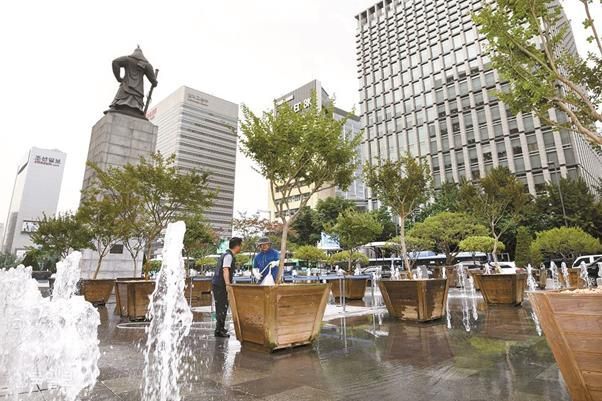
Rows of potted trees stand at one section of Gwanghwamun Square, July 1, to prevent a minor far-right opposition party from setting up sit-in protest tents. / Korea Times photo by Lee Han-ho
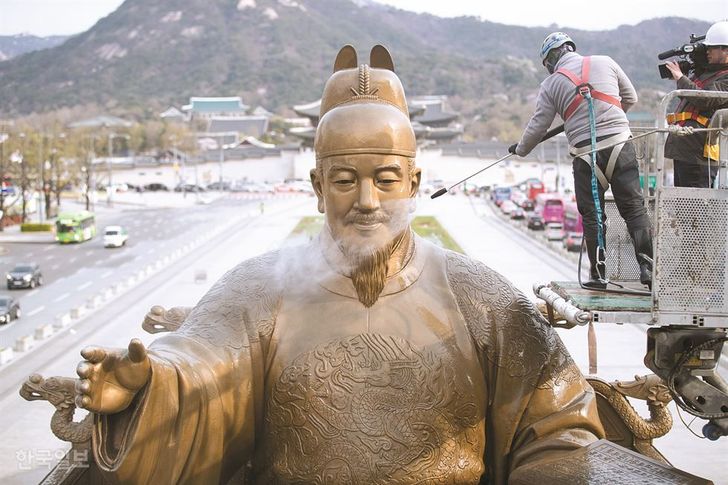
A worker cleans the statue of King Sejong at Gwanghwamun Square in this April photo. / Korea Times file
Others are concerned about the jaded thematic content of the current blueprint, which focuses on the restoration of Woldae as a historic plaza in front of Gyeongbok Palace. Woldae was a terrace where kings held public rituals during the Joseon Kingdom (1392-1910). It was lost in the changes following Japan's annexation of Korea from 1910 to 1945.
“There was no public consensus on why the historical restoration should be centered around the Joseon Kingdom again,” Hwang Pyung-woo, head of Korea Cultural Heritage Policy Institute, said. “There first needs to be a nationwide agreement on what it is we want to celebrate.”
“Restoring Woldae is a long-cherished project of the Cultural Heritage Administration (CHA),” Kang explained. The CHA is providing a third of the construction budget.
The city will nonetheless push ahead with the current design and start constructions next year. Recently though, it met an unexpected roadblock from the Ministry of the Interior and Safety, which must yield part of the grounds of the Central Government Complex to make way for the new U-shaped street and historic plaza.
Last week, Interior Minister Chin Young openly rebuked the city government's plans during a press luncheon, saying “nothing has been definitely negotiated yet” in letting the city government tear down part of the Central Government Complex's front yard and parking lot.
City official Kang, however, confirmed on Tuesday that negotiations were advancing and likely to reach a compromise within the year.