Giuseppe Santori: An Italian castaway on Jeju (Part 4)
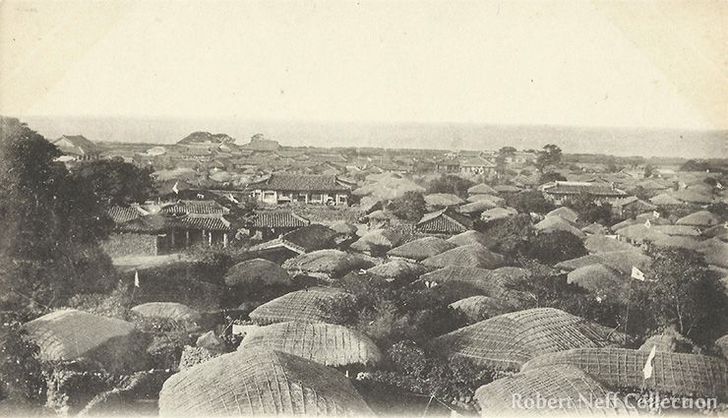
Jeju City within the walls, circa 1910-1920s
By Robert Neff
On September 20, 1878, the Bianca Pertica, an Italian barque, was destroyed in a powerful typhoon. Only five men managed to get into a lifeboat but over the next couple of days, one by one, they began to die.
One week later, only one survivor remained ― Giuseppe Santori ― and he was less than 10 kilometers from Jeju Island.
Santori was the only survivor but he was not alone. Bacchione, the last of his companions, had died the previous day, but Santori did not cast the body into the sea as had been done with the other corpses. Deprived of water for so long, it is easy to imagine Santori struggling to maintain his sanity and, perhaps, as morbid as it might sound, he found some comfort in Bacchione's corpse ― a mute companion to share his ordeal.
A faint breeze began to blow and Santori gratefully reassembled his makeshift mast and raised his sail. Throughout the day and the next, the breeze ― though slight ― continued to blow, propelling him closer and closer to the rocky coast.
Weak and likely delirious, he woke on the morning of the 29th to discover that he was less than 40 meters from shore. His jubilation was dashed when he realized that the wind and current had changed and he was again being taken out to sea.
Without a moment's hesitation, he jumped overboard, leaving his dead companion to drift on the sea alone. It was a desperate act. Unlike many sailors of this era, Santori seems to have been able to swim but the ordeal of his shipwreck and being deprived of food and water for nearly nine days had greatly weakened him.
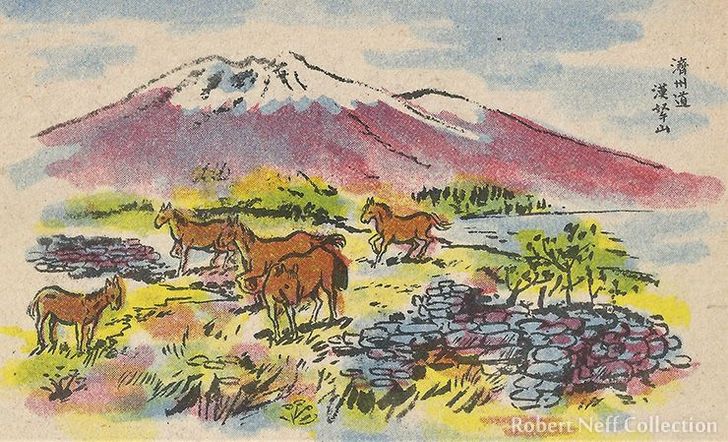
Mount Halla and Jeju ponies.
For nearly two hours he weakly treaded water, convinced that he was going to die, but unwilling to surrender his life even as the current tried to pull him back out to sea. Fortunately, a large swell swept him onto one of the huge jagged volcanic rocks that lined the shore like teeth ― ready to rend ship or man to pieces. Grasping the rock, he was “more dead than alive,” and still at risk of being swept back into the sea by another swell, but at least he was alive.
His struggle to safety was not without witnesses. A group of Koreans watching from shore ventured out on to the rock and carried the water-logged and exhausted Italian to safety. They built a fire, gave him food and water and administered to his needs.

When he was strong enough, they probably questioned him in vain ― Santori did not understand Korean (and probably knew little, if any Chinese). He was given shelter and provisions but carefully watched to make sure that he did not wander from his sanctuary.
Despite the kind treatment he was receiving, he was probably feeling a great deal of trepidation. Korea had the reputation of mistreating shipwrecked sailors. It was commonly understood that to be washed up on the shores of the Korean Peninsula was akin to being sentenced to death or imprisonment. But this was an unjust reputation. For the most part, shipwrecked sailors were well treated in Korea ― they were provided with provisions, their goods secured and they were soon repatriated through Japan and China. It was in the latter two countries the survivors often suffered depredations by the people and officials.
Unbeknown to Santori, word was sent to the island's magistrate who dispatched a minor official and several soldiers to take charge of the Italian. The Korean official conveyed to Santori, through body language and pantomiming, that he was to be moved.
A pony was brought for him to ride, and like many of the foreigners before and after, the local population gathered along his route to catch a glimpse of him. As he was being escorted along the coast we can only speculate as to what he was thinking. Surely there was some fear as he did not know where he was going and for what purpose, but there must have also been some curiosity.
Unfortunately, in his interview, Santori did not elaborate on his Korean experience but a contemporary wrote: Among the black volcanic stone were “flourishing plains, with hills gently rounded off into smooth verdant slopes which at a distance look like soft carpeted meadows” and small fields were worked by farmers.
“The houses or huts are built square or quadrangular, of rough stones and mud, one or more of the sides having a sort of verandah, the floors are made of clay well beaten; the roofs are of light timbers and of a lower pitch than those of Japan, and are covered with long reeds and small bamboos, they are nearly round at the peak. Large bamboos stretch from end to end across the roof at distances of three feet each way, forming a network which is secured through the thatch to prevent the wind blowing off the reeds. They use sliding paper doors as in Japan.”
He was escorted, according to Santori's reckoning, for about 80 kilometers along the coast before he discovered that he was not the only shipwrecked survivor on the island.
[This is a revision of an earlier article that appeared in the RAS Transactions in 2007] Robert Neff has authored and co-authored several books including, Letters from Joseon, Korea Through Western Eyes and Brief Encounters.