University pioneers women empowerment

Ewha Womans University’s campus was originally located in Jeong-dong, central Seoul, in the 1910s. / Courtesy of Ewha Womans University
By Chung Hyun-chae
Established in 1886 as Korea’s first educational institution for women, Ewha Womans University grew through the turbulent history of modern Korea.
Ewha, one of the world’s largest women’s universities, started as a small class called Ewha Hakdang created by Mary F. Scranton, an American Methodist missionary, starting with only one Korean female student.
“Back then, it was very rare for Korean people to send their daughters to school for education, which means Ewha Hakdang was founded to serve the solid purpose of providing educational opportunities for women,” said Ham Dong-ju, director of Ewha Archives.
Ewha launched its college courses in 1910 to nurture female professionals beyond offering basic education.
The school moved its campus from Jeong-dong, central Seoul, to its current location in Sinchon, western Seoul, in 1935.
“Since then, Ewha has become what it looks like today,” Ham said.
Overcoming crisis
Ewha suffered under the 1910-45 Japanese occupation. But it made desperate efforts to protect academic freedom despite Japanese control of every sector of society, including education. This was made possible thanks to the university’s American missionary founder.
“In January 1945, the school lost its name and the curriculum was slimmed down to a one-year course,” Ham said.
Despite all difficulties, Ewha prepared for the restoration of its status as a university prior to the nation’s liberation and independence from Japan.
Ewha received accreditation in 1946 right after liberation. It opened a hospital near Dongdaemun in central Seoul in 1945 to train medical students.
“Ever since the name Ewha Hakdang was bestowed by King Gojong in 1887, Ewha has been a pioneer of higher education. Its achievements have been based on a strong belief in the power of truth and knowledge, as well as the challenging spirit,” said Chang Myong-sue, chair of the university’s Board of Trustees.
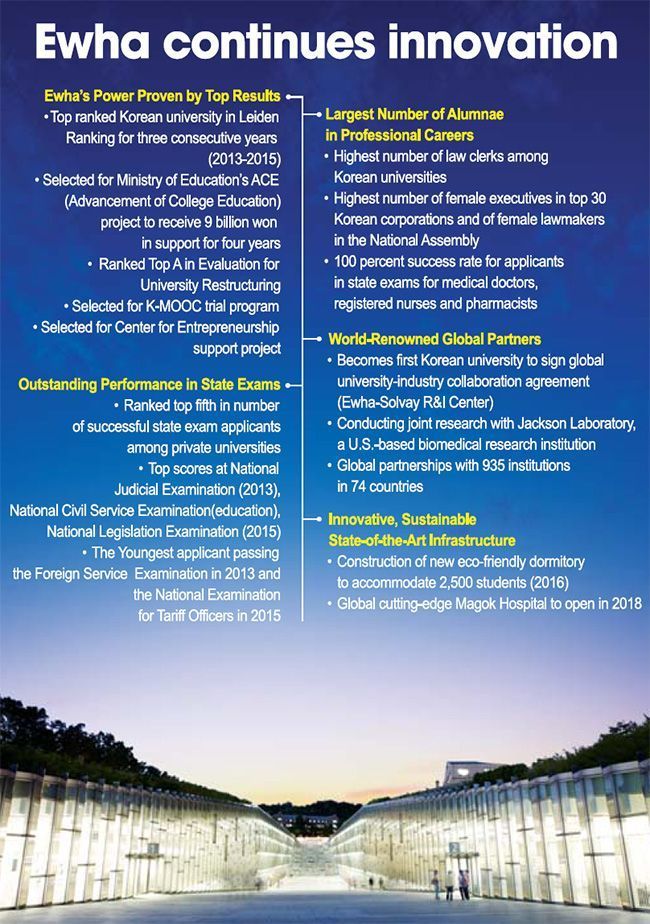
Ewha has many firsts in its history. It became the first Korean women’s university to open a department of law in 1950 and a college of law in 1996. The university also established the world’s first engineering college for women in 1996.
Ewha underwent financial difficulties in the early 1940s under Japanese rule as well as in the late 1960s. But it managed to muddle through with generous financial support from its alumni and other benefactors at home and abroad.
According to Ham, Chu Tae-kyoung donated her entire fortune of 100,000 won in 1943 ― worth 10 billion won today ― to the university when it experienced a severe financial pinch.
Helen Kim, who served as Ewha’s seventh president from 1939 to 1961, went to the U.S. to stage a fundraising campaign for the school in the 1960s.
Her commitment resulted in the establishment of the International Foundation for Ewha Womans University in 1970.
Since then, the foundation, whose board of directors is comprised of 35 Americans and Ewha alumni living in the U.S., has made multiple financial contributions to the university.
21st century values
“I still remember that Helen Kim advocated equal education for women and men. Ewha has played a leading role in educating women,” Ham said. “Now we need to stand up for new values in the 21st century. Ewha will continue to provide better education for women to improve their competitiveness and realize their potential.”