Lockheed-KAI consortium fails to win US jet contract
By Lee Min-hyung
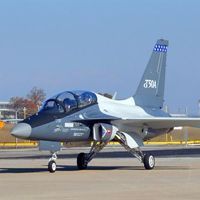
T-50A
A consortium of Lockheed Martin and Korea Aerospace Industries (KAI) has lost a bid for a mega jet contract from the U.S. Air Force due to its failure to compete against a low-price strategy from its rival.
On Friday, the U.S. aerial warfare unit said it awarded the $9.2 billion (10.2 trillion won) Advanced Pilot Training (APT) contract to a consortium led by aerospace giant Boeing.
“The Lockheed-KAI consortium joined the bid by offering a strategic price, but failed to win due to Boeing's low-price bidding strategy,” a KAI official said. The company declined to comment further.
Under the project, the U.S. Air Force planned to replace its 351 outdated T-38C pilot training jets.
Last month, the Lockheed-KAI consortium submitted its final proposal with the T-50A trainer jet. The Boeing-Saab consortium also competed with its BTX-1.
The project was estimated to be worth $19.7 billion, but the Boeing consortium offered $9.2 billion to win the bid. Boeing also offered to provide 457 jets to maintain the upper hand in the bidding process.
All eyes from the Korean defense industry have been on who will win the competition amid expectations for the Korean company to raise its global profile by clinching the deal.
The Korean aircraft giant has been desperate to win the bid to become a top-tier aircraft and aerospace parts manufacturer.
KAI viewed the contract as a potential shortcut to help expand its profile in overseas territories. The company also expressed confidence over winning the contract, as it has enough knowhow to manufacture the T-50 jet by exporting it to major Asian markets.
The U.S. Air Force expressed satisfaction for the competition, as it allowed it to save an enormous amount of money.
“Through competition, we will save at least $10 billion on the T-X program,” Secretary of the Air Force Heather A. Wilson said in a statement. “This new aircraft will provide the advanced training capabilities we need to increase the lethality and effectiveness of future Air Force pilots.”
Following the report, KAI's corporate value has been on a steep decline. On Friday, KAI closed at 35,100 won on the Seoul bourse, down 14,900 won or 29.8 percent from the previous trading day, hit hard by its failure to win the bid.
But market experts voiced optimism for the company's potential rebound on a long-term basis.
“The failure to win the project will cast a slight effect on KAI's profits in 2018 and 2019,” Han Young-soo, an analyst from Samsung Securities, said Friday.
“Even if the APT project is big business, it takes a very long period of time for aircraft manufacturers to finish supplying the jets.”
Under the contract, the U.S. Air Force plans to get full operational capability for the new jets by 2034.
“We raise doubts over the profitability of the project in consideration of Boeing's bidding price and its supply period,” the analyst said.
But on a short-term basis, KAI's stock value is expected to fluctuate for a few days, as the company's stock price has in recent weeks risen on expectations for winning the bid, he said.
“KAI's stock value has increased steeply over hopes for its winning the APT project,” the analyst said. “KAI will face a short-term effect in its stock price.”
The brokerage house offered Friday 41,000 won for a target stock price of KAI.