Germany paints blockchain, crypto rules in 'bottom-up' fashion

Florian Glatz, president of the German Blockchain Association, talks about Germany's regulatory position on blockchain and cryptocurrency. / Korea Times photo by Park Si-soo
This is the second in a three-part series on European countries seeking socio-economic innovation with blockchain technology. ― ED.
By Park Si-soo
BERLIN, Germany ― How to regulate blockchain and crypto businesses? Policy makers around the world are scratching their heads to establish rules on the flourishing but yet unregulated industries.
Rules would reduce regulatory uncertainties but they may come at the cost of dampening growth momentum.
If so, is there any way to hit two birds ― reduce uncertainties while keeping growth momentum intact ― with one stone?
A German tech expert suggests setting rules in a bottom-up fashion.
"When it comes to setting rules on new technology, a bottom-up approach is way more efficient and productive than the conventional top-down style," said Katja Nettesheim, a professor at Steinbeis-Hochschule School of Management and Innovation in Berlin.
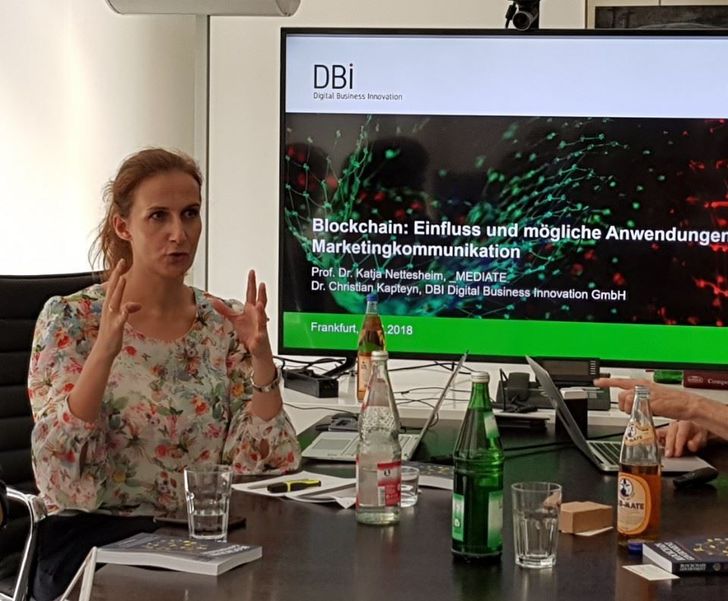
Katja Nettesheim, a professor at Steinbeis-Hochschule School of Management and Innovation, speaks about blockchain regulations. / Korea Times photo by Park Si-soo
The German Blockchain Association (GBA) is a key organization getting the bottom-up approach up and running. The association, established in June 2017 with 32 members, mostly blockchain startups, has played a bridging role, facilitating opinion exchanges between blockchain companies, universities, federal ministries and political parties.
It has grown into a powerful lobby group with 90 members including the Ministry of Economic Affairs and Energy, the Ministry of the Interior, Building and Community, the Ministry of Education and Research, Chancellor Merkel's Christian Democratic Union (CDU) and several opposition parties.
"The government has a team committed to blockchain issues. Our members regularly meet with its officials two or three times a week to share information and discuss a variety of issues," said Joachim Lohkamp, a GBA director.
The regular meetings have kept bureaucrats and politicians informed of various voices from the private sector and they were reflected in a draft of regulations on blockchain and crypto, the director said.
On top of this, the association is running five blockchain pilot projects, including making manipulation-proof digital IDs, a blockchain-based public registry system and integrating a fragmented database, to flesh out the draft.
Germany's chief financial regulator's recent remark reflects Germany's positive stance toward blockchain. Last month, Felix Hufeld, president of the German Financial Supervisory Authority (BaFin), said blockchain was "revolutionary" and its applications could turn the whole financial sector "upside down."
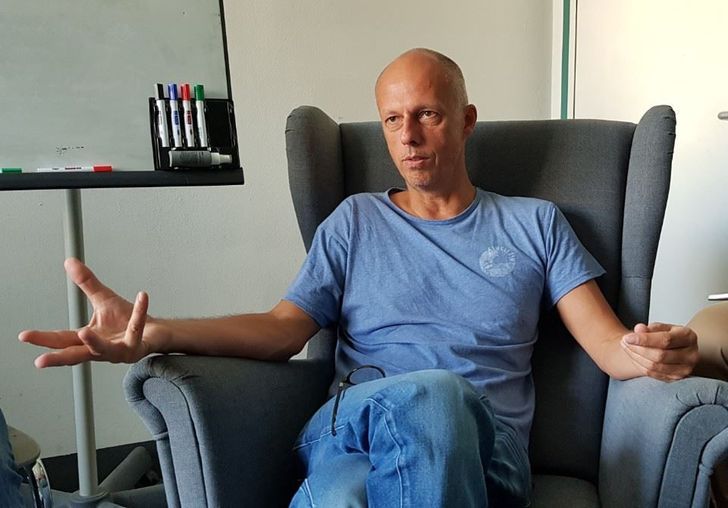
Joachim Lohkamp, a director of the German Blockchain Association, explains the association's role. / Korea Times photo by Park Si-soo
EU-wide pilot programs, regulations
GBA President Florian Glatz voiced the need to make EU-wide blockchain regulations.
"This is an international business, so I don't put much meaning on the shape of a country's regulations," Glatz said.
He said the initiation of EU-wide blockchain pilot projects was being considered. Germany and some other EU countries had suggested ideas. The European Union would soon select the best ideas and put them into practice from next year.
"Germany has suggested some ideas to the European Union. It will soon select the best ones," he said.
German ideas include building a standardized blockchain platform open to all EU member countries. Holland reportedly suggested making blockchain-based digital IDs available across the EU.
The GBA chief said EU-wide rules on initial coin offerings (ICOs) were also under consideration.
"Debate on financial technology is heating up, and things related to ICOs are part of it," he said.
This article was written after participating in a blockchain diploma program hosted by the Korea Press Foundation.