Korea's candlelit rally inspires anti-Abe protesters in Japan

Japanese people demand the resignation of Prime Minister Shinzo Abe at a rally in front of Japan's Diet building in Tokyo, Saturday. / EPA-Yonhap
By Park Ji-won
On April 14, more than 30,000 Japanese people took to the streets in Tokyo to demand the resignation of scandal-ridden Prime Minister Shinzo Abe.
It was Japan's largest demonstration in recent memory. And the rally had quite a similarity with the candlelit protests that swept Korea last year against then-President Park Geun-hye.
In fact, Japanese organizers have been communicating with South Korean activists to learn how to proceed with peaceful but powerful rallies.
The rally was organized by several Japanese organizations including Committee for all-out action, or Sogakari Kodo Jikko Iinkai, Public For the Future and Stand For Truth.
People of all ages seemed to participate in the rally; some held slogans reading “Quit, Abe” while some held microphones. When
started spinning popular club music, people chanted slogans and danced. At night, some started to hold candles and kept silent. It was all part of the demonstration. People who participated in the rally continued to upload real-time footage on websites such as Twitter and blogs, while some livestreamed the event.
(Check:
https://twitter.com/tokyo_no_todo/status/985502520398069760
)
The Japanese police set up a bus barricade against the protesters to block them from entering the parliament grounds.
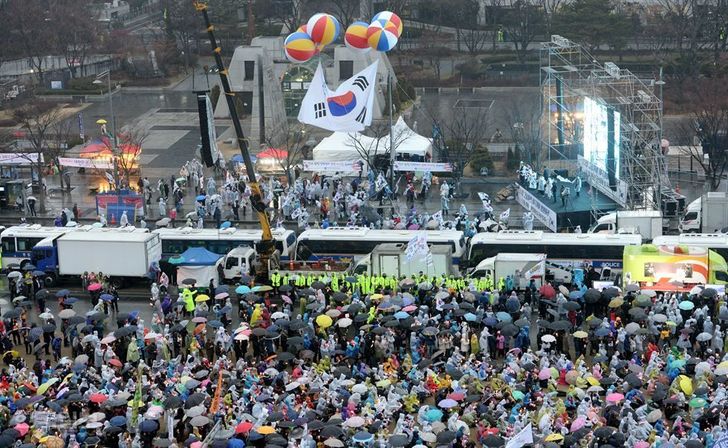
The police set up a bus barricade to block citizens from going further into Gwanghwamun, Seoul, on March 1, 2017, in this file photo, while citizens hold a protest calling for President Park Geun-hye's impeachment. / Korea Times photo
The landscape looks similar to that of Korea's candlelit rallies which were aimed at peaceful demonstrations calling for former President Park Geun-hye's resignation over scandals of bribery and abuse of power from autumn 2016 to spring 2017. Millions of people participated in the rallies.
The rallies led to the impeachment and arrest of Park.
Behind these similarities, there was ongoing bilateral cooperation between organizations of Korea and Japan to make the protest successful. It is likely NGOs in Japan, which have had little experience in large-scale rallies in recent years, reached out to Korean civic groups to get some advice to make the upcoming rally peaceful but powerful like those in Korea. Japanese people rarely hold protests as its culture sees silence as a virtue.
“We are constantly exchanging information with a Korean rally organization which organized the Korean candlelit rallies, by holding international seminars, for example, since 2015 when I won an award in Korea at that time,” Takada Ken, co-chief of the Committee for All-Out Action, said to The Korea Times.
“As a result, we got to have a similar rally as Korea following the continuing communication with the organization.”
Tanaka has been holding rallies for decades to protect the pacifist Constitution.